Willis Craig R G, Calvaruso Marco, Angeloni Debora, Baatout Sarah, Benchoua Alexandra, Bereiter-Hahn Juergen, Bottai Daniele, Buchheim Judith-Irina, Carnero-Diaz Eugénie, Castiglioni Sara, Cavalieri Duccio, Ceccarelli Gabriele, Chouker Alexander, Cialdai Francesca, Ciofani Gianni, Coppola Giuseppe, Cusella Gabriella, Degl'Innocenti Andrea, Desaphy Jean-Francois, Frippiat Jean-Pol, Gelinsky Michael, Genchi Giada, Grano Maria, Grimm Daniela, Guignandon Alain, Herranz Raúl, Hellweg Christine, Iorio Carlo Saverio, Karapantsios Thodoris, van Loon Jack, Lulli Matteo, Maier Jeanette, Malda Jos, Mamaca Emina, Morbidelli Lucia, Osterman Andreas, Ovsianikov Aleksandr, Pampaloni Francesco, Pavezlorie Elizabeth, Pereda-Campos Veronica, Przybyla Cyrille, Rettberg Petra, Rizzo Angela Maria, Robson-Brown Kate, Rossi Leonardo, Russo Giorgio, Salvetti Alessandra, Risaliti Chiara, Santucci Daniela, Sperl Matthias, Tabury Kevin, Tavella Sara, Thielemann Christiane, Willaert Ronnie, Monici Monica, Szewczyk Nathaniel J
School of Chemistry and Biosciences, Faculty of Life Sciences, University of Bradford, Bradford, United Kingdom.
Institute of Molecular Bioimaging and Physiology, National Research Council (IBFM-CNR), Cefalù, Italy.
NPJ Microgravity. 2024 May 1;10(1):50. doi: 10.1038/s41526-024-00395-3.
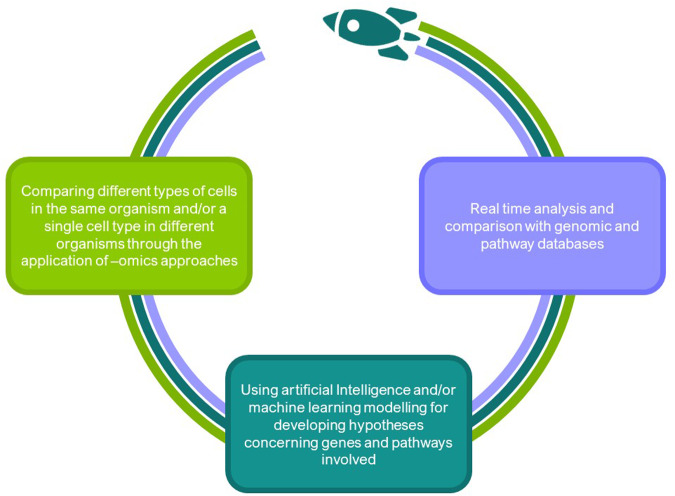
Periodically, the European Space Agency (ESA) updates scientific roadmaps in consultation with the scientific community. The ESA SciSpacE Science Community White Paper (SSCWP) 9, "Biology in Space and Analogue Environments", focusses in 5 main topic areas, aiming to address key community-identified knowledge gaps in Space Biology. Here we present one of the identified topic areas, which is also an unanswered question of life science research in Space: "How to Obtain an Integrated Picture of the Molecular Networks Involved in Adaptation to Microgravity in Different Biological Systems?" The manuscript reports the main gaps of knowledge which have been identified by the community in the above topic area as well as the approach the community indicates to address the gaps not yet bridged. Moreover, the relevance that these research activities might have for the space exploration programs and also for application in industrial and technological fields on Earth is briefly discussed.
欧洲航天局(ESA)会定期与科学界协商更新科学路线图。ESA的《空间与模拟环境中的生物学》科学社区白皮书(SSCWP)9聚焦于5个主要主题领域,旨在解决科学界确定的空间生物学关键知识空白。在此,我们介绍其中一个已确定的主题领域,它也是空间生命科学研究中一个尚未得到解答的问题:“如何获得不同生物系统中参与微重力适应的分子网络的综合图景?”该手稿报告了科学界在上述主题领域中确定的主要知识空白,以及科学界指出的填补尚未弥合的空白的方法。此外,还简要讨论了这些研究活动对太空探索计划以及对地球上工业和技术领域应用可能具有的相关性。