Ko Hyebin, Lim Hyun Ju, Park Jeonghyun, Kim Kyungwon, Suh Hwagyu, Lee Byung Dae, Lee Young Min, Moon Eunsoo, Kim Du-Ri, Park Jong-Hwan, Shin Myung-Jun, Lee Yean-Hwa
Department of Psychiatry, Pusan National University Hospital, Busan, Republic of Korea.
Biomedical Research Institute, Pusan National University Hospital, Busan, Republic of Korea.
Psychiatry Investig. 2024 Apr;21(4):380-386. doi: 10.30773/pi.2023.0286. Epub 2024 Apr 23.
Mental health promotion programs using virtual reality (VR) technology have been developed in various forms. This study aimed to investigate the subjective experience of a VR-assisted mental health promotion program for the community population, which was provided in the form of VR experience on a bus to increase accessibility.
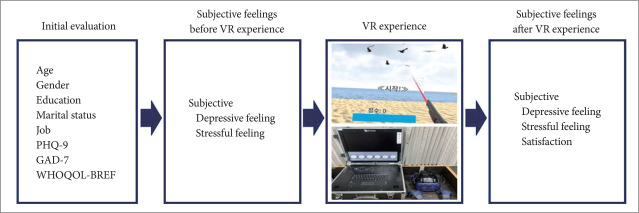
Ninety-six people participated in this study. The relationship between the subjective experience and mental health states such as depression, anxiety, perceived stress, and quality of life was explored. The subjective experience on depression and stress before and after VR program treatment was compared using the Wilcoxon signed-rank test. The satisfaction with the VR-assisted mental health promotion program was examined after using the VR program.
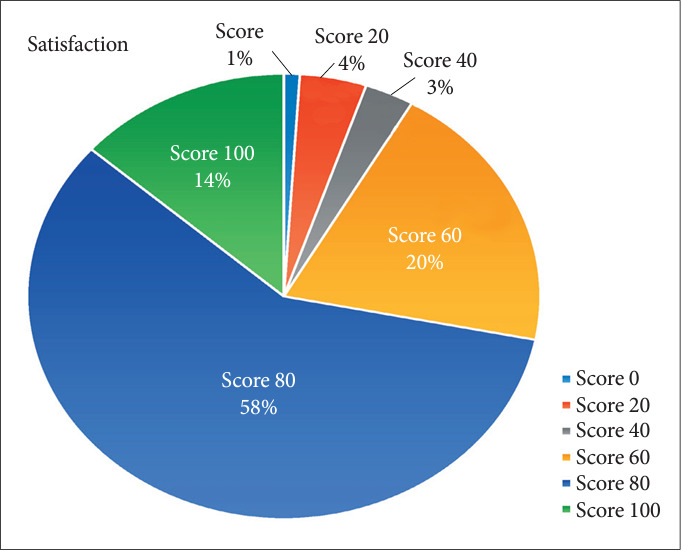
The VR-assisted mental health promotion program on a bus significantly improved subjective symptoms such as depression (p=0.036) and perceived stress (p=0.010) among all the participants. Among the high-risk group, this VR program significantly relieved subjective depressive feeling score (p=0.033), and subjective stressful feeling score (p=0.035). In contrast, there were no significant changes in subjective depressive feelings (p=0.182) and subjective stressful feelings (p=0.058) among the healthy group. Seventy-two percent of the participants reported a high level of satisfaction, scoring 80 points or more.
The findings of this study suggest that the VR-assisted mental health promotion program may effectively improve the subjective depressive and stressful feelings. The use of VR programs on buses to increase of accessibility for the community could be a useful approach for promoting mental health among the population.
已开发出各种形式的使用虚拟现实(VR)技术的心理健康促进项目。本研究旨在调查一项针对社区人群的VR辅助心理健康促进项目的主观体验,该项目以在公交车上进行VR体验的形式提供,以提高可及性。
96人参与了本研究。探讨了主观体验与抑郁、焦虑、感知压力和生活质量等心理健康状态之间的关系。使用Wilcoxon符号秩检验比较VR项目治疗前后抑郁和压力的主观体验。在使用VR项目后,调查了对VR辅助心理健康促进项目的满意度。
公交车上的VR辅助心理健康促进项目显著改善了所有参与者的抑郁(p = 0.036)和感知压力(p = 0.010)等主观症状。在高危组中,该VR项目显著缓解了主观抑郁情绪评分(p = 0.033)和主观压力情绪评分(p = 0.035)。相比之下,健康组的主观抑郁情绪(p = 0.182)和主观压力情绪(p = 0.058)没有显著变化。72%的参与者报告满意度较高,得分在80分及以上。
本研究结果表明,VR辅助心理健康促进项目可能有效改善主观抑郁和压力情绪。在公交车上使用VR项目以提高社区可及性可能是促进人群心理健康的一种有用方法。