Eltokhy Mohamed A, Saad Bishoy T, Eltayeb Wafaa N, Alshahrani Mohammad Y, Radwan Sahar M R, Aboshanab Khaled M, Ashour Mohamed S E
Department of Microbiology, Faculty of Pharmacy, Misr International University (MIU), Cairo, 19648, Egypt.
Department of Bioinformatics, HITS Solutions Co., Cairo, 11765, Egypt.
AMB Express. 2024 May 4;14(1):52. doi: 10.1186/s13568-024-01701-8.
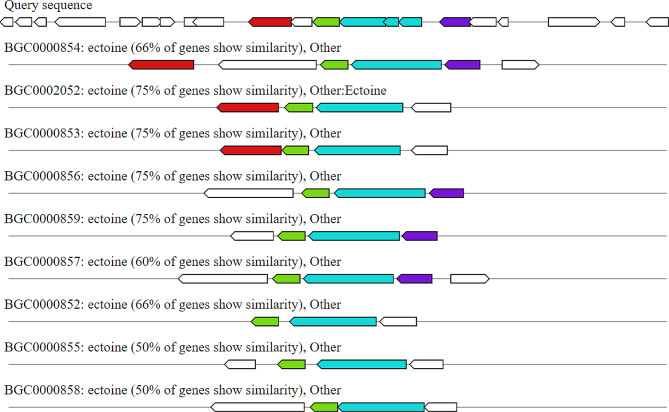
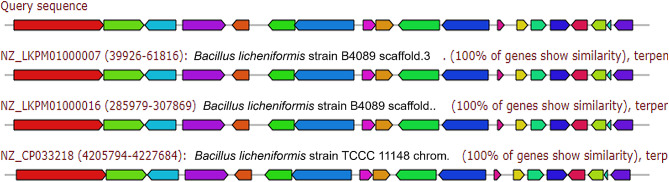
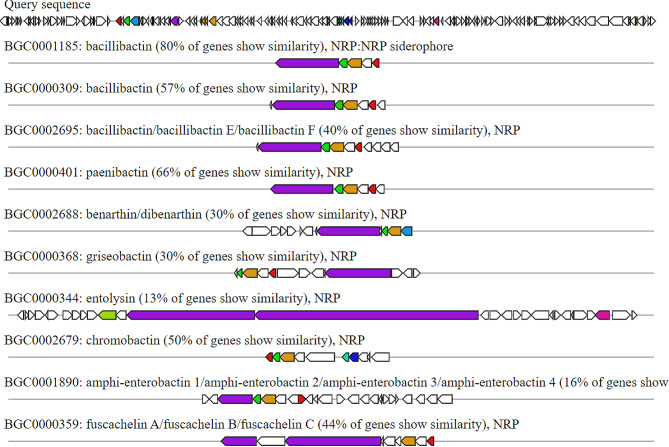
Multidrug-resistant (MDR) pathogens are a rising global health worry that imposes an urgent need for the discovery of novel antibiotics particularly those of natural origin. In this context, we aimed to use the metagenomic nanopore sequence analysis of soil microbiota coupled with the conventional phenotypic screening and genomic analysis for identifying the antimicrobial metabolites produced by promising soil isolate(s). In this study, whole metagenome analysis of the soil sample(s) was performed using MinION™ (Oxford Nanopore Technologies). Aligning and analysis of sequences for probable secondary metabolite gene clusters were extracted and analyzed using the antiSMASH version 2 and DeepBGC. Results of the metagenomic analysis showed the most abundant taxa were Bifidobacterium, Burkholderia, and Nocardiaceae (99.21%, followed by Sphingomonadaceae (82.03%) and B. haynesii (34%). Phenotypic screening of the respective soil samples has resulted in a promising Bacillus isolate that exhibited broad-spectrum antibacterial activities against various MDR pathogens. It was identified using microscopical, cultural, and molecular methods as Bacillus (B.) haynesii isolate MZ922052. The secondary metabolite gene analysis revealed the conservation of seven biosynthetic gene clusters of antibacterial metabolites namely, siderophore lichenicidin VK21-A1/A2 (95% identity), lichenysin (100%), fengycin (53%), terpenes (100%), bacteriocin (100%), Lasso peptide (95%) and bacillibactin (53%). In conclusion, metagenomic nanopore sequence analysis of soil samples coupled with conventional screening helped identify B. haynesii isolate MZ922052 harboring seven biosynthetic gene clusters of promising antimicrobial metabolites. This is the first report for identifying the bacteriocin, lichenysin, and fengycin biosynthetic gene clusters in B. haynesii MZ922052.
多重耐药(MDR)病原体是一个日益严重的全球健康问题,迫切需要发现新型抗生素,特别是天然来源的抗生素。在此背景下,我们旨在利用土壤微生物群的宏基因组纳米孔序列分析,结合传统的表型筛选和基因组分析,来鉴定有潜力的土壤分离株产生的抗菌代谢产物。在本研究中,使用MinION™(牛津纳米孔技术公司)对土壤样本进行了全宏基因组分析。使用antiSMASH版本2和DeepBGC提取并分析可能的次生代谢物基因簇的序列。宏基因组分析结果显示,最丰富的分类群是双歧杆菌属、伯克霍尔德菌属和诺卡氏菌科(99.21%),其次是鞘脂单胞菌科(82.03%)和海恩斯芽孢杆菌(34%)。对相应土壤样本的表型筛选得到了一种有潜力的芽孢杆菌分离株,它对多种MDR病原体表现出广谱抗菌活性。通过显微镜、培养和分子方法将其鉴定为海恩斯芽孢杆菌分离株MZ922052。次生代谢物基因分析揭示了七个抗菌代谢物生物合成基因簇的保守性,即铁载体地衣杀菌素VK21-A1/A2(95%同一性)、地衣素(100%)、丰原素(53%)、萜类化合物(100%)、细菌素(100%)、套索肽(95%)和杆菌铁载体(53%)。总之,土壤样本的宏基因组纳米孔序列分析与传统筛选相结合,有助于鉴定出含有七个有潜力的抗菌代谢物生物合成基因簇的海恩斯芽孢杆菌分离株MZ922052。这是首次报道在海恩斯芽孢杆菌MZ922052中鉴定出细菌素、地衣素和丰原素生物合成基因簇。