Reese Thomas J, Domenico Henry J, Hernandez Antonio, Byrne Daniel W, Moore Ryan P, Williams Jessica B, Douthit Brian J, Russo Elise, McCoy Allison B, Ivory Catherine H, Steitz Bryan D, Wright Adam
1, Department of Biomedical Informatics, Vanderbilt University Medical Center, Nashville, TN, United States.
Department of Biostatistics, Vanderbilt University Medical Center, Nashville, TN, United States.
JMIR Med Inform. 2024 May 8;12:e51842. doi: 10.2196/51842.
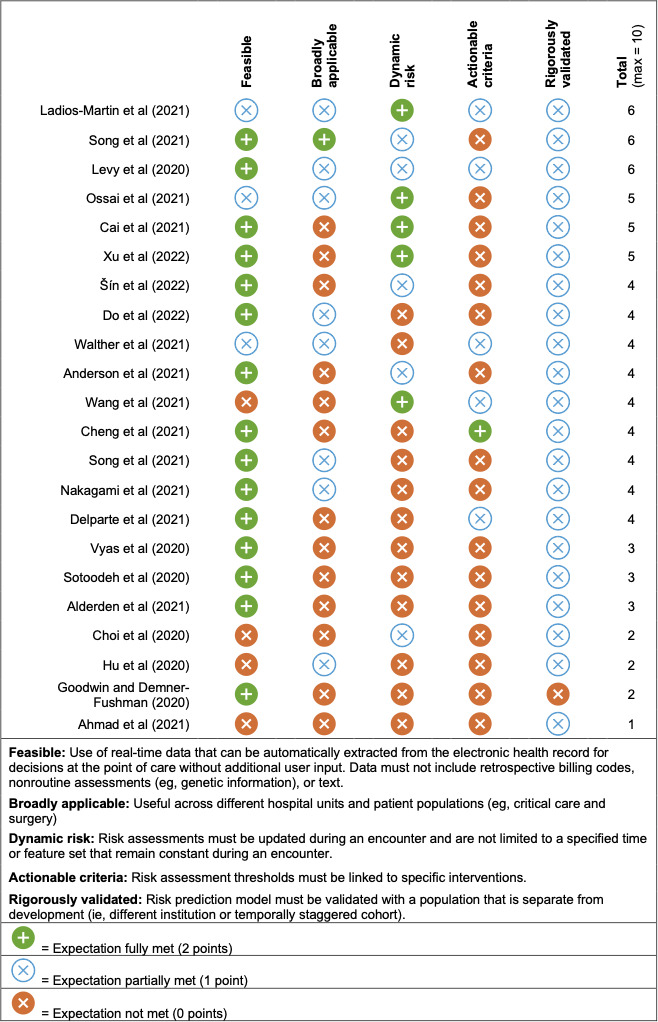
Numerous pressure injury prediction models have been developed using electronic health record data, yet hospital-acquired pressure injuries (HAPIs) are increasing, which demonstrates the critical challenge of implementing these models in routine care.
To help bridge the gap between development and implementation, we sought to create a model that was feasible, broadly applicable, dynamic, actionable, and rigorously validated and then compare its performance to usual care (ie, the Braden scale).
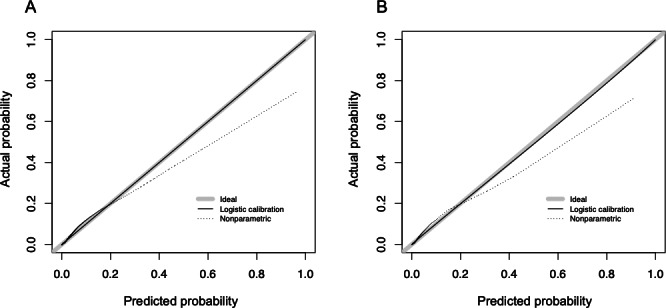
We extracted electronic health record data from 197,991 adult hospital admissions with 51 candidate features. For risk prediction and feature selection, we used logistic regression with a least absolute shrinkage and selection operator (LASSO) approach. To compare the model with usual care, we used the area under the receiver operating curve (AUC), Brier score, slope, intercept, and integrated calibration index. The model was validated using a temporally staggered cohort.
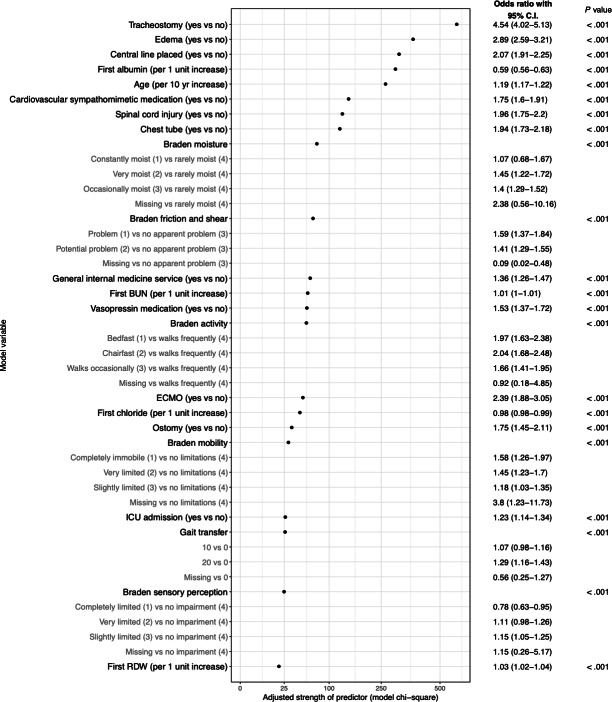
A total of 5458 HAPIs were identified between January 2018 and July 2022. We determined 22 features were necessary to achieve a parsimonious and highly accurate model. The top 5 features included tracheostomy, edema, central line, first albumin measure, and age. Our model achieved higher discrimination than the Braden scale (AUC 0.897, 95% CI 0.893-0.901 vs AUC 0.798, 95% CI 0.791-0.803).
We developed and validated an accurate prediction model for HAPIs that surpassed the standard-of-care risk assessment and fulfilled necessary elements for implementation. Future work includes a pragmatic randomized trial to assess whether our model improves patient outcomes.
利用电子健康记录数据已经开发出了众多压力性损伤预测模型,但医院获得性压力性损伤(HAPIs)却在增加,这表明在常规护理中实施这些模型面临着严峻挑战。
为了弥合模型开发与实施之间的差距,我们试图创建一个可行、广泛适用、动态、可操作且经过严格验证的模型,然后将其性能与常规护理(即Braden量表)进行比较。
我们从197991例成年住院患者的电子健康记录数据中提取了51个候选特征。对于风险预测和特征选择,我们使用了带有最小绝对收缩和选择算子(LASSO)方法的逻辑回归。为了将该模型与常规护理进行比较,我们使用了受试者操作特征曲线下面积(AUC)、Brier评分、斜率、截距和综合校准指数。该模型使用时间交错队列进行验证。
在2018年1月至2022年7月期间共识别出5458例HAPIs。我们确定了22个特征对于实现一个简洁且高度准确的模型是必要的。前5个特征包括气管切开术、水肿、中心静脉导管、首次白蛋白测量值和年龄。我们的模型比Braden量表具有更高的辨别力(AUC 0.897,95%CI 0.893 - 0.901 vs AUC 0.798,95%CI 0.791 - 0.803)。
我们开发并验证了一个针对HAPIs的准确预测模型,该模型超越了护理标准风险评估,并满足了实施所需的必要要素。未来的工作包括一项务实的随机试验,以评估我们的模型是否能改善患者预后。