Experimental Gambling Research Laboratory, School of Health, Medical and Applied Sciences, CQUniversity, University Drive, 4670, Bundaberg, QLD, Australia.
Experimental Gambling Research Laboratory, School of Health, Medical and Applied Sciences, CQUniversity, Adelaide, South Australia, Australia.
BMC Public Health. 2024 May 9;24(1):1270. doi: 10.1186/s12889-024-18286-3.
Gambling abstinence when underage lowers the risk of harmful gambling in later life. However, little research has examined why many young people refrain from gambling, even though this knowledge can inform protective strategies and lower risk factors to reduce underage gambling and subsequent harm. This study draws on the lived experience of adolescent non-gamblers to explore how social determinants while growing up have shaped their reasons and choices to not gamble.
Fourteen Australian non-gamblers, aged 12-17 years, participated in an in-depth individual interview (4 girls, 3 boys) or online community (4 girls, 3 boys). Questions in each condition differed, but both explored participants' gambling-related experiences while growing up, including exposure, attitudes and behaviours of parents and peers, advertising, simulated gambling and motivations for not gambling. The analysis used adaptive grounded theory methods.
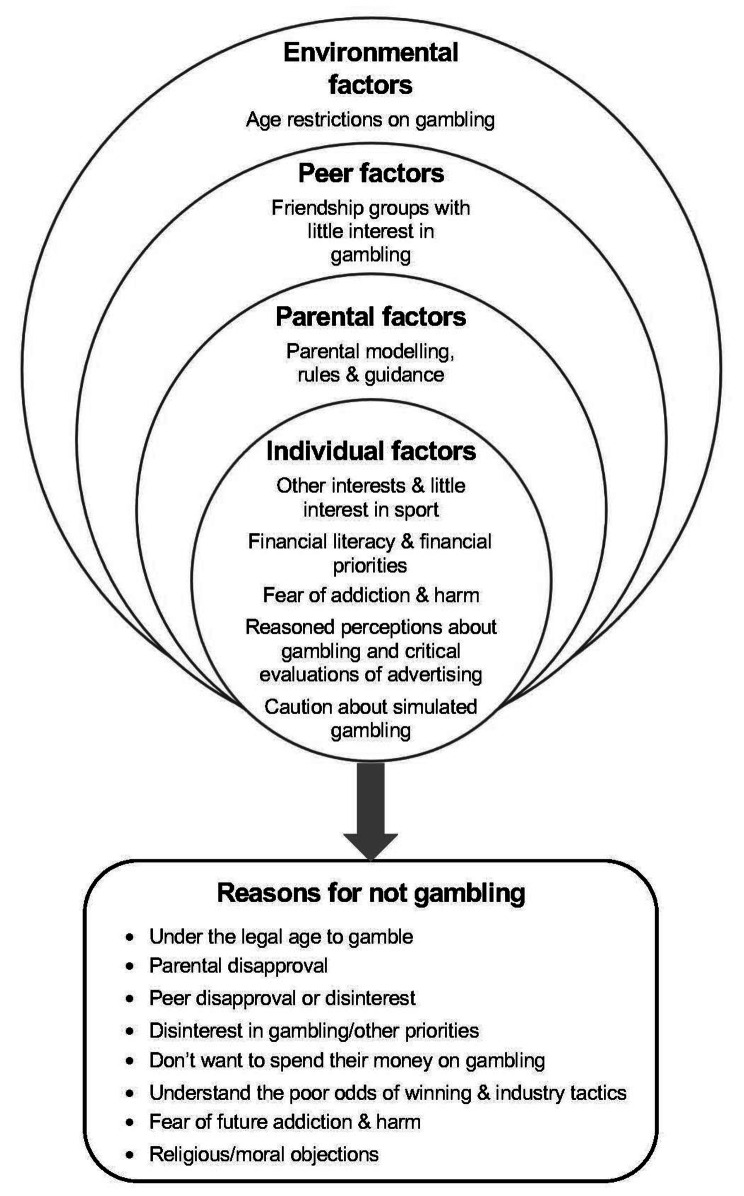
The grounded theory model identifies several reasons for not gambling, including not being interested, being below the legal gambling age, discouragement from parent and peers, concern about gambling addiction and harm, not wanting to risk money on a low chance of winning, and moral objections. These reasons were underpinned by several social determinants, including individual, parental, peer and environmental factors that can interact to deter young people from underage gambling. Key protective factors were parental role modelling and guidance, friendship groups who avoided gambling, critical thinking, rational gambling beliefs, financial literacy and having other hobbies and interests.
Choices to not gamble emanated from multiple layers of influence, implying that multi-layered interventions, aligned with a public health response, are needed to deter underage gambling. At the environmental level, better age-gating for monetary and simulated gambling, countering cultural pressures, and less exposure to promotional gambling messages, may assist young people to resist these influences. Interventions that support parents to provide appropriate role modelling and guidance for their children are also important. Youth education could include cautionary tales from people with lived experience of gambling harm, and education to increase young people's financial literacy, ability to recognise marketing tactics, awareness of the risks and harms of gambling, and how to resist peer and other normalising gambling influences.
未成年时戒除赌博可以降低日后生活中有害赌博的风险。然而,尽管这方面的知识可以为保护策略提供信息并降低风险因素,从而减少未成年赌博和随后的危害,但很少有研究探讨为什么许多年轻人不赌博。本研究借鉴青少年非赌徒的生活经历,探讨社会决定因素如何在成长过程中塑造他们不赌博的原因和选择。
14 名澳大利亚非赌徒,年龄在 12-17 岁之间,参加了深入的个人访谈(4 名女孩,3 名男孩)或在线社区(4 名女孩,3 名男孩)。每个条件下的问题都不同,但都探讨了参与者在成长过程中的赌博相关经历,包括父母和同伴的赌博暴露、态度和行为、广告、模拟赌博以及不赌博的动机。分析使用适应性扎根理论方法。
扎根理论模型确定了不赌博的几个原因,包括不感兴趣、低于法定赌博年龄、父母和同伴的劝阻、对赌博成瘾和伤害的担忧、不想冒险用低赢面的钱赌博,以及道德上的反对。这些原因受到个人、父母、同伴和环境因素的影响,可以相互作用,阻止年轻人参与未成年赌博。关键的保护因素包括父母的榜样作用和指导、避免赌博的朋友圈、批判性思维、理性的赌博信仰、金融知识以及其他爱好和兴趣。
不赌博的选择源于多个层面的影响,这意味着需要采取多层次的干预措施,以配合公共卫生应对措施,阻止未成年赌博。在环境层面上,更好的货币和模拟赌博年龄限制、对抗文化压力,以及减少对促销赌博信息的接触,可能有助于年轻人抵制这些影响。支持父母为孩子提供适当榜样作用和指导的干预措施也很重要。青年教育可以包括有赌博危害生活经历的人的警示故事,以及增加年轻人金融知识、识别营销策略的能力、对赌博风险和危害的认识,以及如何抵制同伴和其他使赌博正常化的影响。