Catherine McAuley School of Nursing and Midwifery, University College Cork, Cork, Ireland.
Department of Rheumatology, Cork University Hospital, Wilton, Cork, Ireland.
Clin Rheumatol. 2024 Jul;43(7):2187-2202. doi: 10.1007/s10067-024-06996-3. Epub 2024 May 11.
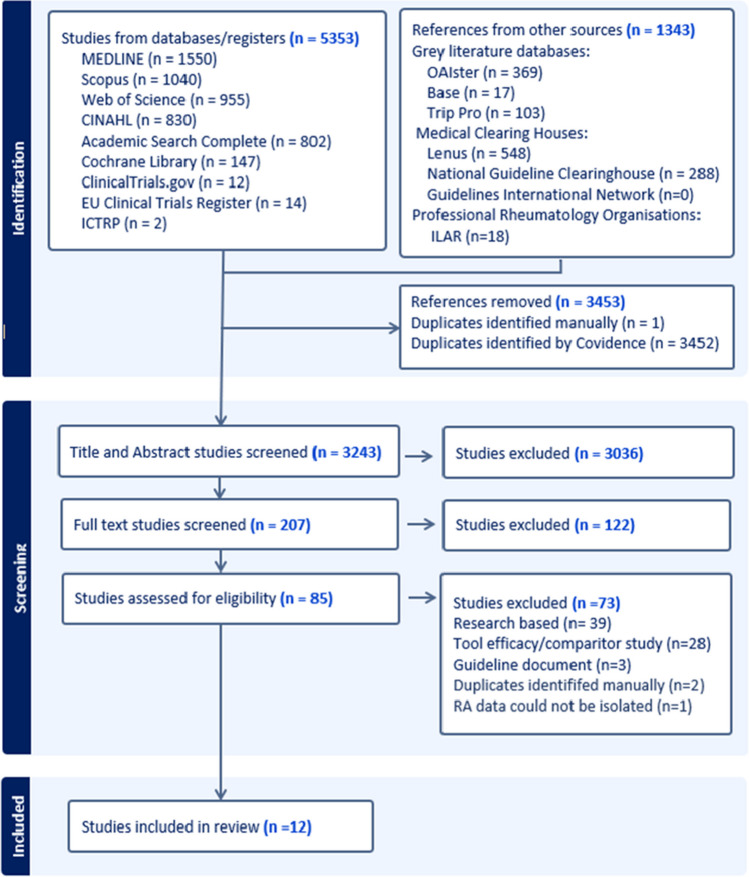
Patients with rheumatoid arthritis (RA) have an increased risk of developing cardiovascular disease (CVD). Identification of at-risk patients is paramount to initiate preventive care and tailor treatments accordingly. Despite international guidelines recommending all patients with RA undergo CVD risk assessment, rates remain suboptimal. The objectives of this review were to map the strategies used to conduct CVD risk assessments in patients with RA in routine care, determine who delivers CVD risk assessments, and identify what composite measures are used. The Joanna Briggs Institute methodological guidelines were used. A literature search was conducted in electronic and grey literature databases, trial registries, medical clearing houses, and professional rheumatology organisations. Findings were synthesised narratively. A total of 12 studies were included. Strategies reported in this review used various system-based interventions to support delivery of CVD risk assessments in patients with RA, operationalised in different ways, adopting two approaches: (a) multidisciplinary collaboration, and (b) education. Various composite measures were cited in use, with and without adjustment for RA. Results from this review demonstrate that although several strategies to support CVD risk assessments in patients with RA are cited in the literature, there is limited evidence to suggest a standardised model has been applied to routine care. Furthermore, extensive evidence to map how health care professionals conduct CVD risk assessments in practice is lacking. Research needs to be undertaken to establish the extent to which healthcare professionals are CVD risk assessing their patients with RA in routine care. Key Points • A limited number of system-based interventions are in use to support the delivery of CVD risk assessments in patients with RA. • Multidisciplinary team collaboration, and education are used to operationalise interventions to support Health Care Professionals in conducting CVD risk assessments in practice. • The extent to which Health Care Professionals are CVD risk assessing their patients with RA needs to be established.
类风湿关节炎 (RA) 患者发生心血管疾病 (CVD) 的风险增加。识别高危患者对于启动预防保健和相应调整治疗至关重要。尽管国际指南建议所有 RA 患者进行 CVD 风险评估,但评估率仍不理想。本综述的目的是绘制在常规护理中对 RA 患者进行 CVD 风险评估所使用的策略,确定谁进行 CVD 风险评估,以及确定使用哪些综合措施。采用了 Joanna Briggs 研究所的方法学指南。在电子和灰色文献数据库、试验登记处、医疗信息交换所和专业风湿病组织中进行了文献检索。结果以叙述性方式进行了综合。共纳入 12 项研究。本综述中报告的策略使用了各种基于系统的干预措施来支持 RA 患者的 CVD 风险评估,这些干预措施以不同的方式实施,采用了两种方法:(a) 多学科协作,和 (b) 教育。在使用中引用了各种综合措施,包括和不包括 RA 的调整。本综述的结果表明,尽管文献中引用了几种支持 RA 患者 CVD 风险评估的策略,但几乎没有证据表明已将标准化模型应用于常规护理。此外,缺乏关于医疗保健专业人员在实践中如何进行 CVD 风险评估的广泛证据。需要开展研究以确定医疗保健专业人员在常规护理中对 RA 患者进行 CVD 风险评估的程度。关键点 • 有一些基于系统的干预措施用于支持 RA 患者 CVD 风险评估的实施。 • 多学科团队协作和教育用于实施干预措施,以支持医疗保健专业人员在实践中进行 CVD 风险评估。 • 需要确定医疗保健专业人员对 RA 患者进行 CVD 风险评估的程度。