Department of Mathematics and Statistics, Cleveland State University, Cleveland, Ohio, United States of America.
Department of Biological, Geological, and Environmental Sciences, Cleveland State University, Cleveland, Ohio, United States of America.
PLoS Comput Biol. 2024 May 13;20(5):e1011416. doi: 10.1371/journal.pcbi.1011416. eCollection 2024 May.
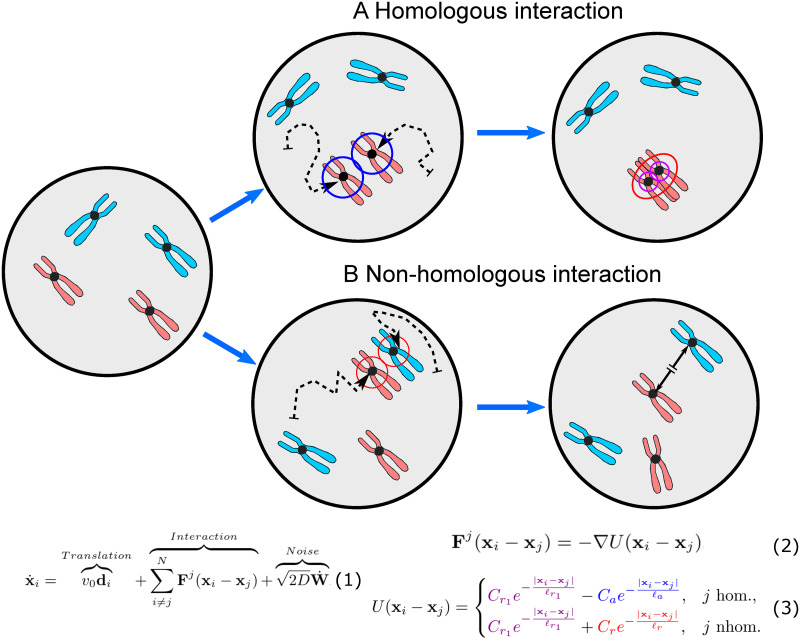
During meiosis, pairing of homologous chromosomes (homologs) ensures the formation of haploid gametes from diploid precursor cells, a prerequisite for sexual reproduction. Pairing during meiotic prophase I facilitates crossover recombination and homolog segregation during the ensuing reductional cell division. Mechanisms that ensure stable homolog alignment in the presence of an excess of non-homologous chromosomes have remained elusive, but rapid chromosome movements appear to play a role in the process. Apart from homolog attraction, provided by early intermediates of homologous recombination, dissociation of non-homologous associations also appears to contribute to homolog pairing, as suggested by the detection of stable non-homologous chromosome associations in pairing-defective mutants. Here, we have developed an agent-based model for homolog pairing derived from the dynamics of a naturally occurring chromosome ensemble. The model simulates unidirectional chromosome movements, as well as collision dynamics determined by attractive and repulsive forces arising from close-range physical interactions. Chromosome number and size as well as movement velocity and repulsive forces are identified as key factors in the kinetics and efficiency of homologous pairing in addition to homolog attraction. Dissociation of interactions between non-homologous chromosomes may contribute to pairing by crowding homologs into a limited nuclear area thus creating preconditions for close-range homolog attraction. Incorporating natural chromosome lengths, the model accurately recapitulates efficiency and kinetics of homolog pairing observed for wild-type and mutant meiosis in budding yeast, and can be adapted to nuclear dimensions and chromosome sets of other organisms.
在减数分裂过程中,同源染色体的配对确保了从二倍体前体细胞形成单倍体配子,这是有性生殖的前提。减数分裂前期 I 中的配对促进了交叉重组,随后的减数分裂细胞分裂导致同源体分离。尽管确保在存在过量非同源染色体的情况下稳定的同源体排列的机制仍然难以捉摸,但快速的染色体运动似乎在该过程中发挥了作用。除了同源重组早期中间产物提供的同源体吸引作用外,非同源体关联的解离似乎也有助于同源体配对,这一点可以从配对缺陷突变体中稳定的非同源染色体关联检测中得到证实。在这里,我们基于自然发生的染色体集合的动力学开发了一个同源体配对的基于代理的模型。该模型模拟了单向染色体运动,以及由近距离物理相互作用产生的吸引力和排斥力决定的碰撞动力学。染色体数量和大小以及运动速度和排斥力被确定为除同源体吸引作用外,影响同源体配对动力学和效率的关键因素。非同源染色体之间相互作用的解离可能通过将同源体挤进有限的核区域从而为近距离同源体吸引作用创造前提条件而有助于配对。该模型结合自然染色体长度,可以准确地再现出野生型和突变型酵母减数分裂中观察到的同源体配对的效率和动力学,并且可以适应其他生物体的核尺寸和染色体组。