Chiaranai Chantira, Chularee Saranya, Saokaew Surasak, Bhatarasakoon Patraporn, Umnuaypornlert Adinat, Chaomuang Natthaya, Doommai Nudchaporn, Nimkuntod Porntip
Institute of Nursing, Suranaree University of Technology, Nakhon Ratchasima, Thailand.
Division of Social and Administrative Pharmacy, Department of Pharmaceutical Care, School of Pharmaceutical Sciences, University of Phayao, Phayao, Thailand.
Int J Nurs Stud Adv. 2023 Dec 1;6:100169. doi: 10.1016/j.ijnsa.2023.100169. eCollection 2024 Jun.
During the COVID-19 pandemic, telehealth was employed to enhance clinical outcomes for patients with type 2 diabetes mellitus. However, the effectiveness of telehealth remains inconclusive.
This study aimed to examine the impact of telehealth on the glycemic control of individuals with type 2 diabetes mellitus during the pandemic.
A systematic review and meta-analysis of randomized controlled trials.
N/A.
A total of 669 studies was sourced from electronic databases, including EMBASE, PubMed, and Scopus. Among these, twelve randomized controlled trials, comprising 1498 participants, were included.
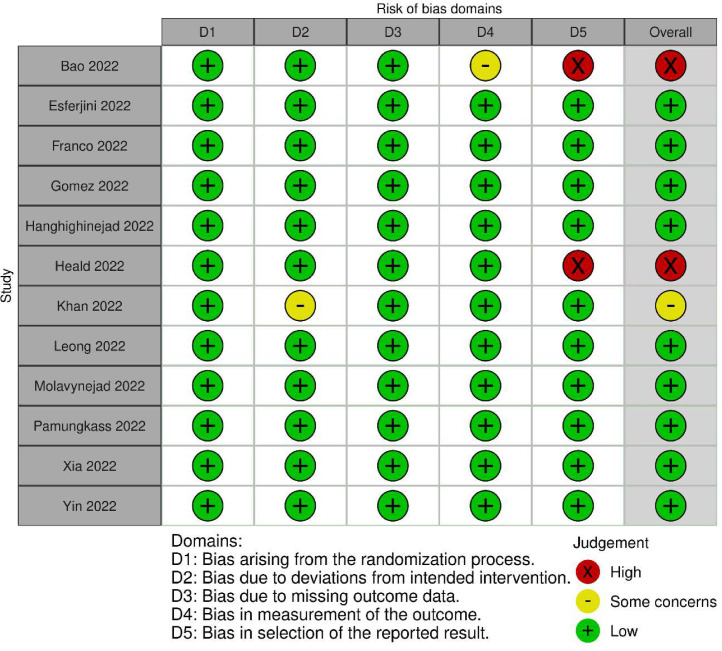
A comprehensive search was performed in electronic databases. The quality of the included studies was assessed using the Cochrane Risk of Bias tool, and statistical heterogeneity was assessed using ² and Cochran's Q tests. A random-effects model was utilized to combine the outcomes. Grading of Recommendations, Assessment, Development, and Evaluations was used to evaluate the certainty of the evidence.
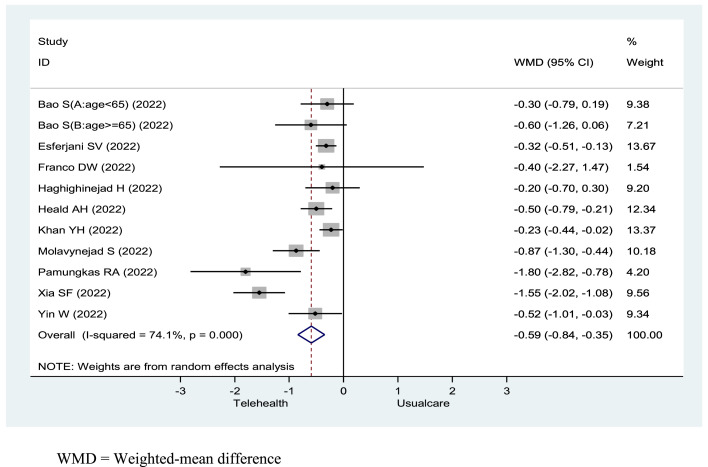
The meta-analysis showed that participants receiving a telehealth intervention achieved a greater reduction in the glycated haemoglobin (HbA1C) compared to those receiving usual care, with a weighted-mean difference of -0.59 (95 % CI -0.84 to -0.35, < .001, ² = 74.1 %, high certainty of evidence). Additionally, participants receiving telehealth interventions experienced better secondary outcomes, including a reduction in fasting blood sugar (16.06 %, 95 %CI -29.64 to -2.48, = .02, high certainty of evidence), a decrease in body mass index (1.5 %, 95 %CI -1.98 to -1.02, < .001, high certainty of evidence), and a decrease in low-density lipoprotein (7.8 %, 95 %CI -14.69 to -0.88, = .027, low certainty of evidence).
In our review, we showed telehealth's positive impact on glycaemic control in type 2 diabetes mellitus patients. Healthcare professionals can use telehealth in diabetes care. Caution is needed due to heterogeneity of the results. Further research should explore the long-term impacts of telehealth interventions.
The study was registered with PROSPERO, CRD42022381879.
在2019冠状病毒病大流行期间,远程医疗被用于改善2型糖尿病患者的临床结局。然而,远程医疗的有效性仍无定论。
本研究旨在探讨大流行期间远程医疗对2型糖尿病患者血糖控制的影响。
对随机对照试验进行系统评价和荟萃分析。
不适用。
共从电子数据库中检索到669项研究,包括EMBASE、PubMed和Scopus。其中,纳入了12项随机对照试验,共1498名参与者。
在电子数据库中进行全面检索。使用Cochrane偏倚风险工具评估纳入研究的质量,使用I²和Cochran's Q检验评估统计异质性。采用随机效应模型合并结果。使用推荐分级、评估、制定和评价(GRADE)来评估证据的确定性。
荟萃分析表明,与接受常规护理的参与者相比,接受远程医疗干预的参与者糖化血红蛋白(HbA1C)降低幅度更大,加权平均差为-0.59(95%CI -0.84至-0.35,P<0.001,I²=74.1%,证据确定性高)。此外,接受远程医疗干预的参与者次要结局更好,包括空腹血糖降低(16.06%,95%CI -29.64至-2.48,P=0.02,证据确定性高)、体重指数下降(1.5%,95%CI -1.98至-1.02,P<0.001,证据确定性高)以及低密度脂蛋白降低(7.8%,95%CI -14.69至-0.88,P=0.027,证据确定性低)。
在我们的综述中,我们展示了远程医疗对2型糖尿病患者血糖控制的积极影响。医疗保健专业人员可在糖尿病护理中使用远程医疗。由于结果存在异质性,需要谨慎。进一步的研究应探索远程医疗干预的长期影响。
该研究已在PROSPERO注册,注册号为CRD42022381879。