Department of Neurosurgery, Mount Sinai Health System, 1468 Madison Ave, New York, NY, 10029, USA.
BMC Musculoskelet Disord. 2024 May 21;25(1):401. doi: 10.1186/s12891-024-07528-5.
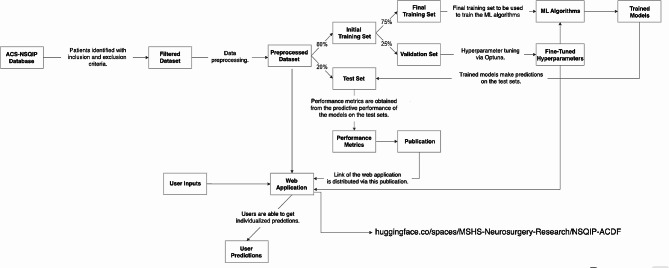
The frequency of anterior cervical discectomy and fusion (ACDF) has increased up to 400% since 2011, underscoring the need to preoperatively anticipate adverse postoperative outcomes given the procedure's expanding use. Our study aims to accomplish two goals: firstly, to develop a suite of explainable machine learning (ML) models capable of predicting adverse postoperative outcomes following ACDF surgery, and secondly, to embed these models in a user-friendly web application, demonstrating their potential utility.
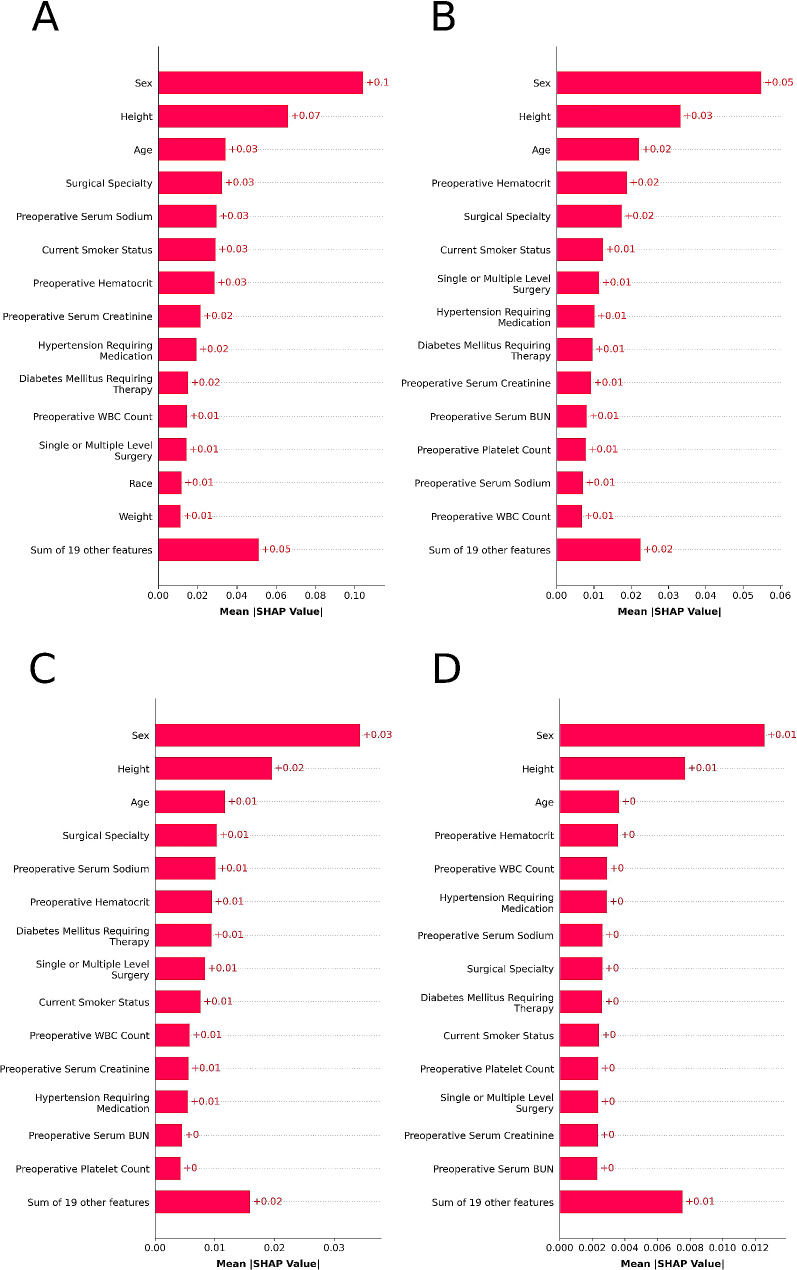
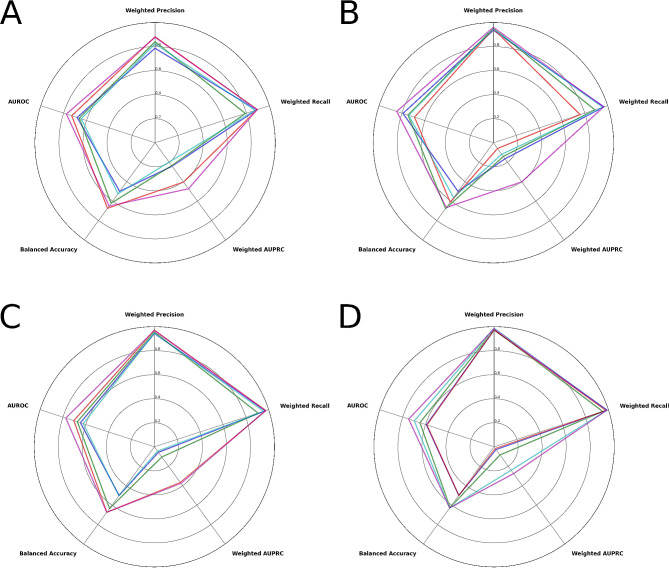
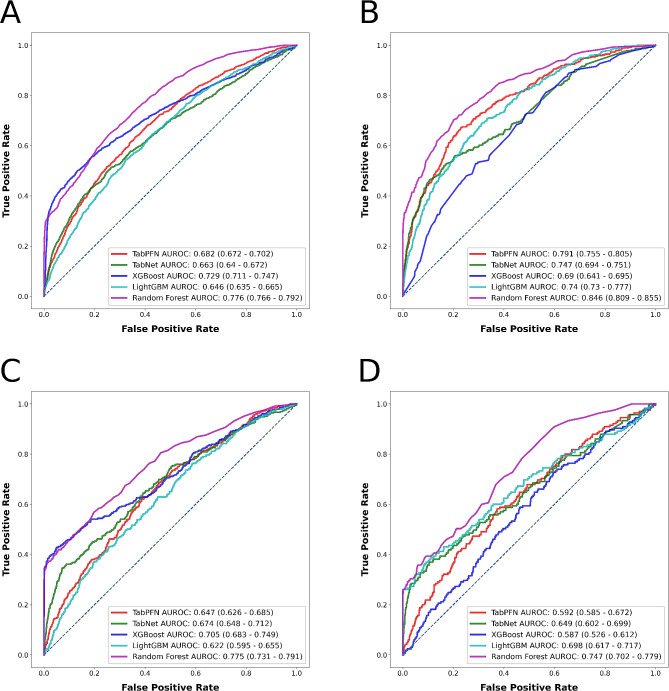
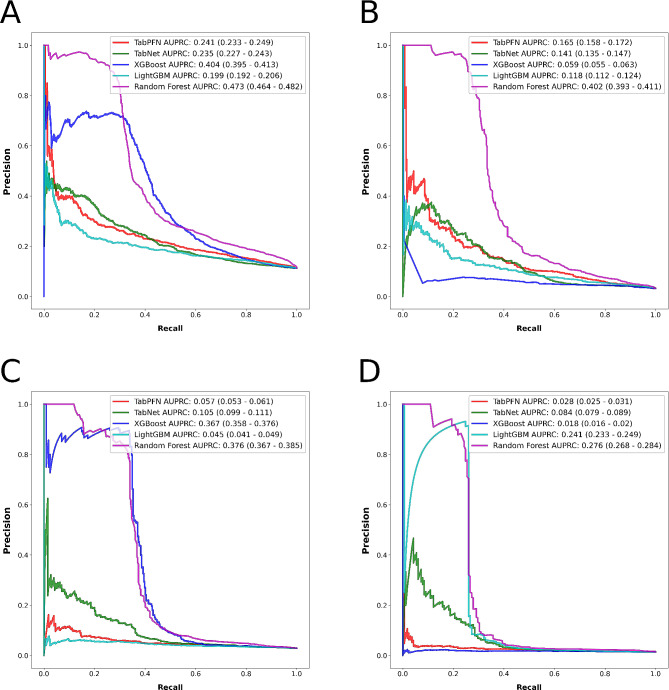
We utilized data from the National Surgical Quality Improvement Program database to identify patients who underwent ACDF surgery. The outcomes of interest were four short-term postoperative adverse outcomes: prolonged length of stay (LOS), non-home discharges, 30-day readmissions, and major complications. We utilized five ML algorithms - TabPFN, TabNET, XGBoost, LightGBM, and Random Forest - coupled with the Optuna optimization library for hyperparameter tuning. To bolster the interpretability of our models, we employed SHapley Additive exPlanations (SHAP) for evaluating predictor variables' relative importance and used partial dependence plots to illustrate the impact of individual variables on the predictions generated by our top-performing models. We visualized model performance using receiver operating characteristic (ROC) curves and precision-recall curves (PRC). Quantitative metrics calculated were the area under the ROC curve (AUROC), balanced accuracy, weighted area under the PRC (AUPRC), weighted precision, and weighted recall. Models with the highest AUROC values were selected for inclusion in a web application.
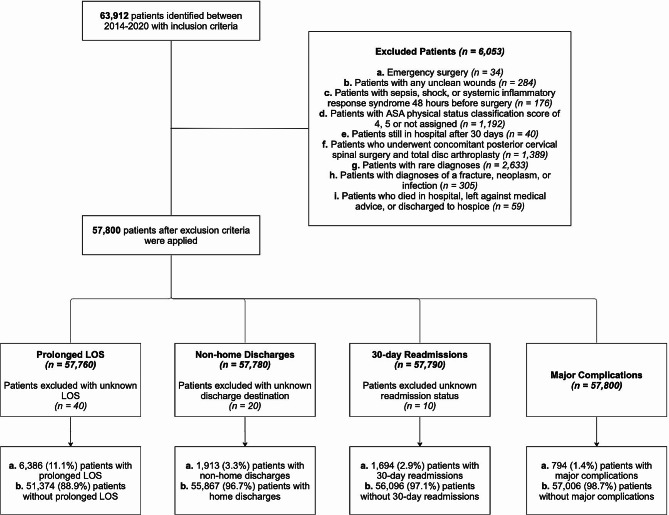
The analysis included 57,760 patients for prolonged LOS [11.1% with prolonged LOS], 57,780 for non-home discharges [3.3% non-home discharges], 57,790 for 30-day readmissions [2.9% readmitted], and 57,800 for major complications [1.4% with major complications]. The top-performing models, which were the ones built with the Random Forest algorithm, yielded mean AUROCs of 0.776, 0.846, 0.775, and 0.747 for predicting prolonged LOS, non-home discharges, readmissions, and complications, respectively.
Our study employs advanced ML methodologies to enhance the prediction of adverse postoperative outcomes following ACDF. We designed an accessible web application to integrate these models into clinical practice. Our findings affirm that ML tools serve as vital supplements in risk stratification, facilitating the prediction of diverse outcomes and enhancing patient counseling for ACDF.
自 2011 年以来,颈椎前路椎间盘切除融合术(ACDF)的频率增加了 400%,鉴于该手术的广泛应用,需要术前预测不良术后结果。我们的研究旨在实现两个目标:首先,开发一套可解释的机器学习(ML)模型,能够预测 ACDF 手术后的不良术后结果;其次,将这些模型嵌入用户友好的 Web 应用程序中,展示其潜在的实用性。
我们利用国家手术质量改进计划数据库的数据,确定接受 ACDF 手术的患者。感兴趣的结果是四个短期术后不良结果:延长住院时间(LOS)、非家庭出院、30 天再入院和主要并发症。我们使用了五种 ML 算法——TabPFN、TabNET、XGBoost、LightGBM 和随机森林——并结合 Optuna 优化库进行超参数调整。为了增强我们模型的可解释性,我们使用了 Shapley Additive exPlanations (SHAP) 来评估预测变量的相对重要性,并使用部分依赖图来说明单个变量对我们表现最佳的模型生成的预测的影响。我们使用接收者操作特征(ROC)曲线和精度-召回曲线(PRC)来可视化模型性能。计算的定量指标包括 ROC 曲线下的面积(AUROC)、平衡准确性、PRC 下的加权面积(AUPRC)、加权精度和加权召回率。选择具有最高 AUROC 值的模型纳入 Web 应用程序。
分析包括 57760 例 LOS 延长患者[11.1% LOS 延长]、57780 例非家庭出院患者[3.3%非家庭出院]、57790 例 30 天再入院患者[2.9%再入院]和 57800 例主要并发症患者[1.4%有主要并发症]。表现最佳的模型是使用随机森林算法构建的,用于预测 LOS 延长、非家庭出院、再入院和并发症的平均 AUROC 分别为 0.776、0.846、0.775 和 0.747。
我们的研究采用先进的 ML 方法来增强 ACDF 后不良术后结果的预测。我们设计了一个易于访问的 Web 应用程序,将这些模型集成到临床实践中。我们的研究结果证实,ML 工具是风险分层的重要补充,有助于预测多种结果并为 ACDF 患者提供更好的咨询。