Silva Adriana, Silva Vanessa, Gomes João Paulo, Coelho Anabela, Batista Rita, Saraiva Cristina, Esteves Alexandra, Martins Ângela, Contente Diogo, Diaz-Formoso Lara, Cintas Luis M, Igrejas Gilberto, Borges Vítor, Poeta Patrícia
Microbiology and Antibiotic Resistance Team (MicroART), Department of Veterinary Sciences, University of Trás-os-Montes and Alto Douro (UTAD), 5000-801 Vila Real, Portugal.
Associated Laboratory for Green Chemistry (LAQV-REQUIMTE), University NOVA School of Science and Technology, 2829-516 Caparica, Portugal.
Antibiotics (Basel). 2024 May 14;13(5):447. doi: 10.3390/antibiotics13050447.
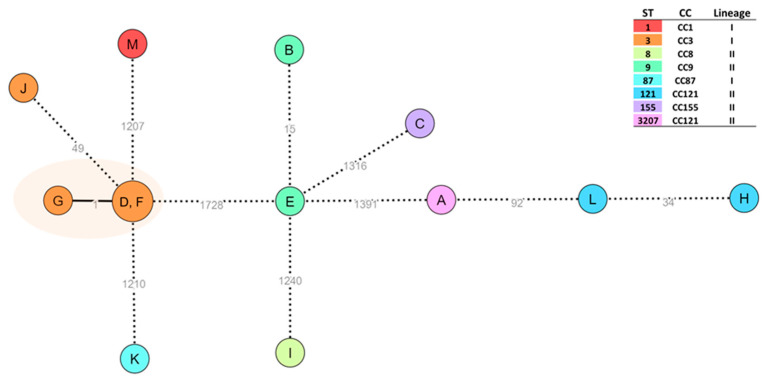
, a foodborne pathogen, exhibits high adaptability to adverse environmental conditions and is common in the food industry, especially in ready-to-eat foods. strains pose food safety challenges due to their ability to form biofilms, increased resistance to disinfectants, and long-term persistence in the environment. The aim of this study was to evaluate the presence and genetic diversity of in food and related environmental products collected from 2014 to 2022 and assess antibiotic susceptibility and biofilm formation abilities. was identified in 13 out of the 227 (6%) of samples, 7 from food products (meat preparation, cheeses, and raw milk) and 6 from food-processing environments (slaughterhouse-floor and catering establishments). All isolates exhibited high biofilm-forming capacity and antibiotic susceptibility testing showed resistance to several classes of antibiotics, especially trimethoprim-sulfamethoxazole and erythromycin. Genotyping and core-genome clustering identified eight sequence types and a cluster of three very closely related ST3 isolates (all from food), suggesting a common contamination source. Whole-genome sequencing (WGS) analysis revealed resistance genes conferring resistance to fosfomycin (), lincosamides (), fluoroquinolones (), and tetracycline (). In addition, the gene was also detected, conferring resistance to disinfecting agents and antiseptics. Virulence gene profiling revealed the presence of 92 associated genes associated with pathogenicity, adherence, and persistence. These findings underscore the presence of strains in food products and food-associated environments, demonstrating a high virulence of these strains associated with resistance genes to antibiotics, but also to disinfectants and antiseptics. Moreover, they emphasize the need for continuous surveillance, effective risk assessment, and rigorous control measures to minimize the public health risks associated to severe infections, particularly listeriosis outbreaks. A better understanding of the complex dynamics of pathogens in food products and their associated environments can help improve overall food safety and develop more effective strategies to prevent severe health consequences and economic losses.
作为一种食源性病原体,对恶劣环境条件具有高度适应性,在食品行业尤其是即食食品中很常见。该菌株由于能够形成生物膜、对消毒剂的抗性增强以及在环境中的长期持久性,给食品安全带来了挑战。本研究的目的是评估2014年至2022年收集的食品及相关环境产品中该菌株的存在情况和遗传多样性,并评估其抗生素敏感性和生物膜形成能力。在227个样本中的13个(6%)中鉴定出了该菌株,7个来自食品产品(肉类制品、奶酪和生牛奶),6个来自食品加工环境(屠宰场地面和餐饮场所)。所有分离株均表现出高生物膜形成能力,抗生素敏感性测试显示对几类抗生素具有抗性,尤其是甲氧苄啶-磺胺甲恶唑和红霉素。基因分型和核心基因组聚类鉴定出8种序列类型以及一组三个密切相关的ST3分离株(均来自食品),表明存在共同的污染来源。全基因组测序(WGS)分析揭示了赋予对磷霉素()、林可酰胺类()、氟喹诺酮类()和四环素()抗性的抗性基因。此外,还检测到了赋予对消毒剂和防腐剂抗性的基因。毒力基因谱分析揭示了存在92个与致病性、黏附性和持久性相关的基因。这些发现强调了该菌株在食品产品和食品相关环境中的存在,表明这些菌株具有与抗生素抗性基因相关的高毒力,而且还与消毒剂和防腐剂抗性相关。此外,它们强调需要持续监测、有效的风险评估和严格的控制措施,以将与严重感染尤其是李斯特菌病暴发相关的公共卫生风险降至最低。更好地了解食品产品及其相关环境中病原体的复杂动态有助于提高整体食品安全,并制定更有效的策略来预防严重的健康后果和经济损失。