Department of Human Anatomy, Wannan Medical College, No.22 West Wenchang Road, Wuhu, 241002, China.
Department of Cardio-Thoracic Surgery, Yijishan Hospital of Wannan Medical College, Wuhu, China.
BMC Med Educ. 2024 May 24;24(1):571. doi: 10.1186/s12909-024-05583-z.
Case-based learning (CBL) methods have gained prominence in medical education, proving especially effective for preclinical training in undergraduate medical education. Tetralogy of Fallot (TOF) is a congenital heart disease characterized by four malformations, presenting a challenge in medical education due to the complexity of its anatomical pathology. Three-dimensional printing (3DP), generating physical replicas from data, offers a valuable tool for illustrating intricate anatomical structures and spatial relationships in the classroom. This study explores the integration of 3DP with CBL teaching for clinical medical undergraduates.
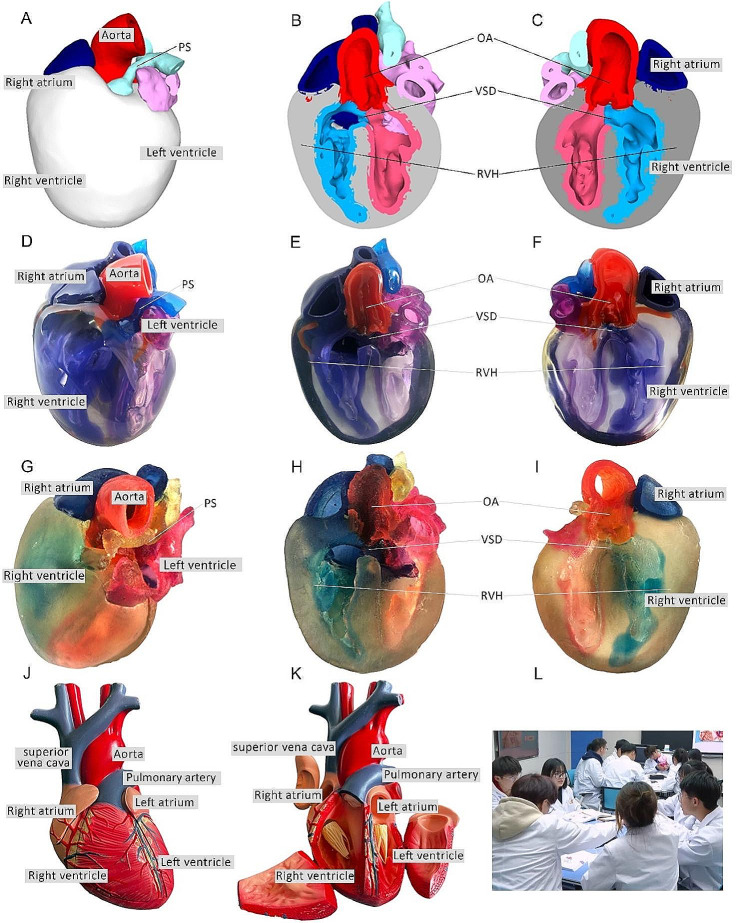
Sixty senior clinical medical undergraduates were randomly assigned to the CBL group and the CBL-3DP group. Computed tomography imaging data from a typical TOF case were exported, processed, and utilized to create four TOF models with a color 3D printer. The CBL group employed CBL teaching methods, while the CBL-3DP group combined CBL with 3D-printed models. Post-class exams and questionnaires assessed the teaching effectiveness of both groups.
The CBL-3DP group exhibited improved performance in post-class examinations, particularly in pathological anatomy and TOF imaging data analysis (P < 0.05). Questionnaire responses from the CBL-3DP group indicated enhanced satisfaction with teaching mode, promotion of diagnostic skills, bolstering of self-assurance in managing TOF cases, and cultivation of critical thinking and clinical reasoning abilities (P < 0.05). These findings underscore the potential of 3D printed models to augment the effectiveness of CBL, aiding students in mastering instructional content and bolstering their interest and self-confidence in learning.
The fusion of CBL with 3D printing models is feasible and effective in TOF instruction to clinical medical undergraduates, and worthy of popularization and application in medical education, especially for courses involving intricate anatomical components.
基于案例的学习(CBL)方法在医学教育中得到了广泛的关注,尤其在本科医学教育的基础医学培训中效果显著。法洛四联症(TOF)是一种由四种畸形组成的先天性心脏病,由于其解剖病理学的复杂性,在医学教育中具有挑战性。三维打印(3DP)技术从数据中生成物理复制品,为在课堂上说明复杂的解剖结构和空间关系提供了宝贵的工具。本研究探讨了将 3DP 与 CBL 教学相结合用于临床医学本科生的教学。
将 60 名临床医学高年级本科生随机分配到 CBL 组和 CBL-3DP 组。从一个典型的 TOF 病例中导出、处理计算机断层扫描成像数据,并使用彩色 3D 打印机创建四个 TOF 模型。CBL 组采用 CBL 教学方法,而 CBL-3DP 组则将 CBL 与 3D 打印模型相结合。通过课后考试和问卷调查评估两组的教学效果。
CBL-3DP 组在课后考试中的表现有所提高,特别是在病理解剖和 TOF 影像学数据分析方面(P<0.05)。CBL-3DP 组的问卷调查结果表明,他们对教学模式的满意度提高了,诊断技能得到了提高,处理 TOF 病例的自信心增强了,批判性思维和临床推理能力也得到了培养(P<0.05)。这些发现突出了 3D 打印模型在增强 CBL 效果方面的潜力,帮助学生掌握教学内容,并提高他们对学习的兴趣和自信心。
CBL 与 3D 打印模型的融合在 TOF 教学中对临床医学本科生是可行且有效的,值得在医学教育中推广和应用,尤其是对于涉及复杂解剖结构的课程。