Benichou Gilles, Lancia Hyshem H
Center for Transplantation Sciences, Department of Surgery, Massachusetts General Hospital and Harvard Medical School, MA, USA.
Center for Transplantation Sciences, Department of Surgery, Massachusetts General Hospital and Harvard Medical School, MA, USA.
Biomed J. 2024 Oct;47(5):100749. doi: 10.1016/j.bj.2024.100749. Epub 2024 May 25.
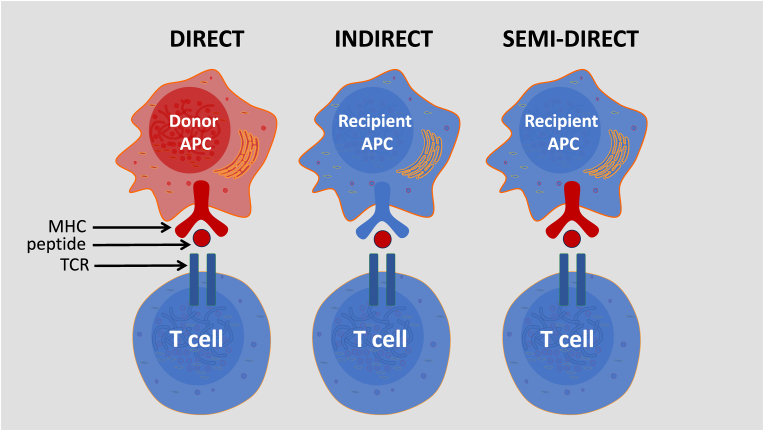
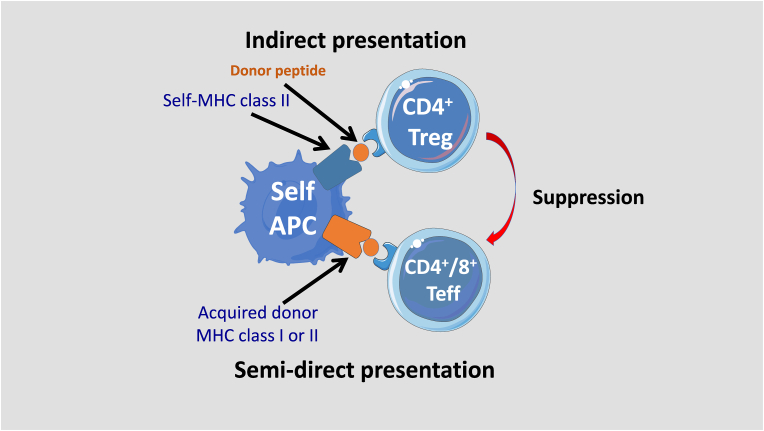
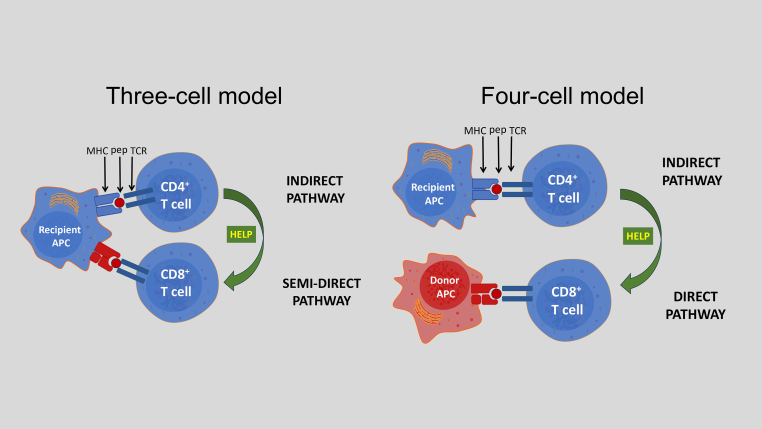
After transplantation of allogeneic tissues and organs, recognition by recipient T cells of donor MHC molecules initiates the pro-inflammatory adaptive immune response leading to allograft rejection. T cell allorecognition has long been known to be mediated via two distinct pathways: the direct pathway in which T cells recognize intact allogeneic MHC molecules displayed on donor cells and the indirect pathway whereby T cells recognize donor MHC peptides processed and presented by recipient antigen-presenting cells (APCs). It is believed that direct allorecognition is the driving force behind early acute allograft rejection while indirect allorecognition is involved in chronic allograft rejection, a progressive condition characterized by graft vasculopathy and tissue fibrosis. Recently, we and others have reported that after transplantation of allogeneic skin and organs, donor MHC molecules are transferred from donor cells to the host's APCs via trogocytosis or extracellular vesicles. Recipient APCs having captured donor MHC molecules can either present them to T cells in their intact form on their surface (semi-direct pathway) or the form of peptides bound to self-MHC molecules (indirect pathway). The present article provides an overview of recent studies evaluating the role of intercellular exchange of MHC molecules in T cell alloimmunity and its contribution to allograft rejection and tolerance.
在同种异体组织和器官移植后,受体T细胞对供体MHC分子的识别启动了促炎性适应性免疫反应,导致同种异体移植排斥。长期以来,已知T细胞同种异体识别通过两种不同途径介导:直接途径,即T细胞识别供体细胞上展示的完整同种异体MHC分子;间接途径,即T细胞识别由受体抗原呈递细胞(APC)加工和呈递的供体MHC肽。据信,直接同种异体识别是早期急性同种异体移植排斥背后的驱动力,而间接同种异体识别参与慢性同种异体移植排斥,这是一种以移植血管病变和组织纤维化为特征的进行性病症。最近,我们和其他人报道,在同种异体皮肤和器官移植后,供体MHC分子通过胞啃作用或细胞外囊泡从供体细胞转移到宿主的APC。捕获了供体MHC分子的受体APC可以将它们以完整形式呈现在其表面上的T细胞(半直接途径),或以与自身MHC分子结合的肽的形式呈递(间接途径)。本文概述了最近评估MHC分子细胞间交换在T细胞同种异体免疫中的作用及其对同种异体移植排斥和耐受的贡献的研究。