School of Clinical Medicine, University of Cambridge, Cambridge, United Kingdom.
Department of Pathology, Papworth Hospital, Papworth Everard, United Kingdom.
Front Immunol. 2019 Jan 23;9:3038. doi: 10.3389/fimmu.2018.03038. eCollection 2018.
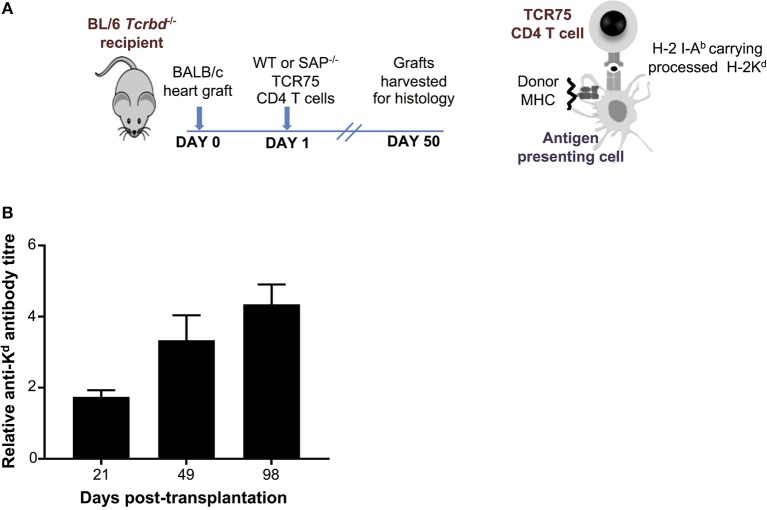
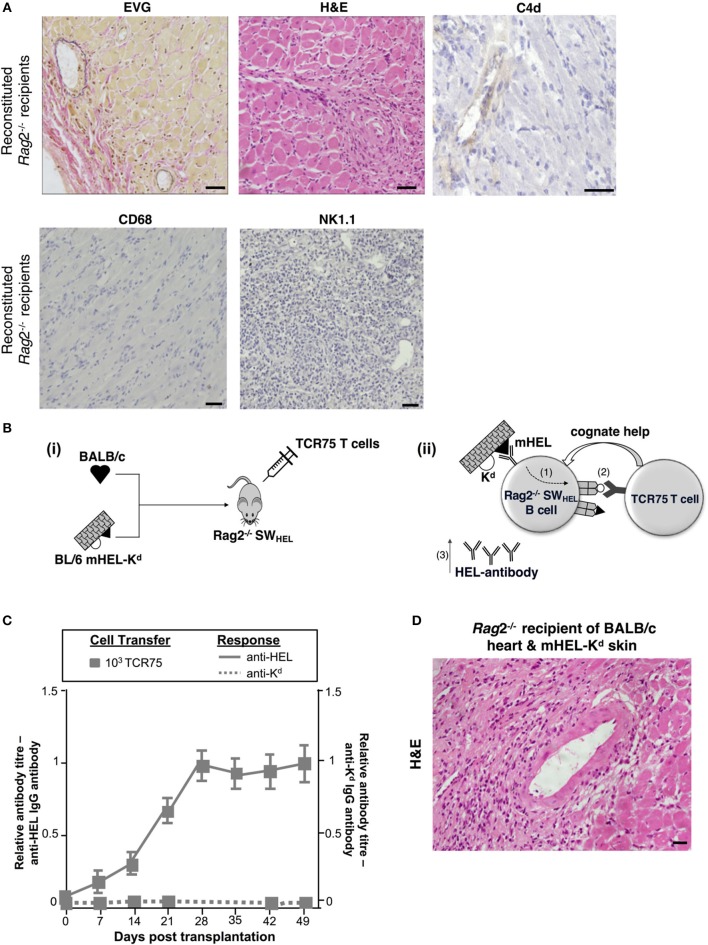
Different profiles of alloantibody responses are observed in the clinic, with those that persist, often despite targeted treatment, associated with poorer long-term transplant outcomes. Although such responses would suggest an underlying germinal center (GC) response, the relationship to cellular events within the allospecific B cell population is unclear. Here we examine the contribution of germinal center (GC) humoral alloimmunity to chronic antibody mediated rejection (AMR). A murine model of chronic AMR was developed in which T cell deficient () C57BL/6 recipients were challenged with MHC-mismatched BALB/c heart allografts and T cell help provided by reconstituting with 10 "TCR75" CD4 T cells that recognize self-restricted allopeptide derived from the H-2K MHC class I alloantigen. Reconstituted recipients developed Ig-switched anti-K alloantibody responses that were slow to develop, but long-lived, with confocal immunofluorescence and flow cytometric characterization of responding H-2K-allospecific B cells confirming persistent splenic GC activity. This was associated with T follicular helper (T) cell differentiation of the transferred TCR75 CD4 T cells. Heart grafts developed progressive allograft vasculopathy, and were rejected chronically (MST 50 days), with explanted allografts displaying features of humoral vascular rejection. Critically, late alloantibody responses were abolished, and heart grafts survived indefinitely, in recipients reconstituted with TCR75 CD4 T cells that were genetically incapable of providing T cell function. The GC response was associated with affinity maturation of the anti-K alloantibody response, and its contribution to progression of allograft vasculopathy related principally to secretion of alloantibody, rather than to enhanced alloreactive T cell priming, because grafts survived long-term when B cells could present alloantigen, but not secrete alloantibody. Similarly, sera sampled at late time points from chronically-rejecting recipients induced more vigorous donor endothelial responses than sera sampled earlier after transplantation. In summary, our results suggest that chronic AMR and progression of allograft vasculopathy is dependent upon allospecific GC activity, with critical help provided by T cells. Clinical strategies that target the T cell subset may hold therapeutic potential. This work is composed of two parts, of which this is Part II. Please read also Part I: Alsughayyir et al., 2019.
临床上观察到同种异体抗体反应的不同特征,那些持续存在的反应,尽管经常进行靶向治疗,也与较差的长期移植结果相关。尽管这些反应表明存在生发中心(GC)反应,但与同种特异性 B 细胞群内的细胞事件的关系尚不清楚。在这里,我们研究了生发中心(GC)体液同种免疫对慢性抗体介导的排斥反应(AMR)的贡献。在该研究中,建立了慢性 AMR 的小鼠模型,其中 T 细胞缺陷()C57BL/6 受体接受 MHC 错配的 BALB/c 心脏同种异体移植物的挑战,并通过用 10 个“TCR75”CD4 T 细胞再构成来提供 T 细胞帮助,这些 T 细胞识别源自 H-2K MHC Ⅰ类同种抗原的自身限制的同种肽。再构成的受体产生了缓慢发展但寿命长的 Ig 开关抗-K 同种抗体反应,通过对反应性 H-2K-同种特异性 B 细胞的共聚焦免疫荧光和流式细胞术分析证实了持续的脾脏 GC 活性。这与转移的 TCR75 CD4 T 细胞的滤泡辅助性 T(Tfh)细胞分化有关。心脏移植物发生进行性同种异体血管病,并慢性排斥(MST50 天),植入的同种异体移植物显示出体液血管排斥的特征。至关重要的是,在用遗传上不能提供 T 细胞功能的 TCR75 CD4 T 细胞再构成的受体中,晚期同种抗体反应被消除,心脏移植物可以无限期存活。GC 反应与抗-K 同种抗体反应的亲和力成熟有关,其对同种异体血管病进展的贡献主要归因于同种抗体的分泌,而不是增强同种反应性 T 细胞的启动,因为当 B 细胞可以呈递同种抗原但不能分泌同种抗体时,移植物可以长期存活。同样,从慢性排斥受体中晚期采集的血清比移植后早期采集的血清引起更强的供体内皮反应。总之,我们的结果表明,慢性 AMR 和同种异体血管病的进展依赖于同种特异性 GC 活性,T 细胞提供关键帮助。针对 T 细胞亚群的临床策略可能具有治疗潜力。这项工作由两部分组成,这是第二部分。请同时阅读第一部分:Alsughayyir 等人,2019 年。