Department of Soil and Crop Science, Colorado State University, Fort Collins, CO, USA.
Department of Microbiology, The Ohio State University, Columbus, OH, USA.
Nat Microbiol. 2024 Jun;9(6):1454-1466. doi: 10.1038/s41564-024-01691-0. Epub 2024 May 28.
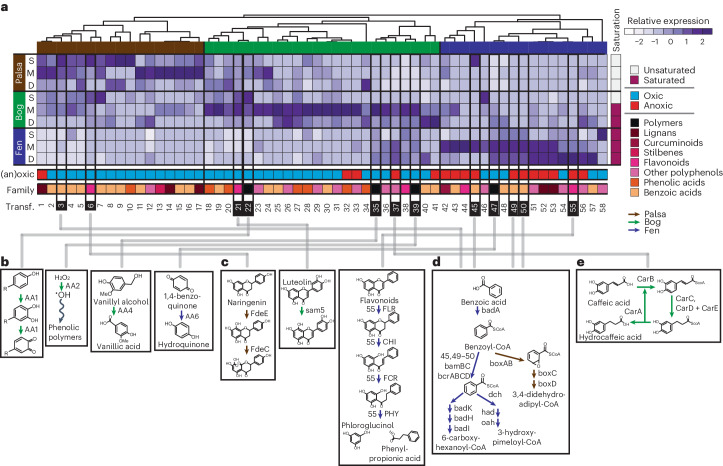
With rising global temperatures, permafrost carbon stores are vulnerable to microbial degradation. The enzyme latch theory states that polyphenols should accumulate in saturated peatlands due to diminished phenol oxidase activity, inhibiting resident microbes and promoting carbon stabilization. Pairing microbiome and geochemical measurements along a permafrost thaw-induced saturation gradient in Stordalen Mire, a model Arctic peatland, we confirmed a negative relationship between phenol oxidase expression and saturation but failed to support other trends predicted by the enzyme latch. To inventory alternative polyphenol removal strategies, we built CAMPER, a gene annotation tool leveraging polyphenol enzyme knowledge gleaned across microbial ecosystems. Applying CAMPER to genome-resolved metatranscriptomes, we identified genes for diverse polyphenol-active enzymes expressed by various microbial lineages under a range of redox conditions. This shifts the paradigm that polyphenols stabilize carbon in saturated soils and highlights the need to consider both oxic and anoxic polyphenol metabolisms to understand carbon cycling in changing ecosystems.
随着全球气温的升高,永久冻土中的碳储量容易受到微生物降解的影响。酶锁理论指出,由于多酚氧化酶活性降低,多酚应该在饱和泥炭地中积累,从而抑制驻留微生物并促进碳的稳定。在斯多塔伦湿地(Stordalen Mire),一个北极泥炭地模型,我们沿着永久冻土解冻引起的饱和度梯度进行了微生物组和地球化学测量,证实了多酚氧化酶表达与饱和度之间存在负相关关系,但未能支持酶锁预测的其他趋势。为了确定替代多酚去除策略,我们构建了 CAMPER,这是一种利用从微生物生态系统中获得的多酚酶知识进行基因注释的工具。将 CAMPER 应用于基因组解析的宏转录组,我们确定了在各种氧化还原条件下,各种微生物谱系表达的多种多酚活性酶的基因。这一发现改变了多酚在饱和土壤中稳定碳的观点,并强调需要考虑好氧和缺氧多酚代谢来理解不断变化的生态系统中的碳循环。