Cottle Rachel M, Fisher Kat G, Leach Olivia K, Wolf S Tony, Kenney W Larry
Department of Kinesiology, The Pennsylvania State University, University Park, Pennsylvania, United States.
Center for Healthy Aging, College of Health and Human Development, The Pennsylvania State University, University Park, Pennsylvania, United States.
J Appl Physiol (1985). 2024 Jul 1;137(1):145-153. doi: 10.1152/japplphysiol.00117.2024. Epub 2024 May 30.
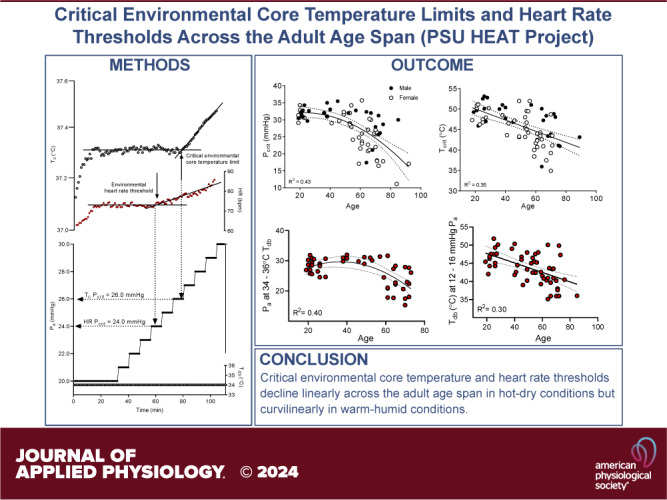
The frequency, duration, and severity of extreme heat events have increased and are projected to continue to increase throughout the next century. As a result, there is an increased risk of excessive heat- and cardiovascular-related morbidity and mortality during these extreme heat events. Therefore, the purposes of this investigation were to establish ) critical environmental core temperature (T) limits for middle-aged adults (MA), ) environmental thresholds that cause heart rate (HR) to progressively rise in MA and older (O) adults, and ) examine critical environmental T limits and HR environmental thresholds across the adult age span. Thirty-three young (Y) (15 F; 23 ± 3 yr), 28 MA (17 F; 51 ± 6 yr), and 31 O (16 F; 70 ± 3 yr) subjects were exposed to progressive heat stress in an environmental chamber in a warm-humid (WH, 34-36°C, 50-90% rh) and a hot-dry (HD, 38°C-52°C, <30% rh) environment while exercising at a low metabolic rate reflecting activities of daily living (∼1.8 METs). In both environments, there was a main effect of age on the critical environmental T limit and environmental HR thresholds (main effect of age all < 0.001). Across the lifespan, critical environmental T and HR thresholds decline linearly with age in HD environments ( ≥ 0.3) and curvilinearly in WH environments ( ≥ 0.4). These data support an age-associated shift in critical environmental T limits and HR thresholds toward lower environmental conditions and can be used to develop evidence-based safety guidelines to minimize future heat-related morbidity and mortality across the adult age span. This study is the first to identify critical environmental core temperature and heart rate thresholds across the adult age spectrum. In addition, our data demonstrate that the rate of decline in T and HR limits with age is environmental-dependent. These findings provide strong empirical data for the development of safety guidelines and policy decisions to mitigate excessive heat- and cardiovascular-related morbidity and mortality for impending heat events.
极端高温事件的频率、持续时间和严重程度都有所增加,预计在下个世纪还将继续上升。因此,在这些极端高温事件期间,与过热和心血管相关的发病和死亡风险也会增加。所以,本研究的目的是:) 确定中年成年人 (MA) 的关键环境核心温度 (T) 限值;) 找出导致MA和老年人 (O) 心率 (HR) 逐渐上升的环境阈值;) 研究整个成年年龄段的关键环境T限值和HR环境阈值。33名年轻人 (Y)(15名女性;23±3岁)、28名MA(17名女性;51±6岁)和31名O(16名女性;70±3岁)受试者在环境舱中接受渐进性热应激,环境为暖湿 (WH,34 - 36°C,50 - 90% 相对湿度) 和干热 (HD,38°C - 52°C,<30% 相对湿度),同时以反映日常生活活动的低代谢率(约1.8代谢当量)进行锻炼。在这两种环境中,年龄对关键环境T限值和环境HR阈值均有主要影响(年龄的主要影响均P<0.001)。在整个寿命周期内,在HD环境中,关键环境T和HR阈值随年龄呈线性下降(R²≥0.3),而在WH环境中呈曲线下降(R²≥0.4)。这些数据支持关键环境T限值和HR阈值随年龄向更低环境条件转变,可用于制定循证安全指南,以尽量减少未来整个成年年龄段与热相关的发病和死亡。本研究首次确定了整个成年年龄谱的关键环境核心温度和心率阈值。此外,我们的数据表明,T和HR限值随年龄下降的速率取决于环境。这些发现为制定安全指南和政策决策提供了有力的实证数据,以减轻即将到来热事件中与过热和心血管相关的发病和死亡。