Roy Sarupa, Majee Priyasha, Sudhakar Sruthi, Mishra Satyajit, Kalia Jeet, Pradeepkumar P I, Srivatsan Seergazhi G
Department of Chemistry, Indian Institute of Science Education and Research (IISER), Pune Dr Homi Bhabha Road Pune 411008 India
Department of Chemistry, Indian Institute of Technology Bombay Mumbai 400076 India
Chem Sci. 2024 Apr 25;15(21):7982-7991. doi: 10.1039/d4sc01755b. eCollection 2024 May 29.
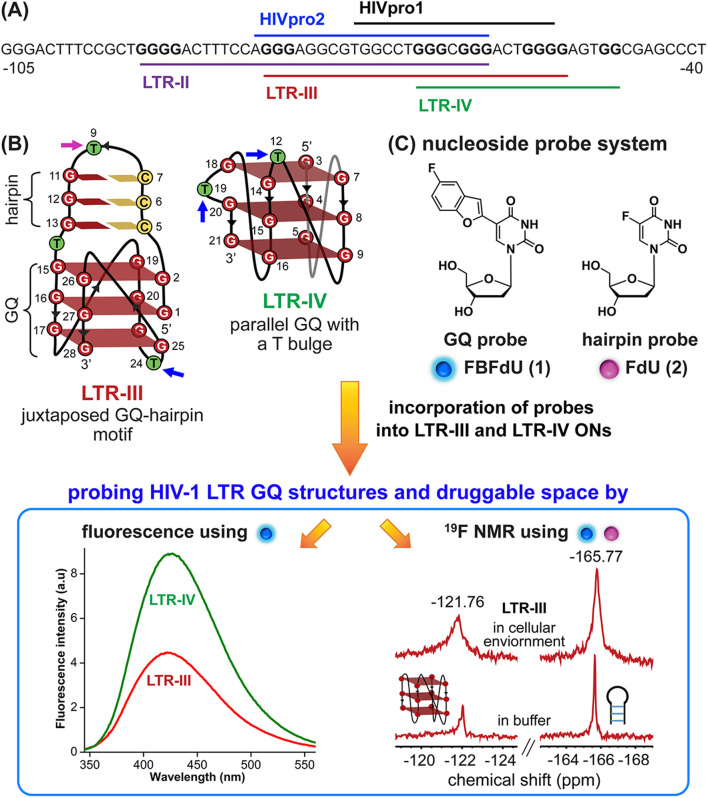
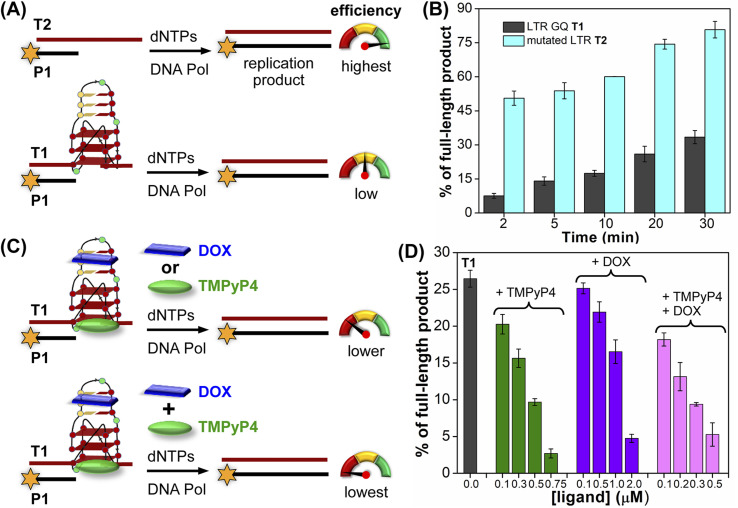
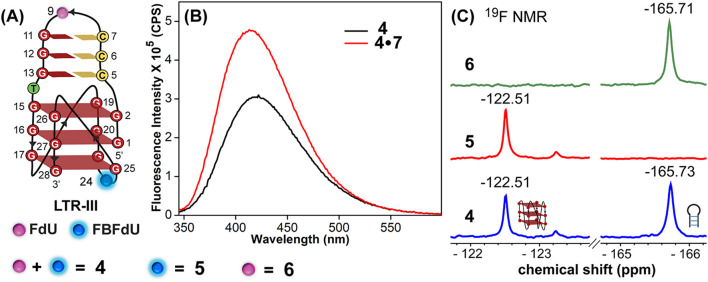
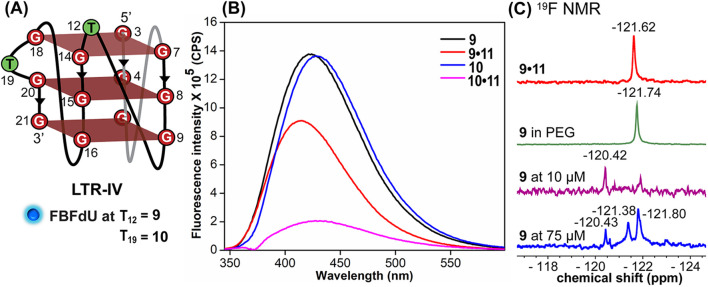
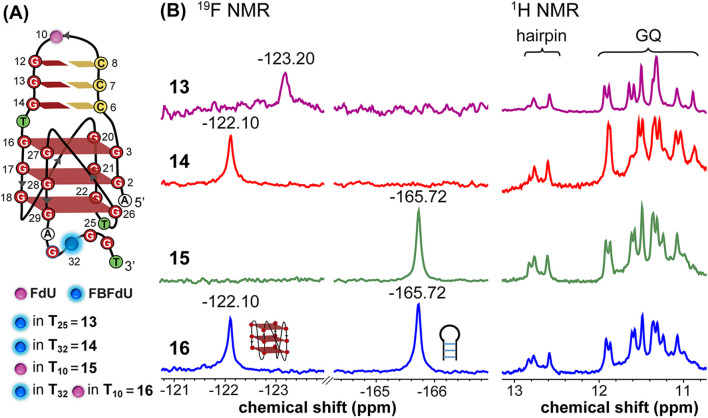
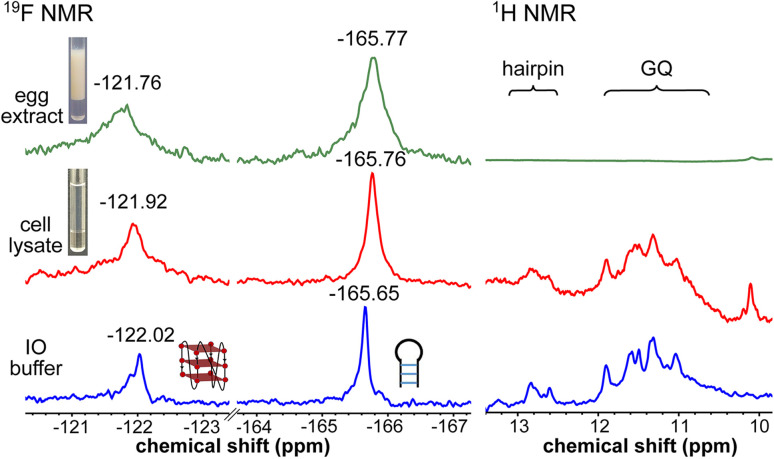
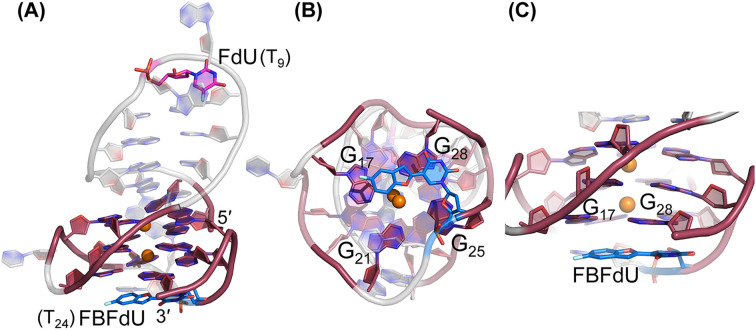
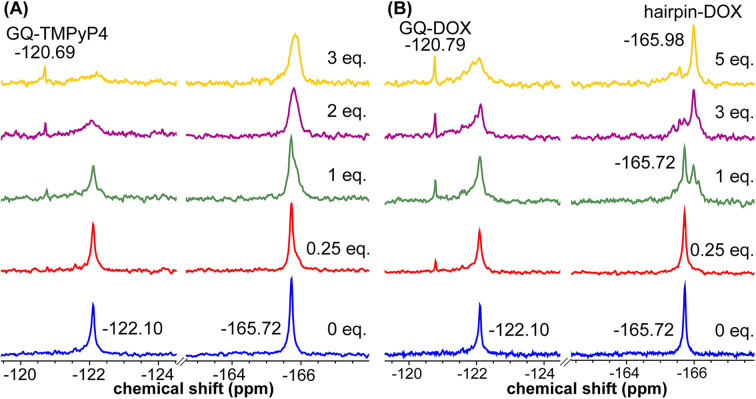
Understanding the structure and recognition of highly conserved regulatory segments of the integrated viral DNA genome that forms unique topologies can greatly aid in devising novel therapeutic strategies to counter chronic infections. In this study, we configured a probe system using highly environment-sensitive nucleoside analogs, 5-fluoro-2'-deoxyuridine (FdU) and 5-fluorobenzofuran-2'-deoxyuridine (FBFdU), to investigate the structural polymorphism of HIV-1 long terminal repeat (LTR) G-quadruplexes (GQs) by fluorescence and F NMR. FdU and FBFdU, serving as hairpin and GQ sensors, produced distinct spectral signatures for different GQ topologies adopted by LTR G-rich oligonucleotides. Importantly, systematic F NMR analysis in oocytes gave unprecedented information on the structure adopted by the LTR G-rich region in the cellular environment. The results indicate that it forms a unique GQ-hairpin hybrid architecture, a potent hotspot for selective targeting. Furthermore, structural models generated using MD simulations provided insights on how the probe system senses different GQs. Using the responsiveness of the probes and DNA polymerase stop assay, we monitored GQ- and hairpin-specific ligand interactions and their synergistic inhibitory effect on the replication process. Our findings suggest that targeting GQ and hairpin motifs simultaneously using bimodal ligands could be a new strategy to selectively block the viral replication.
了解形成独特拓扑结构的整合病毒DNA基因组高度保守调控片段的结构和识别特性,对于设计对抗慢性感染的新型治疗策略具有极大的帮助。在本研究中,我们构建了一个使用对环境高度敏感的核苷类似物5-氟-2'-脱氧尿苷(FdU)和5-氟苯并呋喃-2'-脱氧尿苷(FBFdU)的探针系统,通过荧光和F NMR研究HIV-1长末端重复序列(LTR)G-四链体(GQs)的结构多态性。FdU和FBFdU作为发夹和GQ传感器,为富含LTR G的寡核苷酸所采用的不同GQ拓扑结构产生了独特的光谱特征。重要的是,在卵母细胞中进行的系统F NMR分析给出了关于细胞环境中富含LTR G区域所采用结构的前所未有的信息。结果表明,它形成了一种独特的GQ-发夹杂合结构,是一个选择性靶向的有效热点。此外,使用分子动力学模拟生成的结构模型提供了关于探针系统如何感知不同GQs的见解。利用探针的响应性和DNA聚合酶终止试验,我们监测了GQ和发夹特异性配体相互作用及其对复制过程的协同抑制作用。我们的研究结果表明,使用双峰配体同时靶向GQ和发夹基序可能是一种选择性阻断病毒复制的新策略。