Infectious Diseases and Tropical Medicine Research Center, Shahid Beheshti University of Medical Sciences, Tehran, Iran.
Preventative Gynecology Research Center, Shahid Beheshti University of Medical Sciences, Tehran, Iran.
BMC Infect Dis. 2024 May 31;24(1):546. doi: 10.1186/s12879-024-09442-6.
Oral candidiasis (OC) is a prevalent opportunistic infection in patients with human immunodeficiency virus (HIV) infection. The increasing resistance to antifungal agents in HIV-positive individuals suffering from OC raised concerns. Thus, this study aimed to investigate the prevalence of drug-resistant OC in HIV-positive patients.
Pubmed, Web of Science, Scopus, and Embase databases were systematically searched for eligible articles up to November 30, 2023. Studies reporting resistance to antifungal agents in Candida species isolated from HIV-positive patients with OC were included. Baseline characteristics, clinical features, isolated Candida species, and antifungal resistance were independently extracted by two reviewers. The pooled prevalence with a 95% confidence interval (CI) was calculated using the random effect model or fixed effect model.
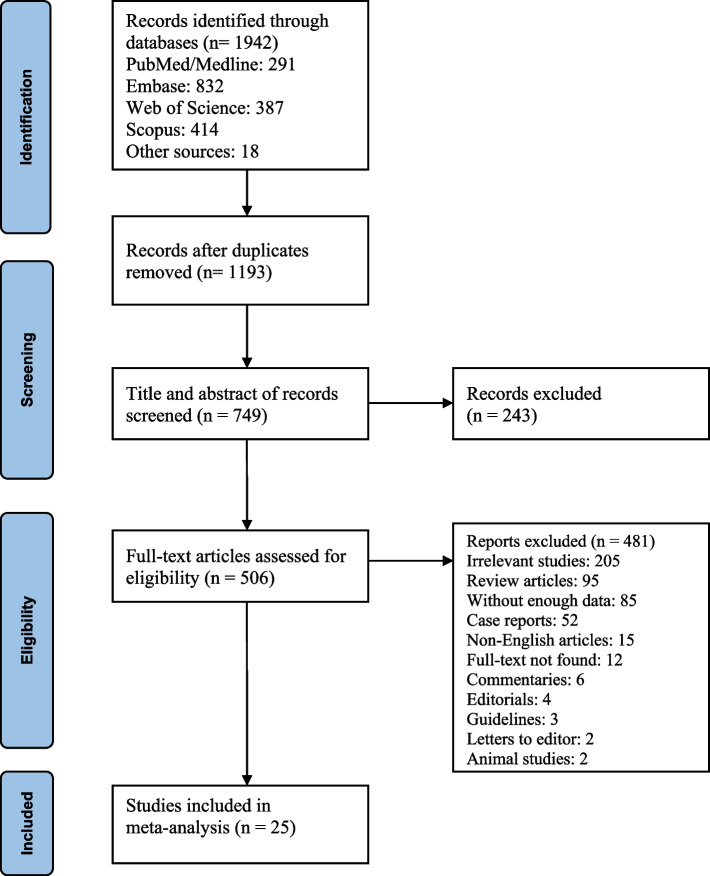
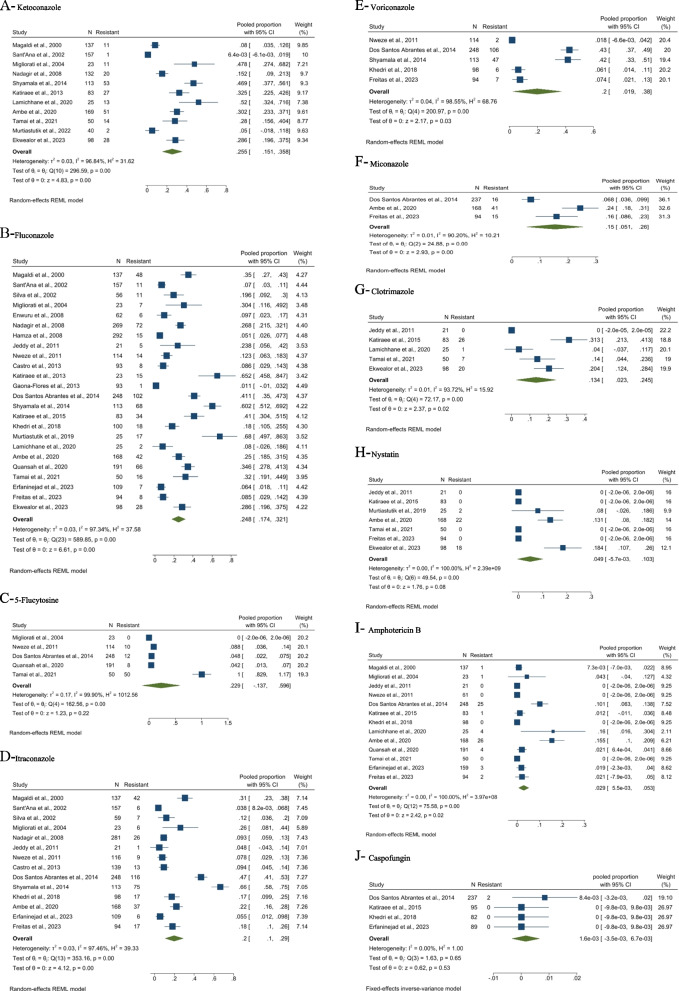
Out of the 1942 records, 25 studies consisting of 2564 Candida species entered the meta-analysis. The pooled prevalence of resistance to the antifungal agents was as follows: ketoconazole (25.5%, 95% CI: 15.1-35.8%), fluconazole (24.8%, 95% CI: 17.4-32.1%), 5-Flucytosine (22.9%, 95% CI: -13.7-59.6%), itraconazole (20.0%, 95% CI: 10.0-26.0%), voriconazole (20.0%, 95% CI: 1.9-38.0%), miconazole (15.0%, 95% CI: 5.1-26.0%), clotrimazole (13.4%, 95% CI: 2.3-24.5%), nystatin (4.9%, 95% CI: -0.05-10.3%), amphotericin B (2.9%, 95% CI: 0.5-5.3%), and caspofungin (0.1%, 95% CI: -0.3-0.6%). Furthermore, there were high heterogeneities among almost all included studies regarding the resistance to different antifungal agents (I > 50.00%, P < 0.01), except for caspofungin (I = 0.00%, P = 0.65).
Our research revealed that a significant number of Candida species found in HIV-positive patients with OC were resistant to azoles and 5-fluocytosine. However, most of the isolates were susceptible to nystatin, amphotericin B, and caspofungin. This suggests that initial treatments for OC, such as azoles, may not be effective. In such cases, healthcare providers may need to consider prescribing alternative treatments like polyenes and caspofungin.
The study protocol was registered in the International Prospective Register of Systematic Reviews as PROSPERO (Number: CRD42024497963).
口腔念珠菌病(OC)是人类免疫缺陷病毒(HIV)感染患者中一种普遍的机会性感染。HIV 阳性个体对抗真菌药物的耐药性不断增加,引起了人们的关注。因此,本研究旨在调查 HIV 阳性患者中耐抗真菌药物 OC 的流行情况。
系统检索了 Pubmed、Web of Science、Scopus 和 Embase 数据库,以获取截至 2023 年 11 月 30 日的相关文献。纳入了报告 HIV 阳性患者 OC 分离出的念珠菌对抗真菌药物耐药性的研究。两名评审员分别独立提取基线特征、临床特征、分离的念珠菌物种和抗真菌耐药性。使用随机效应模型或固定效应模型计算 95%置信区间(CI)的汇总患病率。
在 1942 条记录中,有 25 项研究共涉及 2564 株念珠菌进入了荟萃分析。抗真菌药物耐药的汇总患病率如下:酮康唑(25.5%,95%CI:15.1-35.8%)、氟康唑(24.8%,95%CI:17.4-32.1%)、5-氟胞嘧啶(22.9%,95%CI:-13.7-59.6%)、伊曲康唑(20.0%,95%CI:10.0-26.0%)、伏立康唑(20.0%,95%CI:1.9-38.0%)、咪康唑(15.0%,95%CI:5.1-26.0%)、克霉唑(13.4%,95%CI:2.3-24.5%)、制霉菌素(4.9%,95%CI:-0.05-10.3%)、两性霉素 B(2.9%,95%CI:0.5-5.3%)和卡泊芬净(0.1%,95%CI:-0.3-0.6%)。此外,几乎所有纳入的研究在不同抗真菌药物耐药方面都存在高度异质性(I>50.00%,P<0.01),除了卡泊芬净(I=0.00%,P=0.65)。
我们的研究表明,HIV 阳性患者 OC 中分离出的大量念珠菌对唑类药物和 5-氟胞嘧啶具有耐药性。然而,大多数分离株对制霉菌素、两性霉素 B 和卡泊芬净敏感。这表明初始 OC 治疗,如唑类药物,可能无效。在这种情况下,医疗保健提供者可能需要考虑开其他治疗方法,如多烯类和卡泊芬净。
该研究方案已在国际前瞻性系统评价注册中心(PROSPERO)注册,编号为 CRD42024497963。