• 文献检索
  • 文档翻译
  • 深度研究
  • 学术资讯
  • Suppr Zotero 插件Zotero 插件
  • 邀请有礼
  • 套餐&价格
  • 历史记录
应用&插件
Suppr Zotero 插件Zotero 插件浏览器插件Mac 客户端Windows 客户端微信小程序
定价
高级版会员购买积分包购买API积分包
服务
文献检索文档翻译深度研究API 文档MCP 服务
关于我们
关于 Suppr公司介绍联系我们用户协议隐私条款
关注我们

Suppr 超能文献

核心技术专利:CN118964589B侵权必究
粤ICP备2023148730 号-1Suppr @ 2026

文献检索

告别复杂PubMed语法,用中文像聊天一样搜索,搜遍4000万医学文献。AI智能推荐,让科研检索更轻松。

立即免费搜索

文件翻译

保留排版,准确专业,支持PDF/Word/PPT等文件格式,支持 12+语言互译。

免费翻译文档

深度研究

AI帮你快速写综述,25分钟生成高质量综述,智能提取关键信息,辅助科研写作。

立即免费体验

无细胞游离 DNA 检测肾移植排斥反应。

Cell-free DNA for the detection of kidney allograft rejection.

机构信息

Université Paris Cité, INSERM U970, Paris Institute for Transplantation and Organ Regeneration, Paris, France.

Department of Kidney Transplantation, Necker Hospital, Assistance Publique - Hôpitaux de Paris, Paris, France.

出版信息

Nat Med. 2024 Aug;30(8):2320-2327. doi: 10.1038/s41591-024-03087-3. Epub 2024 Jun 2.

DOI:10.1038/s41591-024-03087-3
PMID:38824959
原文链接:https://pmc.ncbi.nlm.nih.gov/articles/PMC11333280/
Abstract

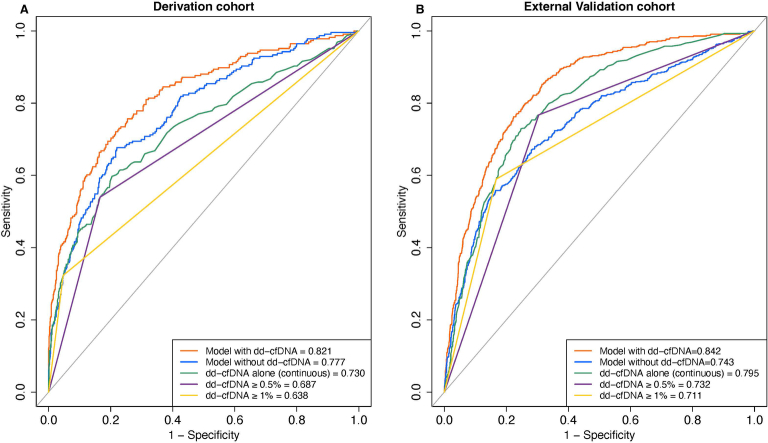
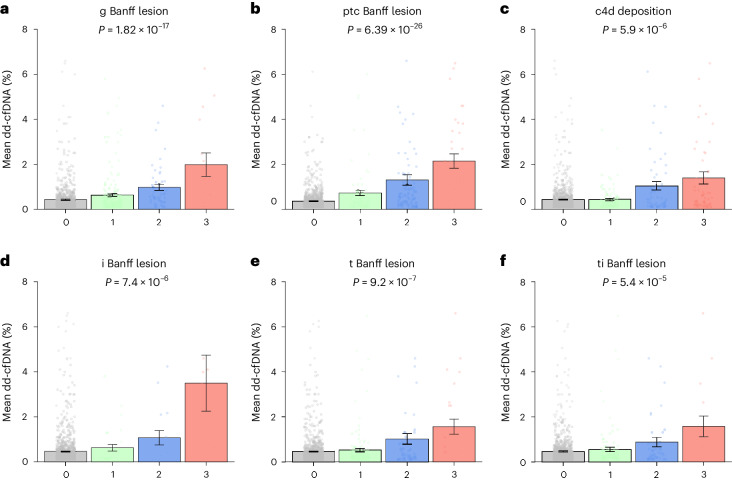
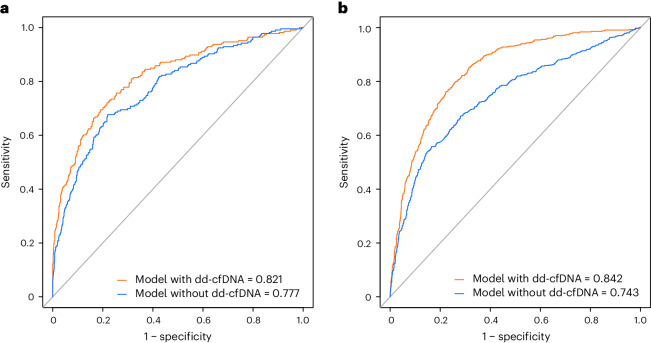
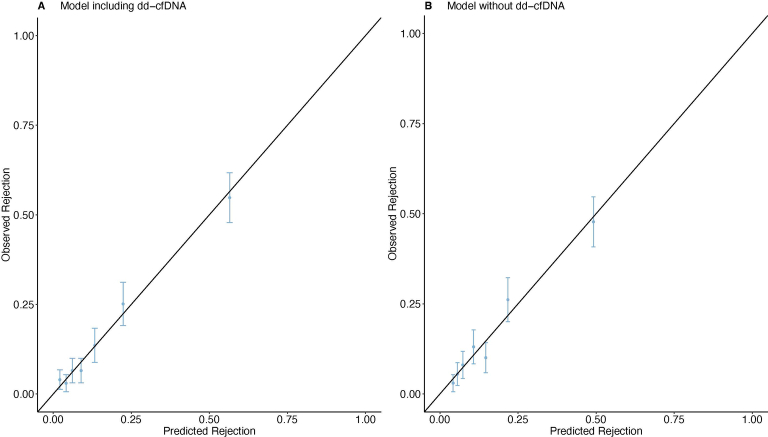
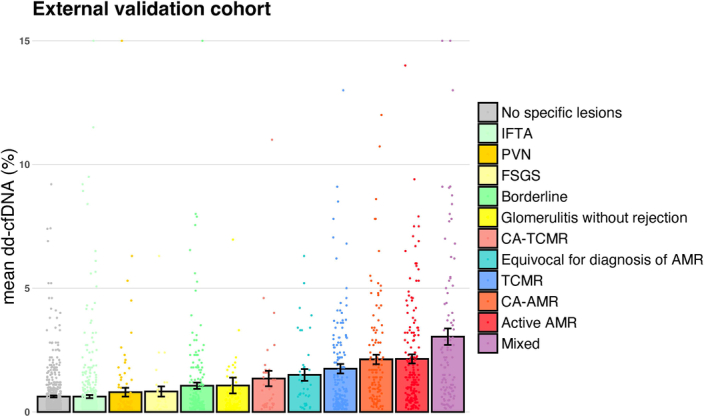
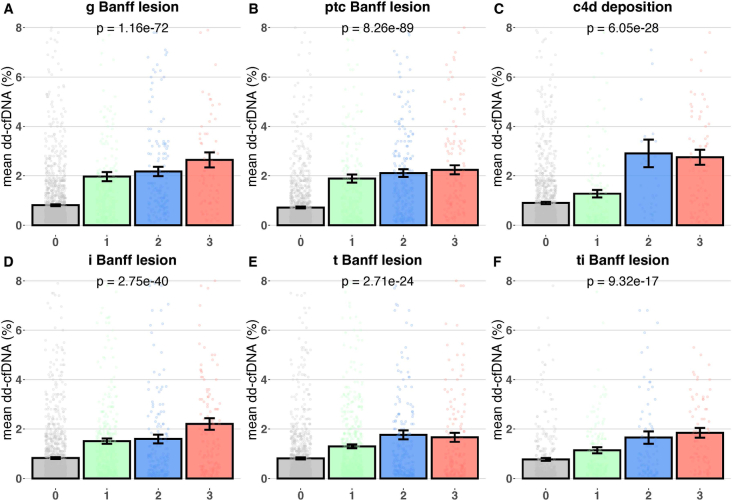
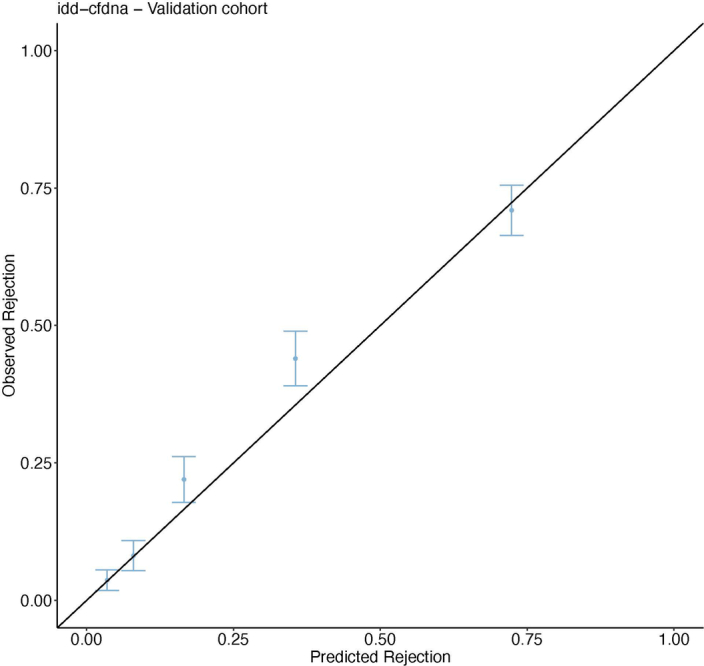
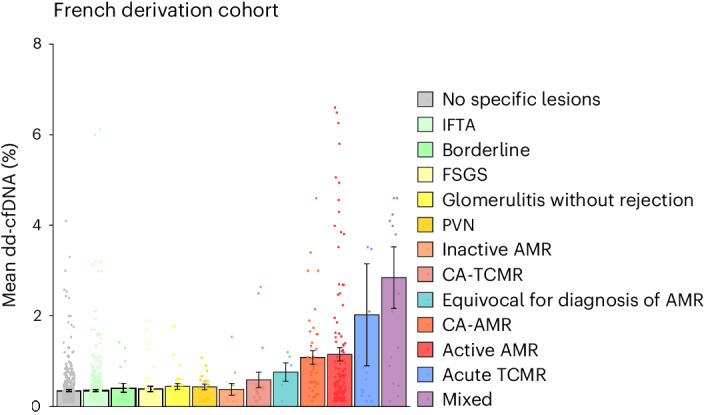
Donor-derived cell-free DNA (dd-cfDNA) is an emerging noninvasive biomarker that has the potential to detect allograft injury. The capacity of dd-cfDNA to detect kidney allograft rejection and its added clinical value beyond standard of care patient monitoring is unclear. We enrolled 2,882 kidney allograft recipients from 14 transplantation centers in Europe and the United States in an observational population-based study. The primary analysis included 1,134 patients. Donor-derived cell-free DNA levels strongly correlated with allograft rejection, including antibody-mediated rejection (P < 0.0001), T cell-mediated rejection (P < 0.0001) and mixed rejection (P < 0.0001). In multivariable analysis, circulating dd-cfDNA was significantly associated with allograft rejection (odds ratio 2.275; 95% confidence interval (CI) 1.902-2.739; P < 0.0001) independently of standard of care patient monitoring parameters. The inclusion of dd-cfDNA to a standard of care prediction model showed improved discrimination (area under the curve 0.777 (95% CI 0.741-0.811) to 0.821 (95% CI 0.784-0.852); P = 0.0011) and calibration. These results were confirmed in the external validation cohorts (n = 1,748) including a cohort of African American patients (n = 439). Finally, dd-cfDNA showed high predictive value to detect subclinical rejection in stable patients. Our study provides insights on the potential value of assessing dd-cfDNA, in addition to standard of care monitoring, to improve the detection of allograft rejection. ClinicalTrials.gov registration: NCT05995379 .

摘要

供体来源的无细胞游离 DNA(dd-cfDNA)是一种新兴的非侵入性生物标志物,有可能检测同种异体移植物损伤。dd-cfDNA 检测肾移植排斥反应的能力及其在标准护理患者监测之外的附加临床价值尚不清楚。我们在欧洲和美国的 14 个移植中心招募了 2882 名肾移植受者进行观察性基于人群的研究。主要分析包括 1134 名患者。供体来源的无细胞游离 DNA 水平与移植物排斥反应强烈相关,包括抗体介导的排斥反应(P<0.0001)、T 细胞介导的排斥反应(P<0.0001)和混合排斥反应(P<0.0001)。在多变量分析中,循环 dd-cfDNA 与移植物排斥反应显著相关(比值比 2.275;95%置信区间(CI)1.902-2.739;P<0.0001),独立于标准护理患者监测参数。将 dd-cfDNA 纳入标准护理预测模型显示出更好的区分度(曲线下面积 0.777(95%CI 0.741-0.811)至 0.821(95%CI 0.784-0.852);P=0.0011)和校准。这些结果在外部验证队列(n=1748)中得到了证实,包括一个非裔美国患者队列(n=439)。最后,dd-cfDNA 在稳定患者中检测亚临床排斥反应具有很高的预测价值。我们的研究提供了关于评估 dd-cfDNA 的潜在价值的见解,除了标准护理监测外,还可以提高同种异体移植物排斥反应的检测。临床试验注册:NCT05995379。
https://cdn.ncbi.nlm.nih.gov/pmc/blobs/8861/11333280/dd0e0cddef30/41591_2024_3087_Fig9_ESM.jpg
https://cdn.ncbi.nlm.nih.gov/pmc/blobs/8861/11333280/196c1f8fb2b9/41591_2024_3087_Fig1_HTML.jpg
https://cdn.ncbi.nlm.nih.gov/pmc/blobs/8861/11333280/c78c0998bc96/41591_2024_3087_Fig2_HTML.jpg
https://cdn.ncbi.nlm.nih.gov/pmc/blobs/8861/11333280/f56cb010b1ea/41591_2024_3087_Fig3_HTML.jpg
https://cdn.ncbi.nlm.nih.gov/pmc/blobs/8861/11333280/72c4d5371b0c/41591_2024_3087_Fig4_ESM.jpg
https://cdn.ncbi.nlm.nih.gov/pmc/blobs/8861/11333280/b823daa1568c/41591_2024_3087_Fig5_ESM.jpg
https://cdn.ncbi.nlm.nih.gov/pmc/blobs/8861/11333280/7b0672320f1c/41591_2024_3087_Fig6_ESM.jpg
https://cdn.ncbi.nlm.nih.gov/pmc/blobs/8861/11333280/298dca116faf/41591_2024_3087_Fig7_ESM.jpg
https://cdn.ncbi.nlm.nih.gov/pmc/blobs/8861/11333280/bd5a9263686a/41591_2024_3087_Fig8_ESM.jpg
https://cdn.ncbi.nlm.nih.gov/pmc/blobs/8861/11333280/dd0e0cddef30/41591_2024_3087_Fig9_ESM.jpg
https://cdn.ncbi.nlm.nih.gov/pmc/blobs/8861/11333280/196c1f8fb2b9/41591_2024_3087_Fig1_HTML.jpg
https://cdn.ncbi.nlm.nih.gov/pmc/blobs/8861/11333280/c78c0998bc96/41591_2024_3087_Fig2_HTML.jpg
https://cdn.ncbi.nlm.nih.gov/pmc/blobs/8861/11333280/f56cb010b1ea/41591_2024_3087_Fig3_HTML.jpg
https://cdn.ncbi.nlm.nih.gov/pmc/blobs/8861/11333280/72c4d5371b0c/41591_2024_3087_Fig4_ESM.jpg
https://cdn.ncbi.nlm.nih.gov/pmc/blobs/8861/11333280/b823daa1568c/41591_2024_3087_Fig5_ESM.jpg
https://cdn.ncbi.nlm.nih.gov/pmc/blobs/8861/11333280/7b0672320f1c/41591_2024_3087_Fig6_ESM.jpg
https://cdn.ncbi.nlm.nih.gov/pmc/blobs/8861/11333280/298dca116faf/41591_2024_3087_Fig7_ESM.jpg
https://cdn.ncbi.nlm.nih.gov/pmc/blobs/8861/11333280/bd5a9263686a/41591_2024_3087_Fig8_ESM.jpg
https://cdn.ncbi.nlm.nih.gov/pmc/blobs/8861/11333280/dd0e0cddef30/41591_2024_3087_Fig9_ESM.jpg

相似文献

1
Cell-free DNA for the detection of kidney allograft rejection.无细胞游离 DNA 检测肾移植排斥反应。
Nat Med. 2024 Aug;30(8):2320-2327. doi: 10.1038/s41591-024-03087-3. Epub 2024 Jun 2.
2
Combining Blood Gene Expression and Cellfree DNA to Diagnose Subclinical Rejection in Kidney Transplant Recipients.联合血液基因表达和循环游离 DNA 检测诊断肾移植受者亚临床排斥反应。
Clin J Am Soc Nephrol. 2021 Oct;16(10):1539-1551. doi: 10.2215/CJN.05530421.
3
Evaluation of a Decentralized Donor-Derived Cell-Free DNA Assay for Kidney Allograft Rejection Monitoring.用于肾移植排斥反应监测的分散式供体来源游离DNA检测方法的评估
Transpl Int. 2024 Dec 17;37:13919. doi: 10.3389/ti.2024.13919. eCollection 2024.
4
Donor-derived cell-free DNA (dd-cfDNA) for detection of allograft rejection in pediatric kidney transplants.供体来源的无细胞 DNA(dd-cfDNA)在儿科肾移植中的同种异体排斥检测。
Pediatr Transplant. 2021 Mar;25(2):e13850. doi: 10.1111/petr.13850. Epub 2020 Nov 20.
5
Early clinical experience using donor-derived cell-free DNA to detect rejection in kidney transplant recipients.使用供者来源无细胞游离 DNA 检测肾移植受者排斥的早期临床经验。
Am J Transplant. 2019 Jun;19(6):1663-1670. doi: 10.1111/ajt.15289. Epub 2019 Mar 29.
6
Donor-derived cell-free DNA predicted allograft rejection and severe microvascular inflammation in kidney transplant recipients.供者来源的无细胞 DNA 可预测肾移植受者的移植物排斥和严重的微血管炎症。
Front Immunol. 2024 Jul 9;15:1433918. doi: 10.3389/fimmu.2024.1433918. eCollection 2024.
7
Noninvasive detection of graft injury after heart transplant using donor-derived cell-free DNA: A prospective multicenter study.使用供体来源的无细胞游离 DNA 无创检测心脏移植后移植物损伤:一项前瞻性多中心研究。
Am J Transplant. 2019 Oct;19(10):2889-2899. doi: 10.1111/ajt.15339. Epub 2019 Apr 8.
8
Diagnostic Performance of Donor-Derived Plasma Cell-Free DNA Fraction for Antibody-Mediated Rejection in Post Renal Transplant Recipients: A Prospective Observational Study.供体源性浆细胞游离 DNA 片段在肾移植受者抗体介导排斥反应中的诊断性能:一项前瞻性观察研究。
Front Immunol. 2020 Feb 28;11:342. doi: 10.3389/fimmu.2020.00342. eCollection 2020.
9
Absolute quantification of donor-derived cell-free DNA as a marker of rejection and graft injury in kidney transplantation: Results from a prospective observational study.作为肾移植排斥反应和移植物损伤标志物的供体游离 DNA 绝对定量:前瞻性观察研究结果。
Am J Transplant. 2019 Nov;19(11):3087-3099. doi: 10.1111/ajt.15416. Epub 2019 May 28.
10
Donor-derived cell-free DNA as a new biomarker for cardiac allograft rejection: A prospective study (FreeDNA-CAR).供体来源的游离DNA作为心脏移植排斥反应的新型生物标志物:一项前瞻性研究(FreeDNA-CAR)
J Heart Lung Transplant. 2025 Apr;44(4):560-569. doi: 10.1016/j.healun.2024.11.009. Epub 2024 Nov 20.

引用本文的文献

1
Beyond the Blood Cell: The Emerging Role of Cell-Free DNA in Transfusion Medicine.超越血细胞:游离DNA在输血医学中的新兴作用
J Hematol. 2025 Jul 8;14(4):165-173. doi: 10.14740/jh2064. eCollection 2025 Aug.
2
Novel Biomarkers for Rejection in Kidney Transplantation: A Comprehensive Review.肾移植排斥反应的新型生物标志物:综述
J Clin Med. 2025 Aug 4;14(15):5489. doi: 10.3390/jcm14155489.
3
Association of Blood Donor-derived Cell-free DNA Levels With Banff Scores and Histopathological Lesions in Kidney Allograft Biopsies: Results From an Observational Study.

本文引用的文献

1
Prognostic Biomarkers in Kidney Transplantation: A Systematic Review and Critical Appraisal.肾移植中的预后生物标志物:系统评价和批判性评估。
J Am Soc Nephrol. 2024 Feb 1;35(2):177-188. doi: 10.1681/ASN.0000000000000260. Epub 2023 Dec 6.
2
Challenges in the management of the kidney allograft: from decline to failure: conclusions from a Kidney Disease: Improving Global Outcomes (KDIGO) Controversies Conference.移植肾管理面临的挑战:从下降到衰竭:KDIGO 争议会议的结论。
Kidney Int. 2023 Dec;104(6):1076-1091. doi: 10.1016/j.kint.2023.05.010. Epub 2023 May 24.
3
An Assessment of the Value of Donor-derived Cell-free DNA Surveillance in Patients With Preserved Kidney Allograft Function.
肾移植活检中献血者来源的游离DNA水平与班夫评分和组织病理学病变的关联:一项观察性研究的结果
Transplant Direct. 2025 Apr 10;11(5):e1794. doi: 10.1097/TXD.0000000000001794. eCollection 2025 May.
4
Reshaping transplantation with AI, emerging technologies and xenotransplantation.利用人工智能、新兴技术和异种移植重塑移植领域。
Nat Med. 2025 Jul 14. doi: 10.1038/s41591-025-03801-9.
5
Donor-derived cell-free DNA and miRNA monitoring for the early prediction and diagnosis of liver allograft rejection and patient outcomes.供体来源的游离DNA和微小RNA监测用于肝移植排斥反应及患者预后的早期预测和诊断。
Front Immunol. 2025 Jun 24;16:1604200. doi: 10.3389/fimmu.2025.1604200. eCollection 2025.
6
Clinical and Histopathological Determinants for Kidney Allograft Survival in the Eurotransplant Senior Program (ESP) at the Time of Allocation.欧洲移植高级计划(ESP)分配时肾移植受者存活的临床和组织病理学决定因素
Transpl Int. 2025 Jun 2;38:14153. doi: 10.3389/ti.2025.14153. eCollection 2025.
7
Case Report: Metastatic small bowel adenocarcinoma with DNA mismatch repair deficiency in an organ transplant recipient treated with anti-PD-1 immunotherapy.病例报告:接受抗PD-1免疫治疗的器官移植受者发生DNA错配修复缺陷的转移性小肠腺癌
Front Oncol. 2025 Jun 12;15:1579364. doi: 10.3389/fonc.2025.1579364. eCollection 2025.
8
Antibody-mediated rejection-treatment standard.抗体介导的排斥反应治疗标准。
Nephrol Dial Transplant. 2025 Aug 1;40(8):1615-1627. doi: 10.1093/ndt/gfaf097.
9
The Art (and Science) of Individualized Selection of Non-Invasive Prenatal Screening (NIPS).非侵入性产前筛查(NIPS)个体化选择的艺术(与科学)
Int J Womens Health. 2025 May 7;17:1271-1283. doi: 10.2147/IJWH.S437214. eCollection 2025.
10
The predictive power of profiling the DNA methylome in human health and disease.人类健康与疾病中DNA甲基化组分析的预测能力。
Epigenomics. 2025 Jun;17(9):599-610. doi: 10.1080/17501911.2025.2500907. Epub 2025 May 10.
对移植肾功能正常的肾移植受者中供体来源游离DNA监测价值的评估
Transplantation. 2023 Jan 1;107(1):274-282. doi: 10.1097/TP.0000000000004267. Epub 2022 Aug 1.
4
Combining Donor-derived Cell-free DNA Fraction and Quantity to Detect Kidney Transplant Rejection Using Molecular Diagnoses and Histology as Confirmation.采用分子诊断和组织学作为确证手段,结合供体游离 DNA 片段和数量检测来诊断肾移植排斥反应。
Transplantation. 2022 Dec 1;106(12):2435-2442. doi: 10.1097/TP.0000000000004212. Epub 2022 Nov 22.
5
Clinical outcomes from the Assessing Donor-derived cell-free DNA Monitoring Insights of kidney Allografts with Longitudinal surveillance (ADMIRAL) study.肾移植纵向监测评估供体来源游离DNA监测见解(ADMIRAL)研究的临床结果。
Kidney Int. 2022 Apr;101(4):793-803. doi: 10.1016/j.kint.2021.11.034. Epub 2021 Dec 22.
6
Beyond the Biopsy: Monitoring Immune Status in Kidney Recipients.超越活检:监测肾移植受者的免疫状态。
Clin J Am Soc Nephrol. 2021 Sep;16(9):1413-1422. doi: 10.2215/CJN.14840920. Epub 2021 Aug 6.
7
Incidence, risk factors, treatment, and consequences of antibody-mediated kidney transplant rejection: A systematic review.抗体介导的肾移植排斥反应的发生率、危险因素、治疗和后果:系统评价。
Clin Transplant. 2021 Jul;35(7):e14320. doi: 10.1111/ctr.14320. Epub 2021 May 5.
8
Cell-Free DNA to Detect Heart Allograft Acute Rejection.无细胞游离 DNA 检测心脏移植物急性排斥反应
Circulation. 2021 Mar 23;143(12):1184-1197. doi: 10.1161/CIRCULATIONAHA.120.049098. Epub 2021 Jan 13.
9
The Banff 2019 Kidney Meeting Report (I): Updates on and clarification of criteria for T cell- and antibody-mediated rejection.《2019 年班夫肾脏会议报告(一):T 细胞和抗体介导排斥反应标准的更新和澄清》。
Am J Transplant. 2020 Sep;20(9):2318-2331. doi: 10.1111/ajt.15898. Epub 2020 May 28.
10
Optimizing Detection of Kidney Transplant Injury by Assessment of Donor-Derived Cell-Free DNA via Massively Multiplex PCR.通过大规模多重聚合酶链反应评估供体来源的游离DNA优化肾移植损伤检测
J Clin Med. 2018 Dec 23;8(1):19. doi: 10.3390/jcm8010019.