Department of Neurology, Washington University School of Medicine in St. Louis, St Louis, Missouri, USA.
Institute of Public Health, Faculty of Biomedical Sciences, Università della Svizzera italiana, Lugano, Switzerland.
Alzheimers Dement. 2024 Jul;20(7):4828-4840. doi: 10.1002/alz.14041. Epub 2024 Jun 5.
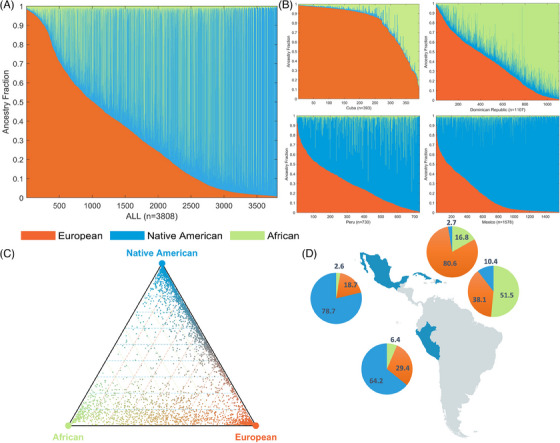
Leveraging the nonmonolithic structure of Latin America, which represents a large variability in social determinants of health (SDoH) and high levels of genetic admixture, we aim to evaluate the relative contributions of SDoH and genetic ancestry in predicting dementia prevalence in Latin American populations.
Community-dwelling participants aged 65 and older (N = 3808) from Cuba, Dominican Republic, Mexico, and Peru completed the 10/66 protocol assessments. Dementia was diagnosed using the cross-culturally validated 10/66 algorithm. Multivariate linear regression models adjusted for SDoH were used in the main analysis. This study used cross-sectional data from the 1066 population-based study.
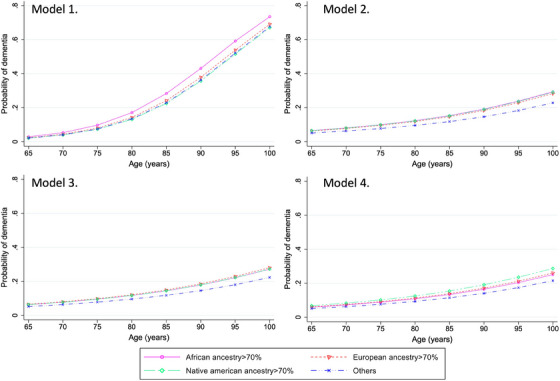
Individuals with higher proportions of Native American (>70%) and African American (>70%) ancestry were more likely to exhibit factors contributing to worse SDoH, such as lower educational levels (p < 0.001), lower socioeconomic status (p < 0.001), and higher frequency of vascular risk factors (p < 0.001). After adjusting for measures of SDoH, there was no association between ancestry proportion and dementia probability, and ancestry proportions no longer significantly accounted for the variance in cognitive performance (African predominant p = 0.31 [-0.19, 0.59] and Native predominant p = 0.74 [-0.24, 0.33]).
The findings suggest that social and environmental factors play a more crucial role than genetic ancestry in predicting dementia prevalence in Latin American populations. This underscores the need for public health strategies and policies that address these social determinants to effectively reduce dementia risk in these communities.
Countries in Latin America express a large variability in social determinants of health and levels of admixture. After adjustment for downstream societal factors linked to SDoH, genetic ancestry shows no link to dementia. Population ancestry profiles alone do not influence cognitive performance. SDoH are key drivers of racial disparities in dementia and cognitive performance.
利用拉丁美洲非整体结构的优势,该结构代表了健康社会决定因素(SDoH)的高度变异性和高水平的遗传混合,我们旨在评估 SDoH 和遗传祖先在预测拉丁美洲人群痴呆症患病率方面的相对贡献。
来自古巴、多米尼加共和国、墨西哥和秘鲁的年龄在 65 岁及以上的社区居民(N=3808 人)完成了 10/66 方案评估。痴呆症使用经过跨文化验证的 10/66 算法进行诊断。主要分析中使用了调整 SDoH 的多变量线性回归模型。这项研究使用了基于 1066 人的横断面数据。
具有较高比例的美洲原住民(>70%)和非裔美国人(>70%)祖先的个体更有可能表现出导致 SDoH 恶化的因素,例如较低的教育水平(p<0.001)、较低的社会经济地位(p<0.001)和更高的血管危险因素频率(p<0.001)。在调整 SDoH 措施后,祖先比例与痴呆症概率之间没有关联,并且祖先比例不再显著解释认知表现的差异(非洲裔为主 p=0.31[-0.19, 0.59]和美洲原住民为主 p=0.74[-0.24, 0.33])。
研究结果表明,社会和环境因素在预测拉丁美洲人群的痴呆症患病率方面比遗传祖先发挥更关键的作用。这突显出需要采取公共卫生策略和政策来解决这些社会决定因素,以有效降低这些社区的痴呆症风险。
拉丁美洲各国在健康社会决定因素和混合水平方面表现出很大的变异性。在调整与 SDoH 相关的下游社会因素后,遗传祖先与痴呆症没有关联。人口祖先谱本身并不影响认知表现。SDoH 是痴呆症和认知表现种族差异的关键驱动因素。