• 文献检索
  • 文档翻译
  • 深度研究
  • 学术资讯
  • Suppr Zotero 插件Zotero 插件
  • 邀请有礼
  • 套餐&价格
  • 历史记录
应用&插件
Suppr Zotero 插件Zotero 插件浏览器插件Mac 客户端Windows 客户端微信小程序
定价
高级版会员购买积分包购买API积分包
服务
文献检索文档翻译深度研究API 文档MCP 服务
关于我们
关于 Suppr公司介绍联系我们用户协议隐私条款
关注我们

Suppr 超能文献

核心技术专利:CN118964589B侵权必究
粤ICP备2023148730 号-1Suppr @ 2026

文献检索

告别复杂PubMed语法,用中文像聊天一样搜索,搜遍4000万医学文献。AI智能推荐,让科研检索更轻松。

立即免费搜索

文件翻译

保留排版,准确专业,支持PDF/Word/PPT等文件格式,支持 12+语言互译。

免费翻译文档

深度研究

AI帮你快速写综述,25分钟生成高质量综述,智能提取关键信息,辅助科研写作。

立即免费体验

自动驾驶的多模式解释对驾驶性能、认知负荷、专业知识、信心和信任的影响。

Effects of multimodal explanations for autonomous driving on driving performance, cognitive load, expertise, confidence, and trust.

机构信息

University of California - San Diego, La Jolla, CA, 92093, USA.

Toyota Research Institute, Los Altos, 94022, USA.

出版信息

Sci Rep. 2024 Jun 6;14(1):13061. doi: 10.1038/s41598-024-62052-9.

DOI:10.1038/s41598-024-62052-9
PMID:38844766
原文链接:https://pmc.ncbi.nlm.nih.gov/articles/PMC11156640/
Abstract

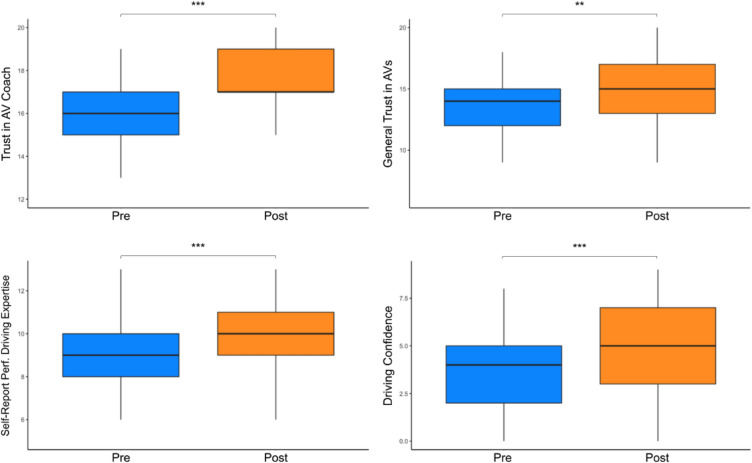
Advances in autonomous driving provide an opportunity for AI-assisted driving instruction that directly addresses the critical need for human driving improvement. How should an AI instructor convey information to promote learning? In a pre-post experiment (n = 41), we tested the impact of an AI Coach's explanatory communications modeled after performance driving expert instructions. Participants were divided into four (4) groups to assess two (2) dimensions of the AI coach's explanations: information type ('what' and 'why'-type explanations) and presentation modality (auditory and visual). We compare how different explanatory techniques impact driving performance, cognitive load, confidence, expertise, and trust via observational learning. Through interview, we delineate participant learning processes. Results show AI coaching can effectively teach performance driving skills to novices. We find the type and modality of information influences performance outcomes. Differences in how successfully participants learned are attributed to how information directs attention, mitigates uncertainty, and influences overload experienced by participants. Results suggest efficient, modality-appropriate explanations should be opted for when designing effective HMI communications that can instruct without overwhelming. Further, results support the need to align communications with human learning and cognitive processes. We provide eight design implications for future autonomous vehicle HMI and AI coach design.

摘要

自动驾驶技术的进步为 AI 辅助驾驶指导提供了机会,这直接解决了人类驾驶改进的关键需求。AI 教练应该如何传达信息以促进学习?在一项前后测实验(n = 41)中,我们测试了模仿驾驶专家指导的 AI 教练解释性沟通对学习的影响。参与者被分为四组,评估 AI 教练解释的两个维度:信息类型(“是什么”和“为什么”类型的解释)和呈现方式(听觉和视觉)。我们通过观察学习来比较不同的解释技术如何影响驾驶表现、认知负荷、信心、专业知识和信任。通过访谈,我们描述了参与者的学习过程。结果表明,AI 教练可以有效地向新手传授驾驶技能。我们发现信息的类型和呈现方式会影响表现结果。参与者学习效果的差异归因于信息如何引导注意力、减轻不确定性以及影响参与者的过载。结果表明,在设计能够进行指导而不造成负担的有效 HMI 通信时,应选择高效、适合模式的解释。此外,结果支持根据人类学习和认知过程来调整沟通的必要性。我们为未来的自动驾驶汽车 HMI 和 AI 教练设计提供了八项设计启示。

https://cdn.ncbi.nlm.nih.gov/pmc/blobs/c4d5/11156640/93f4de139540/41598_2024_62052_Fig5_HTML.jpg
https://cdn.ncbi.nlm.nih.gov/pmc/blobs/c4d5/11156640/0cb3c761e458/41598_2024_62052_Fig1_HTML.jpg
https://cdn.ncbi.nlm.nih.gov/pmc/blobs/c4d5/11156640/70c4debf9215/41598_2024_62052_Fig2_HTML.jpg
https://cdn.ncbi.nlm.nih.gov/pmc/blobs/c4d5/11156640/a2ea8c133259/41598_2024_62052_Fig3_HTML.jpg
https://cdn.ncbi.nlm.nih.gov/pmc/blobs/c4d5/11156640/beedea165d09/41598_2024_62052_Fig4_HTML.jpg
https://cdn.ncbi.nlm.nih.gov/pmc/blobs/c4d5/11156640/93f4de139540/41598_2024_62052_Fig5_HTML.jpg
https://cdn.ncbi.nlm.nih.gov/pmc/blobs/c4d5/11156640/0cb3c761e458/41598_2024_62052_Fig1_HTML.jpg
https://cdn.ncbi.nlm.nih.gov/pmc/blobs/c4d5/11156640/70c4debf9215/41598_2024_62052_Fig2_HTML.jpg
https://cdn.ncbi.nlm.nih.gov/pmc/blobs/c4d5/11156640/a2ea8c133259/41598_2024_62052_Fig3_HTML.jpg
https://cdn.ncbi.nlm.nih.gov/pmc/blobs/c4d5/11156640/beedea165d09/41598_2024_62052_Fig4_HTML.jpg
https://cdn.ncbi.nlm.nih.gov/pmc/blobs/c4d5/11156640/93f4de139540/41598_2024_62052_Fig5_HTML.jpg

相似文献

1
Effects of multimodal explanations for autonomous driving on driving performance, cognitive load, expertise, confidence, and trust.自动驾驶的多模式解释对驾驶性能、认知负荷、专业知识、信心和信任的影响。
Sci Rep. 2024 Jun 6;14(1):13061. doi: 10.1038/s41598-024-62052-9.
2
More Is Not Always Better: Impacts of AI-Generated Confidence and Explanations in Human-Automation Interaction.并非越多越好:人工智能生成的信心和解释对人机交互的影响。
Hum Factors. 2024 Dec;66(12):2606-2620. doi: 10.1177/00187208241234810. Epub 2024 Mar 4.
3
Effect of Artificial Intelligence Tutoring vs Expert Instruction on Learning Simulated Surgical Skills Among Medical Students: A Randomized Clinical Trial.人工智能辅导与专家指导对医学生模拟手术技能学习效果的影响:一项随机临床试验。
JAMA Netw Open. 2022 Feb 1;5(2):e2149008. doi: 10.1001/jamanetworkopen.2021.49008.
4
Introduction matters: Manipulating trust in automation and reliance in automated driving.引言很重要:操纵对自动化的信任和对自动驾驶的依赖。
Appl Ergon. 2018 Jan;66:18-31. doi: 10.1016/j.apergo.2017.07.006. Epub 2017 Aug 12.
5
Investigating what level of visual information inspires trust in a user of a highly automated vehicle.研究高度自动化车辆用户对何种程度的视觉信息产生信任。
Appl Ergon. 2021 Jan;90:103272. doi: 10.1016/j.apergo.2020.103272. Epub 2020 Oct 3.
6
Designing for Confidence: The Impact of Visualizing Artificial Intelligence Decisions.为信心而设计:可视化人工智能决策的影响
Front Neurosci. 2022 Jun 24;16:883385. doi: 10.3389/fnins.2022.883385. eCollection 2022.
7
Effect of AI Explanations on Human Perceptions of Patient-Facing AI-Powered Healthcare Systems.人工智能解释对患者对人工智能赋能的医疗保健系统的感知的影响。
J Med Syst. 2021 May 4;45(6):64. doi: 10.1007/s10916-021-01743-6.
8
The Impact of Explanations on Layperson Trust in Artificial Intelligence-Driven Symptom Checker Apps: Experimental Study.解释对非专业人士信任人工智能驱动的症状检查应用程序的影响:实验研究。
J Med Internet Res. 2021 Nov 3;23(11):e29386. doi: 10.2196/29386.
9
Autonomous Driving Control Based on the Technique of Semantic Segmentation.基于语义分割技术的自动驾驶控制。
Sensors (Basel). 2023 Jan 12;23(2):895. doi: 10.3390/s23020895.
10
Examining the effect of explanation on satisfaction and trust in AI diagnostic systems.考察解释对人工智能诊断系统的满意度和信任度的影响。
BMC Med Inform Decis Mak. 2021 Jun 3;21(1):178. doi: 10.1186/s12911-021-01542-6.

引用本文的文献

1
Early detection of cognitive decline with deep learning and graph-based modeling.利用深度学习和基于图的建模早期检测认知能力下降。
MethodsX. 2025 Jun 2;14:103405. doi: 10.1016/j.mex.2025.103405. eCollection 2025 Jun.
2
Challenging Cognitive Load Theory: The Role of Educational Neuroscience and Artificial Intelligence in Redefining Learning Efficacy.挑战认知负荷理论:教育神经科学和人工智能在重新定义学习效能中的作用。
Brain Sci. 2025 Feb 15;15(2):203. doi: 10.3390/brainsci15020203.

本文引用的文献

1
Identifying objective behavioural measures of expert driver situation awareness.识别专家驾驶员情境意识的客观行为测量方法。
Accid Anal Prev. 2021 Dec;163:106465. doi: 10.1016/j.aap.2021.106465. Epub 2021 Nov 7.
2
Causability and explainability of artificial intelligence in medicine.人工智能在医学中的可归因性与可解释性。
Wiley Interdiscip Rev Data Min Knowl Discov. 2019 Jul-Aug;9(4):e1312. doi: 10.1002/widm.1312. Epub 2019 Apr 2.
3
Artificial intelligence for precision education in radiology.人工智能在放射学精准教育中的应用。
Br J Radiol. 2019 Nov;92(1103):20190389. doi: 10.1259/bjr.20190389. Epub 2019 Jul 26.
4
Artificial intelligence to support human instruction.人工智能辅助人工指导。
Proc Natl Acad Sci U S A. 2019 Mar 5;116(10):3953-3955. doi: 10.1073/pnas.1900370116. Epub 2019 Feb 19.
5
Artificial intelligence in radiology.人工智能在放射学中的应用。
Nat Rev Cancer. 2018 Aug;18(8):500-510. doi: 10.1038/s41568-018-0016-5.
6
Differences between racing and non-racing drivers: A simulator study using eye-tracking.赛车手与非赛车手之间的差异:一项使用眼动追踪技术的模拟器研究。
PLoS One. 2017 Nov 9;12(11):e0186871. doi: 10.1371/journal.pone.0186871. eCollection 2017.
7
The anova to mixed model transition.方差分析到混合模型的转换。
Neurosci Biobehav Rev. 2016 Sep;68:1004-1005. doi: 10.1016/j.neubiorev.2016.05.034. Epub 2016 May 27.
8
The relative roles of visuospatial and linguistic working memory systems in generating inferences during visual narrative comprehension.视觉空间和语言工作记忆系统在视觉叙事理解过程中进行推理时的相对作用。
Mem Cognit. 2016 Feb;44(2):207-19. doi: 10.3758/s13421-015-0558-7.
9
Learning Styles: Concepts and Evidence.学习风格:概念与证据。
Psychol Sci Public Interest. 2008 Dec;9(3):105-19. doi: 10.1111/j.1539-6053.2009.01038.x. Epub 2008 Dec 1.
10
Immediate perceptual response to intersensory discrepancy.对跨感觉差异的即时感知反应。
Psychol Bull. 1980 Nov;88(3):638-67.