Institute for Clinical and Experimental Medicine, Department of Diagnostic and Interventional Radiology, Videnska 1958/9, 140 21 PRAGUE 4, Prague, Czech Republic.
Laboratory of Immunology, Thomayer University Hospital, Prague, Czech Republic.
MAGMA. 2024 Oct;37(5):937-946. doi: 10.1007/s10334-024-01171-w. Epub 2024 Jun 12.
Many patients with long COVID experience neurological and psychological symptoms. Signal abnormalities on MR images in the corpus callosum have been reported. Knowledge about the metabolic profile in the splenium of the corpus callosum (CCS) may contribute to a better understanding of the pathophysiology of long COVID.
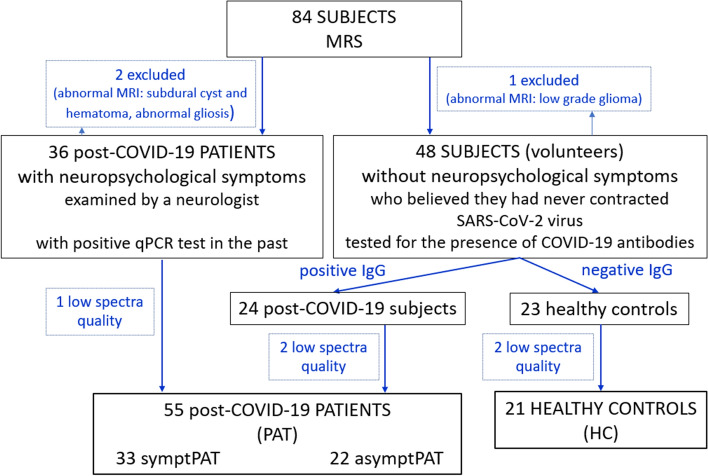
Eighty-one subjects underwent proton MR spectroscopy examination. The metabolic concentrations of total N-acetylaspartate (NAA), choline-containing compounds (Cho), total creatine (Cr), myo-inositol (mI), and NAA/Cho in the CCS were statistically compared in the group of patients containing 58 subjects with positive IgG COVID-19 antibodies or positive SARS-CoV-2 qPCR test at least two months before the MR and the group of healthy controls containing 23 subjects with negative IgG antibodies.
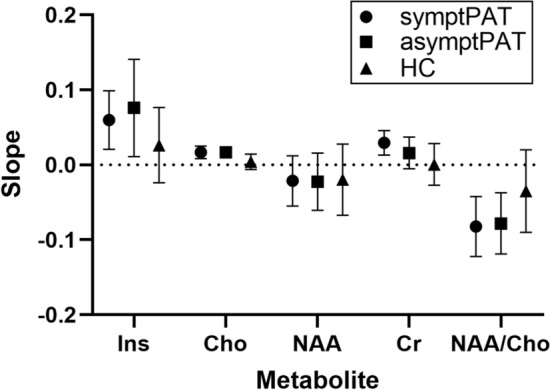
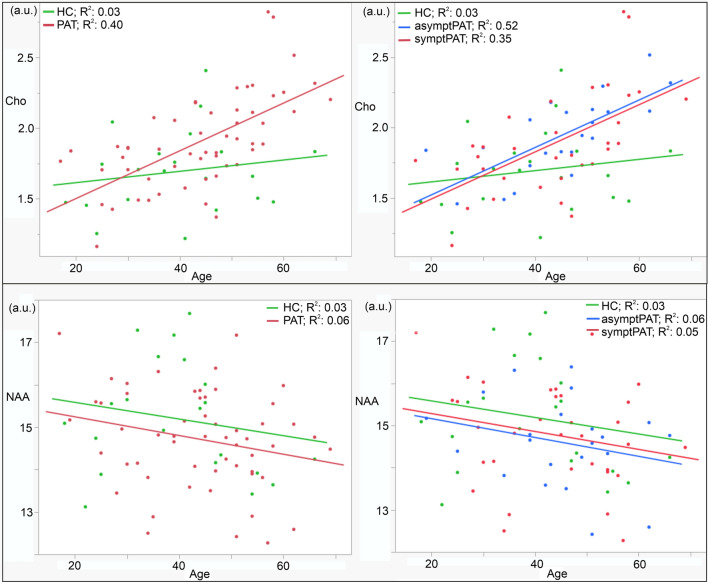
An age-dependent effect of SARS-CoV-2 on Cho concentrations in the CCS has been observed. Considering the subjective threshold of age = 40 years, older patients showed significantly increased Cho concentrations in the CCS than older healthy controls (p = 0.02). NAA, Cr, and mI were unchanged. All metabolite concentrations in the CCS of younger post-COVID-19 patients remained unaffected by SARS-CoV-2. Cho did not show any difference between symptomatic and asymptomatic patients (p = 0.91).
Our results suggest that SARS-CoV-2 disproportionately increases Cho concentration in the CCS among older post-COVID-19 patients compared to younger ones. The observed changes in Cho may be related to the microstructural reorganization in the CCS also reported in diffusion measurements rather than increased membrane turnover. These changes do not seem to be related to neuropsychological problems of the post-COVID-19 patients. Further metabolic studies are recommended to confirm these observations.
许多长新冠患者出现神经和心理症状。已有研究报告称,胼胝体的磁共振成像(MRI)信号异常。了解胼胝体压部(CCS)的代谢特征可能有助于更好地理解长新冠的病理生理学。
81 名受试者接受了质子磁共振波谱检查。对至少在 MRI 前两个月 IgG 新冠病毒抗体阳性或 SARS-CoV-2 qPCR 检测阳性的 58 例患者组和 IgG 抗体阴性的 23 例健康对照组的 CCS 中总 N-乙酰天冬氨酸(NAA)、含胆碱化合物(Cho)、总肌酸(Cr)、肌醇(mI)和 NAA/Cho 的代谢浓度进行了统计学比较。
观察到 SARS-CoV-2 对 CCS 中 Cho 浓度的年龄依赖性影响。考虑到年龄=40 岁的主观阈值,老年患者 CCS 中的 Cho 浓度明显高于老年健康对照组(p=0.02)。NAA、Cr 和 mI 没有变化。所有年轻新冠后患者的 CCS 代谢物浓度均不受 SARS-CoV-2 影响。Cho 在有症状和无症状患者之间没有差异(p=0.91)。
我们的结果表明,与年轻新冠后患者相比,SARS-CoV-2 在老年新冠后患者的 CCS 中不成比例地增加 Cho 浓度。观察到的 Cho 变化可能与扩散测量中也报告的 CCS 中的微观结构重组有关,而不是与膜周转率增加有关。这些变化似乎与新冠后患者的神经心理问题无关。建议进行进一步的代谢研究以证实这些观察结果。