Daniore Paola, Nittas Vasileios, Haag Christina, Bernard Jürgen, Gonzenbach Roman, von Wyl Viktor
Institute for Implementation Science in Health Care, University of Zurich, Zurich, Switzerland.
Digital Society Initiative, University of Zurich, Zurich, Switzerland.
NPJ Digit Med. 2024 Jun 18;7(1):161. doi: 10.1038/s41746-024-01151-3.
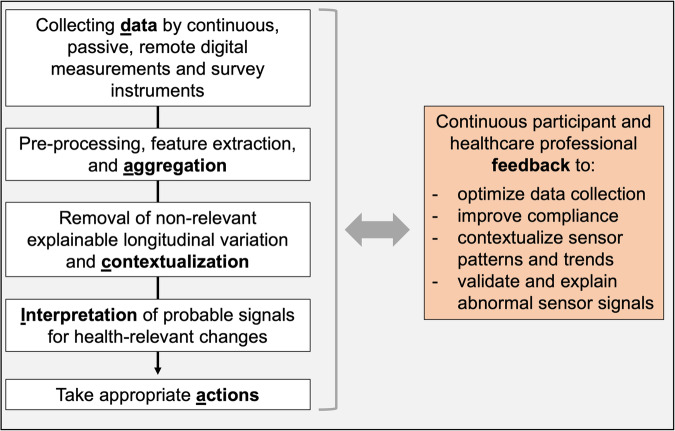
Wearable sensor technologies are becoming increasingly relevant in health research, particularly in the context of chronic disease management. They generate real-time health data that can be translated into digital biomarkers, which can provide insights into our health and well-being. Scientific methods to collect, interpret, analyze, and translate health data from wearables to digital biomarkers vary, and systematic approaches to guide these processes are currently lacking. This paper is based on an observational, longitudinal cohort study, BarKA-MS, which collected wearable sensor data on the physical rehabilitation of people living with multiple sclerosis (MS). Based on our experience with BarKA-MS, we provide and discuss ten lessons we learned in relation to digital biomarker development across key study phases. We then summarize these lessons into a guiding framework (DACIA) that aims to informs the use of wearable sensor data for digital biomarker development and chronic disease management for future research and teaching.
可穿戴传感器技术在健康研究中变得越来越重要,特别是在慢性病管理的背景下。它们生成的实时健康数据可以转化为数字生物标志物,从而为我们的健康和幸福提供见解。从可穿戴设备收集、解释、分析和转化健康数据为数字生物标志物的科学方法各不相同,目前缺乏指导这些过程的系统方法。本文基于一项观察性纵向队列研究BarKA-MS,该研究收集了多发性硬化症(MS)患者身体康复的可穿戴传感器数据。基于我们在BarKA-MS中的经验,我们提供并讨论了在关键研究阶段与数字生物标志物开发相关的十条经验教训。然后,我们将这些经验教训总结成一个指导框架(DACIA),旨在为未来的研究和教学中使用可穿戴传感器数据进行数字生物标志物开发和慢性病管理提供参考。