Duke-NUS Medical School, 8 College Road, Singapore, 169857, Singapore.
Department of Neurology, National Neuroscience Institute, 11 Jalan Tan Tock Seng, Singapore, 308433, Singapore.
Sci Rep. 2024 Jun 26;14(1):14690. doi: 10.1038/s41598-024-65575-3.
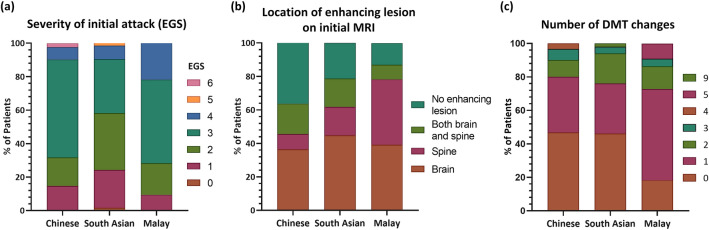
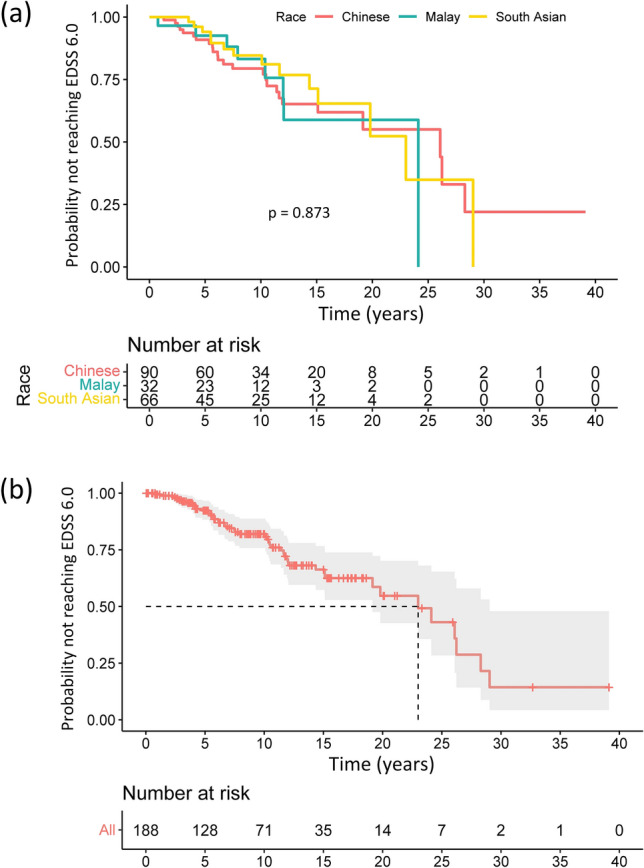
Studies in Western populations have shown that Black and Hispanic patients have an earlier age of Multiple Sclerosis (MS) onset and a more severe disease course characterised by faster disability accrual compared to Whites. It is yet unclear whether MS disease characteristics and clinical course differ amongst Asian racial groups. Singapore is uniquely poised to investigate this as its multi-racial population comprises three genetically diverse Asian racial groups-Chinese, Malay and South Asian. Herein, we sought to elucidate differences in the clinical phenotypes, disease-modifying therapy (DMT) usage, and disease course amongst these three Asian racial groups by performinga retrospective observational study on MS patients seen at the National Neuroscience Institute, Singapore. Data on demographics, disease characteristics, ancillary investigations, and DMT usage were collected. One hundred and eighty-eight patients were included (90 Chinese, 32 Malay, and 66 South Asian). Our findings showed that MS prevalence was the highest in South Asians followed by Malays and Chinese, while demographics, healthcare access, and longer-term disease course were identical across the racial groups. However, several differences and trends were elucidated: (1) South Asian patients had milder sentinel attacks (p = 0.006), (2) a higher proportion of Malay patients had enhancing lesions on their initial MRI (p = 0.057) and the lesion topography differed across the races (p = 0.034), and (3) more Malay patients switched out of their initial DMT (p = 0.051). In conclusion, MS disease characteristics were largely similar across these three Asian racial groups, and while there were some clinical and radiological differences at presentation, these did not influence longer-term outcomes.
西方人群的研究表明,与白人相比,黑人和西班牙裔患者多发性硬化症(MS)的发病年龄更早,疾病进程更严重,残疾累积速度更快。目前尚不清楚亚洲不同种族群体的 MS 疾病特征和临床病程是否存在差异。新加坡具有独特的优势来研究这个问题,因为其多民族人口由三个具有遗传差异的亚洲种族群体组成,包括华人、马来人和南亚人。在此,我们通过对在新加坡国家神经科学研究所就诊的 MS 患者进行回顾性观察性研究,旨在阐明这三个亚洲种族群体之间的临床表型、疾病修饰治疗(DMT)使用和疾病进程的差异。收集了人口统计学、疾病特征、辅助检查和 DMT 使用的数据。共纳入 188 例患者(90 例华人、32 例马来人和 66 例南亚人)。我们的研究结果表明,MS 的患病率以南亚人最高,其次是马来人和华人,而种族群体之间的人口统计学、医疗保健获得情况和长期疾病病程是相同的。然而,我们也揭示了一些差异和趋势:(1)南亚患者的首发症状更轻微(p=0.006);(2)较多的马来患者在初始 MRI 上有强化病变(p=0.057),病变的分布在不同种族间存在差异(p=0.034);(3)较多的马来患者改变了初始 DMT(p=0.051)。总之,这些亚洲三个种族群体的 MS 疾病特征基本相似,尽管在发病时存在一些临床和影像学差异,但这些差异并未影响长期结局。