Sgamato Costantino, Rocco Alba, Compare Debora, Priadko Kateryna, Romano Marco, Nardone Gerardo
Gastroenterology Unit, Department of Clinical Medicine and Surgery, University Federico II of Naples, 80131 Naples, Italy.
Hepatogastroenterology Unit, Department of Precision Medicine, University of Campania "L. Vanvitelli", 80138 Naples, Italy.
Antibiotics (Basel). 2024 May 24;13(6):484. doi: 10.3390/antibiotics13060484.
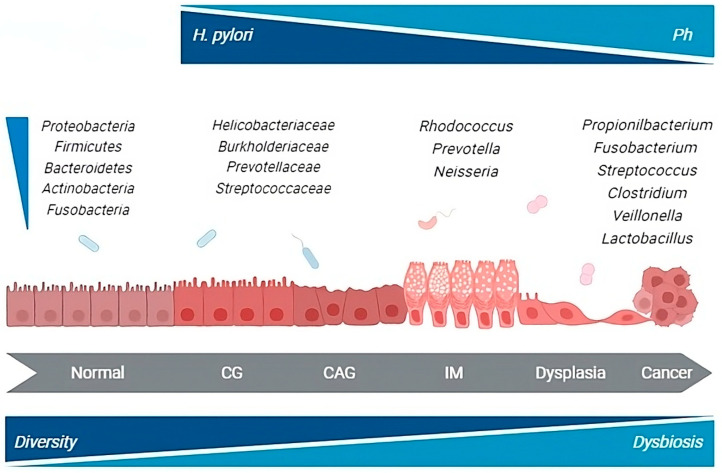
Gastric cancer (GC) still represents one of the leading causes of cancer-related mortality and is a major public health issue worldwide. Understanding the etiopathogenetic mechanisms behind GC development holds immense potential to revolutionize patients' treatment and prognosis. Within the complex web of genetic predispositions and environmental factors, the connection between () and gastric microbiota emerges as a focus of intense research investigation. According to the most recent hypotheses, triggers inflammatory responses and molecular alterations in gastric mucosa, while non- microbiota modulates disease progression. In this review, we analyze the current state of the literature on the relationship between and non- gastric microbiota in gastric carcinogenesis, highlighting the mechanisms by which microecological dysbiosis can contribute to the malignant transformation of the mucosa.
胃癌(GC)仍然是癌症相关死亡的主要原因之一,是全球重大的公共卫生问题。了解GC发生背后的病因发病机制对于彻底改变患者的治疗和预后具有巨大潜力。在复杂的遗传易感性和环境因素网络中,()与胃微生物群之间的联系成为深入研究的焦点。根据最新假说,()引发胃黏膜的炎症反应和分子改变,而非微生物群调节疾病进展。在本综述中,我们分析了关于()与非()胃微生物群在胃癌发生中关系的文献现状,强调了微生态失调导致黏膜恶性转化的机制。