• 文献检索
  • 文档翻译
  • 深度研究
  • 学术资讯
  • Suppr Zotero 插件Zotero 插件
  • 邀请有礼
  • 套餐&价格
  • 历史记录
应用&插件
Suppr Zotero 插件Zotero 插件浏览器插件Mac 客户端Windows 客户端微信小程序
定价
高级版会员购买积分包购买API积分包
服务
文献检索文档翻译深度研究API 文档MCP 服务
关于我们
关于 Suppr公司介绍联系我们用户协议隐私条款
关注我们

Suppr 超能文献

核心技术专利:CN118964589B侵权必究
粤ICP备2023148730 号-1Suppr @ 2026

文献检索

告别复杂PubMed语法,用中文像聊天一样搜索,搜遍4000万医学文献。AI智能推荐,让科研检索更轻松。

立即免费搜索

文件翻译

保留排版,准确专业,支持PDF/Word/PPT等文件格式,支持 12+语言互译。

免费翻译文档

深度研究

AI帮你快速写综述,25分钟生成高质量综述,智能提取关键信息,辅助科研写作。

立即免费体验

自我护理促进项目对2型糖尿病合并糖尿病视网膜病变患者自我护理行为参与度及健康相关结局的影响:一项单盲随机对照试验。

Effect of a self-care promoting program on engagement in self-care behaviors and health-related outcomes among persons with type 2 diabetes and diabetic retinopathy: A single-blind randomized controlled trial.

作者信息

Madit Wimol, Harnirattisai Teeranut, Hain Debra, Gaudio Paul Anton

机构信息

Faculty of Nursing, Thammasat University, Pathum Thani, Thailand.

Christine E. Lynn College of Nursing, Florida Atlantic University, United States.

出版信息

Belitung Nurs J. 2024 Jun 28;10(3):272-284. doi: 10.33546/bnj.3360. eCollection 2024.

DOI:10.33546/bnj.3360
PMID:38947309
原文链接:https://pmc.ncbi.nlm.nih.gov/articles/PMC11211747/
Abstract

BACKGROUND

Diabetic retinopathy (DR) is the most common microvascular complication of diabetes, leading to visual impairment and eventual blindness. Promoting self-care behaviors is crucial in controlling DR progression and preventing blindness.

OBJECTIVE

This study aimed to investigate the effects of a Self-Care Promoting Program (SCPP) on engagement in self-care behaviors, HbA1c levels, visual acuity (VA), severity of DR, and vision-related quality of life (VRQoL) among individuals with type 2 diabetes and DR.

METHODS

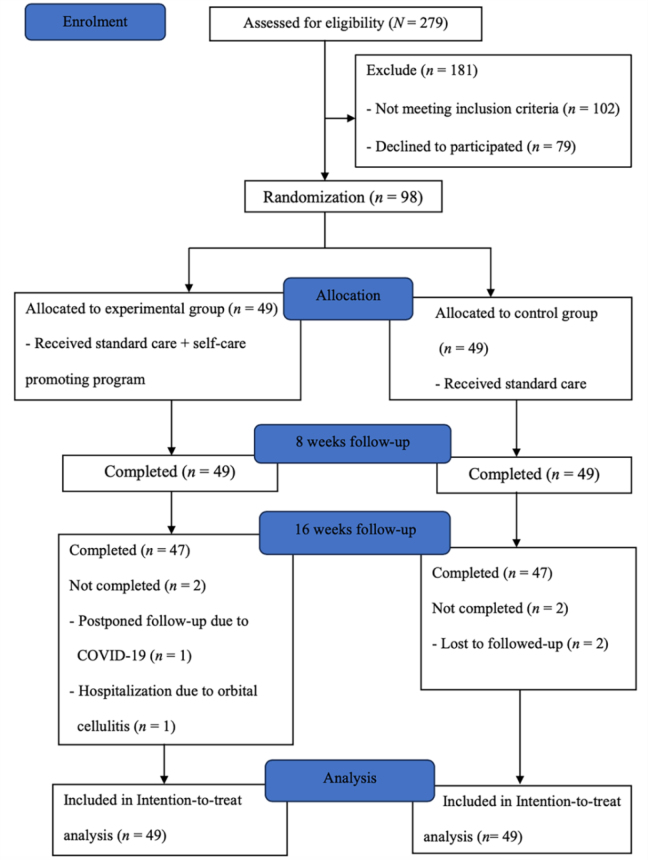
This study employed a single-blind randomized controlled trial design to compare SCPP with conventional diabetic care interventions (standard care). The SCPP was based on the Self-Care of Chronic Illness Theory, Self-efficacy theory, and the Association of Diabetic Care and Education Specialist (ADCES) guidelines incorporating health education, self-care maintenance, monitoring, and management skills training over 12 weeks. Ninety-eight participants were randomly allocated to the experimental or control group ( = 49 per group). While the experimental group received SCPP alongside standard care, the control group received standard care alone. Data collection occurred between May 2022 and March 2023 and included demographic information, the Self-Care of Diabetes Index questionnaire (SCODI), the self-care for diabetes eye care questionnaire (SCFDE), the impact of visual impairment questionnaire (IVI-Thai version), and retinal images for DR severity grading. Data analysis utilized descriptive statistics, Chi-Square tests, -tests, and MANOVA.

RESULTS

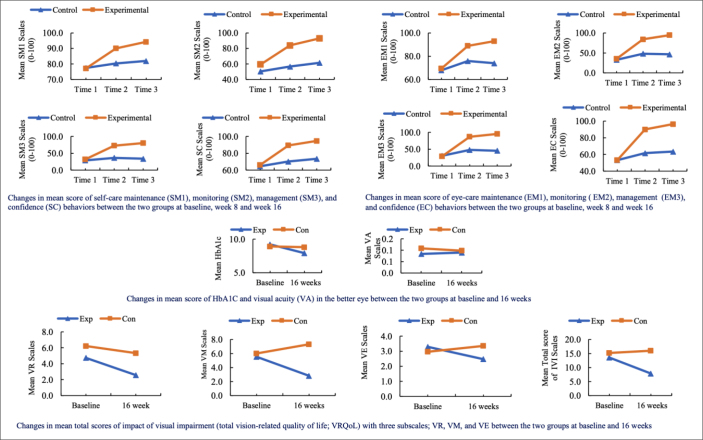
Following 8 and 16 weeks of SCPP, the experimental group had significantly higher mean scores in engagement with self-care and eye-care behaviors compared to the control group ( <0.001). The highest scores were observed in self-care and eye-care confidence behaviors, followed by maintenance, monitoring, and management. Furthermore, HbA1c levels and VRQoL significantly decreased and were lower than those of the control group at week 16 ( <0.001 and <0.05, respectively). However, there were no significant differences in VA, and DR severity increased in both groups by week 16.

CONCLUSION

SCPP benefits individuals with DR, enhancing their confidence and ability to perform, monitor, and manage self-care behaviors. These strategies contribute to improved diabetes management, enhanced quality of life, and reduced DR-related blindness. Integrating SCPP into routine DR management is recommended, with nurses playing a pivotal role in overseeing and driving this integration, highlighting the critical role of nurses in managing this widespread global disease.

TRIAL REGISTRY NUMBER

Thai Clinical Trials Registration (TCTR20230302002).
摘要
https://cdn.ncbi.nlm.nih.gov/pmc/blobs/201d/11211747/c32eae0b69b8/BNJ-10-3-272-g002.jpg
https://cdn.ncbi.nlm.nih.gov/pmc/blobs/201d/11211747/63b748b65cdb/BNJ-10-3-272-g001.jpg
https://cdn.ncbi.nlm.nih.gov/pmc/blobs/201d/11211747/c32eae0b69b8/BNJ-10-3-272-g002.jpg
https://cdn.ncbi.nlm.nih.gov/pmc/blobs/201d/11211747/63b748b65cdb/BNJ-10-3-272-g001.jpg
https://cdn.ncbi.nlm.nih.gov/pmc/blobs/201d/11211747/c32eae0b69b8/BNJ-10-3-272-g002.jpg

背景

糖尿病视网膜病变(DR)是糖尿病最常见的微血管并发症,可导致视力损害并最终失明。促进自我护理行为对于控制DR进展和预防失明至关重要。

目的

本研究旨在调查自我护理促进计划(SCPP)对2型糖尿病合并DR患者的自我护理行为参与度、糖化血红蛋白(HbA1c)水平、视力(VA)、DR严重程度以及视力相关生活质量(VRQoL)的影响。

方法

本研究采用单盲随机对照试验设计,将SCPP与传统糖尿病护理干预措施(标准护理)进行比较。SCPP基于慢性病自我护理理论、自我效能理论以及糖尿病护理与教育专家协会(ADCES)指南,在12周内纳入健康教育、自我护理维持、监测和管理技能培训。98名参与者被随机分配到实验组或对照组(每组49人)。实验组在接受标准护理的同时接受SCPP,对照组仅接受标准护理。数据收集于2022年5月至2023年3月期间进行,包括人口统计学信息、糖尿病自我护理指数问卷(SCODI)、糖尿病眼部护理自我护理问卷(SCFDE)、视力损害影响问卷(泰语版)以及用于DR严重程度分级的视网膜图像。数据分析采用描述性统计、卡方检验、t检验和多变量方差分析。

结果

在SCPP实施8周和16周后,实验组在自我护理和眼部护理行为参与度方面的平均得分显著高于对照组(P<0.001)。自我护理和眼部护理信心行为得分最高,其次是维持、监测和管理。此外,HbA1c水平和VRQoL在第16周时显著下降,且低于对照组(分别为P<0.001和P<0.05)。然而,VA没有显著差异,到第16周时两组的DR严重程度均有所增加。

结论

SCPP对DR患者有益,可增强他们执行、监测和管理自我护理行为的信心和能力。这些策略有助于改善糖尿病管理、提高生活质量并减少与DR相关的失明。建议将SCPP纳入常规DR管理,护士在监督和推动这种整合方面发挥关键作用,凸显了护士在管理这种全球广泛疾病中的重要作用。

试验注册号

泰国临床试验注册(TCTR20230302002)。

相似文献

1
Effect of a self-care promoting program on engagement in self-care behaviors and health-related outcomes among persons with type 2 diabetes and diabetic retinopathy: A single-blind randomized controlled trial.自我护理促进项目对2型糖尿病合并糖尿病视网膜病变患者自我护理行为参与度及健康相关结局的影响:一项单盲随机对照试验。
Belitung Nurs J. 2024 Jun 28;10(3):272-284. doi: 10.33546/bnj.3360. eCollection 2024.
2
Epidemiology of Ocular Functions and Diseases in Persons With Diabetes糖尿病患者眼部功能与疾病的流行病学
3
Impacts of monocular, binocular, and functional visual acuity on vision-related quality of life in patients with type 2 diabetes.单眼、双眼和功能性视力对 2 型糖尿病患者视觉相关生活质量的影响。
Sci Rep. 2021 Jan 11;11(1):298. doi: 10.1038/s41598-020-79483-9.
4
The effect of educational program based on theory of planned behavior on promoting retinopathy preventive behaviors in patients with type 2 diabetes: RCT.基于计划行为理论的教育方案对促进 2 型糖尿病患者视网膜病变预防行为的效果:随机对照试验。
BMC Endocr Disord. 2021 Jan 14;21(1):17. doi: 10.1186/s12902-021-00680-2.
5
Prognostic factors for the development and progression of proliferative diabetic retinopathy in people with diabetic retinopathy.增生性糖尿病性视网膜病变在糖尿病性视网膜病变患者中发展和进展的预测因素。
Cochrane Database Syst Rev. 2023 Feb 22;2(2):CD013775. doi: 10.1002/14651858.CD013775.pub2.
6
Standard threshold laser versus subthreshold micropulse laser for adults with diabetic macular oedema: the DIAMONDS non-inferiority RCT.标准阈值激光与亚阈值微脉冲激光治疗成人糖尿病性黄斑水肿:DIAMONDS 非劣效性 RCT。
Health Technol Assess. 2022 Dec;26(50):1-86. doi: 10.3310/SZKI2484.
7
The future of Cochrane Neonatal.考克兰新生儿协作网的未来。
Early Hum Dev. 2020 Nov;150:105191. doi: 10.1016/j.earlhumdev.2020.105191. Epub 2020 Sep 12.
8
Folic acid supplementation and malaria susceptibility and severity among people taking antifolate antimalarial drugs in endemic areas.在流行地区,服用抗叶酸抗疟药物的人群中,叶酸补充剂与疟疾易感性和严重程度的关系。
Cochrane Database Syst Rev. 2022 Feb 1;2(2022):CD014217. doi: 10.1002/14651858.CD014217.
9
[The impact of diabetic retinopathy on vision-related quality of life].[糖尿病视网膜病变对视力相关生活质量的影响]
Zhonghua Yan Ke Za Zhi. 2022 Oct 11;58(10):760-768. doi: 10.3760/cma.j.cn112142-20211210-00581.
10
Evaluating the effectiveness of opportunistic eye screening model for people with diabetes attending diabetes clinic at Mnazi Mmoja Hospital, Zanzibar.评估在桑给巴尔 Mnazi Mmoja 医院糖尿病诊所就诊的糖尿病患者进行机会性眼病筛查模型的有效性。
BMC Ophthalmol. 2014 Jun 24;14:81. doi: 10.1186/1471-2415-14-81.

引用本文的文献

1
Natural remedies proposed for the management of diabetic retinopathy (DR): diabetic complications.用于治疗糖尿病视网膜病变(DR)的天然疗法:糖尿病并发症。
Naunyn Schmiedebergs Arch Pharmacol. 2025 Feb 15. doi: 10.1007/s00210-025-03866-w.
2
Transcultural adaptation and theoretical models validation of the Spanish version of the Self-Care of Diabetes Inventory.《糖尿病自我管理量表》西班牙语版的跨文化调适与理论模型验证
Front Med (Lausanne). 2024 Sep 10;11:1423948. doi: 10.3389/fmed.2024.1423948. eCollection 2024.

本文引用的文献

1
Establishing appropriate sample size for developing and validating a questionnaire in nursing research.在护理研究中确定用于开发和验证问卷的合适样本量。
Belitung Nurs J. 2021 Oct 28;7(5):356-360. doi: 10.33546/bnj.1927. eCollection 2021.
2
Prognostic factors for the development and progression of proliferative diabetic retinopathy in people with diabetic retinopathy.增生性糖尿病性视网膜病变在糖尿病性视网膜病变患者中发展和进展的预测因素。
Cochrane Database Syst Rev. 2023 Feb 22;2(2):CD013775. doi: 10.1002/14651858.CD013775.pub2.
3
Self-Management Nursing Intervention for Controlling Glucose among Diabetes: A Systematic Review and Meta-Analysis.
自我管理护理干预对糖尿病患者血糖控制的效果:系统评价和荟萃分析。
Int J Environ Res Public Health. 2021 Dec 3;18(23):12750. doi: 10.3390/ijerph182312750.
4
Characteristics of self-care interventions for patients with a chronic condition: A scoping review.自我护理干预对慢性病患者的特点:范围综述。
Int J Nurs Stud. 2021 Apr;116:103713. doi: 10.1016/j.ijnurstu.2020.103713. Epub 2020 Jul 15.
5
How do self-care maintenance, self-care monitoring, and self-care management affect glycated haemoglobin in adults with type 2 diabetes? A multicentre observational study.自我护理维持、自我护理监测和自我护理管理如何影响2型糖尿病成人患者的糖化血红蛋白?一项多中心观察性研究。
Endocrine. 2020 Sep;69(3):542-552. doi: 10.1007/s12020-020-02354-w. Epub 2020 Jun 5.
6
An Effective Model of Diabetes Care and Education: Revising the AADE7 Self-Care Behaviors.一种有效的糖尿病护理和教育模式:修订 AADE7 自我护理行为。
Diabetes Educ. 2020 Apr;46(2):139-160. doi: 10.1177/0145721719894903. Epub 2020 Jan 12.
7
The War on Diabetic Retinopathy: Where Are We Now?糖尿病性视网膜病变的防治之战:我们现在处于什么位置?
Asia Pac J Ophthalmol (Phila). 2019 Nov-Dec;8(6):448-456. doi: 10.1097/APO.0000000000000267.
8
Diabetic Retinopathy Preferred Practice Pattern®.糖尿病视网膜病变首选诊疗模式®
Ophthalmology. 2020 Jan;127(1):P66-P145. doi: 10.1016/j.ophtha.2019.09.025. Epub 2019 Sep 25.
9
IDF Diabetes Atlas: A review of studies utilising retinal photography on the global prevalence of diabetes related retinopathy between 2015 and 2018.国际糖尿病联盟糖尿病地图集:对 2015 年至 2018 年期间利用视网膜摄影评估全球糖尿病相关视网膜病变患病率的研究的综述。
Diabetes Res Clin Pract. 2019 Nov;157:107840. doi: 10.1016/j.diabres.2019.107840. Epub 2019 Nov 14.
10
Strategies to Tackle the Global Burden of Diabetic Retinopathy: From Epidemiology to Artificial Intelligence.应对糖尿病视网膜病变全球负担的策略:从流行病学到人工智能。
Ophthalmologica. 2020;243(1):9-20. doi: 10.1159/000502387. Epub 2019 Aug 13.