Adedinsewo Demilade, Morales-Lara Andrea Carolina, Hardway Heather, Johnson Patrick, Young Kathleen A, Garzon-Siatoya Wendy Tatiana, Butler Tobah Yvonne S, Rose Carl H, Burnette David, Seccombe Kendra, Fussell Mia, Phillips Sabrina, Lopez-Jimenez Francisco, Attia Zachi I, Friedman Paul A, Carter Rickey E, Noseworthy Peter A
Department of Cardiovascular Medicine, Mayo Clinic, Jacksonville, Florida.
Department of Quantitative Health Sciences, Mayo Clinic, Jacksonville, Florida.
Cardiovasc Digit Health J. 2024 Apr 5;5(3):132-140. doi: 10.1016/j.cvdhj.2024.03.005. eCollection 2024 Jun.
Cardiomyopathy is a leading cause of pregnancy-related mortality and the number one cause of death in the late postpartum period. Delay in diagnosis is associated with severe adverse outcomes.
To evaluate the performance of an artificial intelligence-enhanced electrocardiogram (AI-ECG) and AI-enabled digital stethoscope to detect left ventricular systolic dysfunction in an obstetric population.
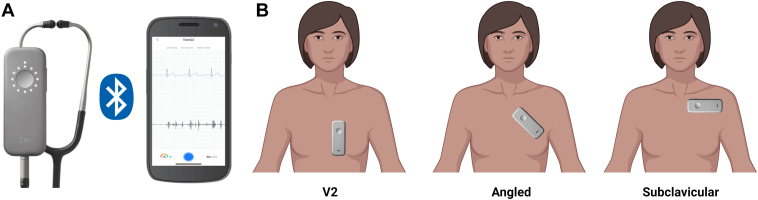
We conducted a single-arm prospective study of pregnant and postpartum women enrolled at 3 sites between October 28, 2021, and October 27, 2022. Study participants completed a standard 12-lead ECG, digital stethoscope ECG and phonocardiogram recordings, and a transthoracic echocardiogram within 24 hours. Diagnostic performance was evaluated using the area under the curve (AUC).
One hundred women were included in the final analysis. The median age was 31 years (Q1: 27, Q3: 34). Thirty-eight percent identified as non-Hispanic White, 32% as non-Hispanic Black, and 21% as Hispanic. Five percent and 6% had left ventricular ejection fraction (LVEF) <45% and <50%, respectively. The AI-ECG model had near-perfect classification performance (AUC: 1.0, 100% sensitivity; 99%-100% specificity) for detection of cardiomyopathy at both LVEF categories. The AI-enabled digital stethoscope had an AUC of 0.98 (95% CI: 0.95, 1.00) and 0.97 (95% CI: 0.93, 1.00), for detection of LVEF <45% and <50%, respectively, with 100% sensitivity and 90% specificity.
We demonstrate an AI-ECG and AI-enabled digital stethoscope were effective for detecting cardiac dysfunction in an obstetric population. Larger studies, including an evaluation of the impact of screening on clinical outcomes, are essential next steps.
心肌病是妊娠相关死亡的主要原因,也是产后晚期死亡的首要原因。诊断延迟与严重不良后果相关。
评估人工智能增强心电图(AI-ECG)和人工智能数字听诊器在产科人群中检测左心室收缩功能障碍的性能。
我们于2021年10月28日至2022年10月27日在3个地点对孕妇和产后妇女进行了一项单臂前瞻性研究。研究参与者在24小时内完成了标准12导联心电图、数字听诊器心电图和心音图记录,以及经胸超声心动图检查。使用曲线下面积(AUC)评估诊断性能。
最终分析纳入了100名女性。中位年龄为31岁(第一四分位数:27岁,第三四分位数:34岁)。38%为非西班牙裔白人,32%为非西班牙裔黑人,21%为西班牙裔。5%和6%的左心室射血分数(LVEF)分别<45%和<50%。AI-ECG模型在两种LVEF类别下检测心肌病的分类性能近乎完美(AUC:1.0,灵敏度100%;特异性99%-100%)。人工智能数字听诊器检测LVEF<45%和<50%的AUC分别为0.98(95%CI:0.95,1.00)和0.97(95%CI:0.93,1.00),灵敏度为100%,特异性为9