Hou Ling, Zhao Jinbo, He Ting, Su Ke, Li Yuanhong
Department of Central Hospital of Tujia and Miao Autonomous Prefecture, Hubei University of Medicine, Shiyan, Hubei Province, People's Republic of China.
Cardiovascular Disease Center, Central Hospital of Tujia and Miao Autonomous Prefecture, Hubei University of Medicine, Enshi, Hubei Province, People's Republic of China.
Risk Manag Healthc Policy. 2024 Jul 5;17:1779-1786. doi: 10.2147/RMHP.S468235. eCollection 2024.
Coronary artery disease (CAD) remains a significant global health challenge, with percutaneous coronary intervention (PCI) being a primary revascularization method. In-stent restenosis (ISR) post-PCI, although reduced, continues to impact patient outcomes. Inflammation and platelet activation play key roles in ISR development, emphasizing the need for accurate risk assessment tools. The systemic inflammation aggregation index (AISI) has shown promise in predicting adverse outcomes in various conditions but has not been studied in relation to ISR.
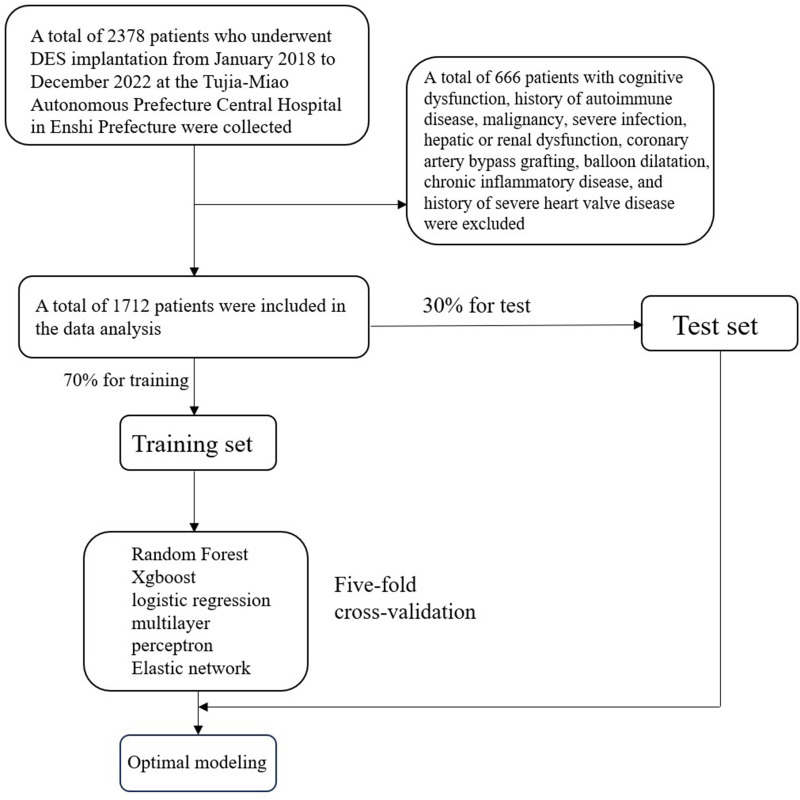
A retrospective observational study included 1712 patients post-drug-eluting stent (DES) implantation. Data collected encompassed demographics, medical history, medication use, laboratory parameters, and angiographic details. AISI, calculated from specific blood cell counts, was evaluated alongside other variables using machine learning models, including random forest, Xgboost, elastic networks, logistic regression, and multilayer perceptron. The optimal model was selected based on performance metrics and further interpreted using variable importance analysis and the SHAP method.
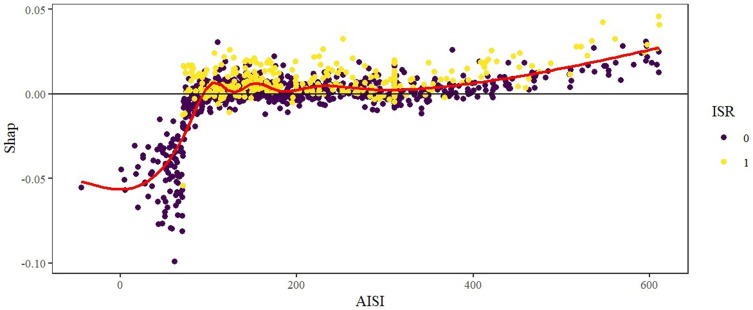
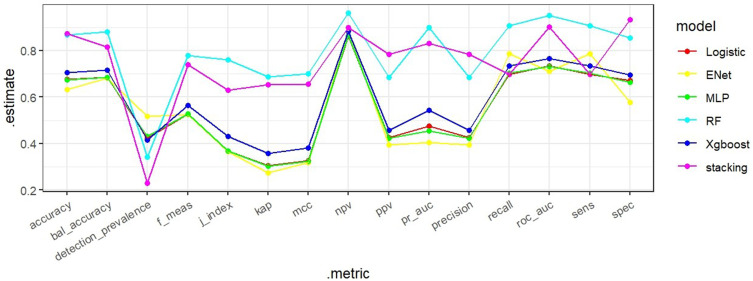
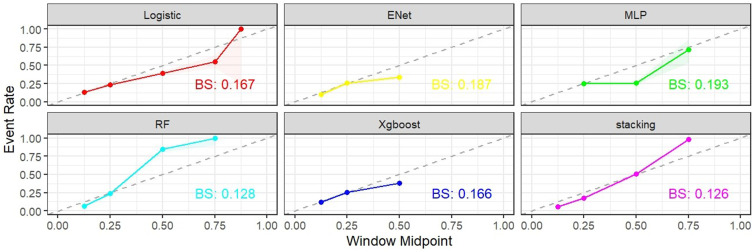
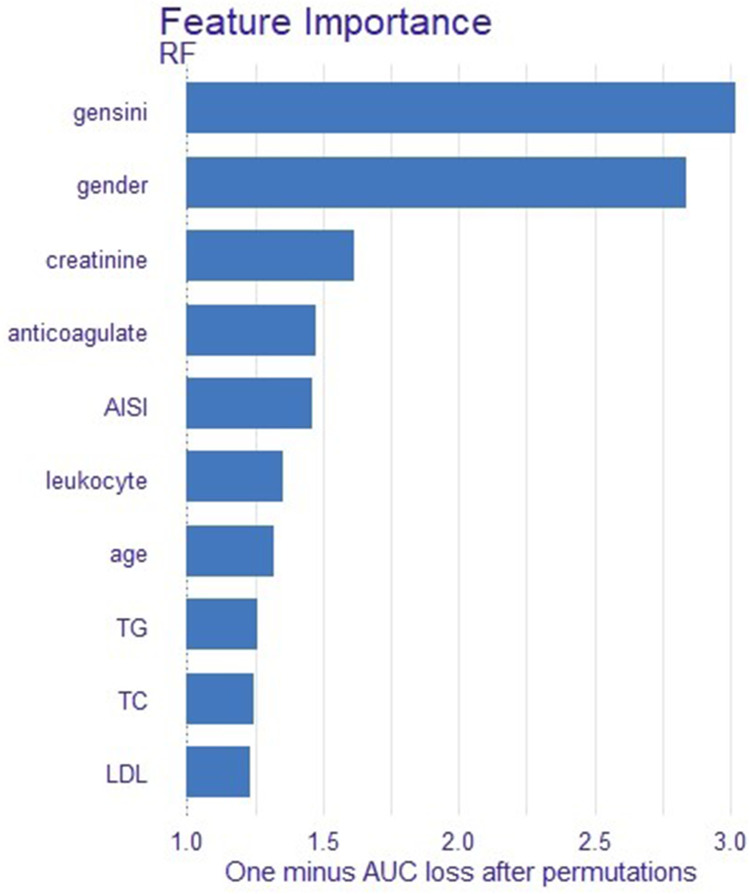
Our study revealed that ISR occurred in 25.8% of patients, with a range of demographic and clinical factors influencing the risk of its development. The random forest model emerged as the most adept in predicting ISR, and AISI featured prominently among the top variables affecting ISR prediction. Notably, higher AISI values were positively correlated with an elevated probability of ISR occurrence. Comparative evaluation and visual analysis of model performance, the random forest model demonstrates high reliability in predicting ISR, with specific metrics including an AUC of 0.9569, accuracy of 0.911, sensitivity of 0.855, PPV of 0.81, and NPV of 0.948.
AISI demonstrated itself as a significant independent risk factor for ISR following DES implantation, with an escalation in AISI levels indicating a heightened risk of ISR occurrence.
冠状动脉疾病(CAD)仍然是一项重大的全球健康挑战,经皮冠状动脉介入治疗(PCI)是主要的血运重建方法。PCI术后支架内再狭窄(ISR)虽有所减少,但仍会影响患者预后。炎症和血小板活化在ISR的发生发展中起关键作用,这凸显了准确风险评估工具的必要性。全身炎症聚集指数(AISI)在预测各种情况下的不良结局方面显示出前景,但尚未针对ISR进行研究。
一项回顾性观察性研究纳入了1712例药物洗脱支架(DES)植入术后患者。收集的数据包括人口统计学、病史、用药情况、实验室参数和血管造影细节。根据特定血细胞计数计算得出的AISI,与其他变量一起使用机器学习模型进行评估,包括随机森林、Xgboost、弹性网络、逻辑回归和多层感知器。根据性能指标选择最佳模型,并使用变量重要性分析和SHAP方法进行进一步解释。
我们的研究显示,25.8%的患者发生了ISR,一系列人口统计学和临床因素影响其发生风险。随机森林模型在预测ISR方面最为擅长,AISI在影响ISR预测的顶级变量中显著突出。值得注意的是,较高的AISI值与ISR发生概率升高呈正相关。对模型性能进行比较评估和可视化分析,随机森林模型在预测ISR方面显示出高可靠性,具体指标包括曲线下面积(AUC)为0.9569、准确率为0.911、灵敏度为0.855、阳性预测值(PPV)为0.81和阴性预测值(NPV)为0.948。
AISI被证明是DES植入术后ISR的一个重要独立危险因素,AISI水平升高表明ISR发生风险增加。