Cognitive Science Program, Indiana University, Bloomington, IN, USA.
School of Informatics, Computing, and Engineering, Indiana University, Bloomington, IN, USA.
Nat Commun. 2024 Jul 12;15(1):5865. doi: 10.1038/s41467-024-50248-6.
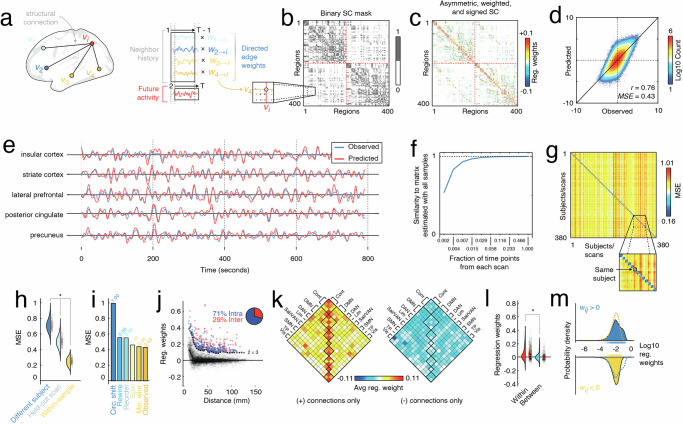
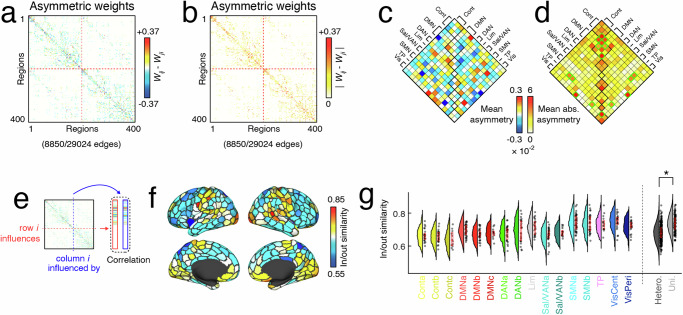
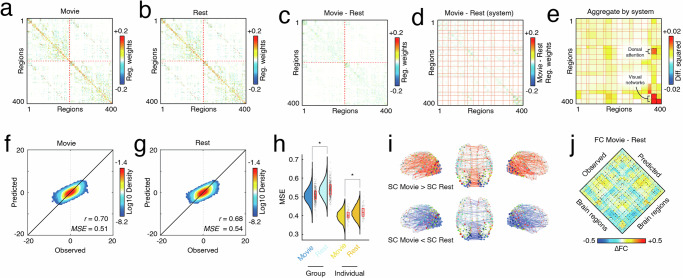
The macroscale connectome is the network of physical, white-matter tracts between brain areas. The connections are generally weighted and their values interpreted as measures of communication efficacy. In most applications, weights are either assigned based on imaging features-e.g. diffusion parameters-or inferred using statistical models. In reality, the ground-truth weights are unknown, motivating the exploration of alternative edge weighting schemes. Here, we explore a multi-modal, regression-based model that endows reconstructed fiber tracts with directed and signed weights. We find that the model fits observed data well, outperforming a suite of null models. The estimated weights are subject-specific and highly reliable, even when fit using relatively few training samples, and the networks maintain a number of desirable features. In summary, we offer a simple framework for weighting connectome data, demonstrating both its ease of implementation while benchmarking its utility for typical connectome analyses, including graph theoretic modeling and brain-behavior associations.
宏观连接组是大脑区域之间的物理白质束的网络。这些连接通常是加权的,其值被解释为通信效率的度量。在大多数应用中,权重要么是基于成像特征(例如扩散参数)分配的,要么是使用统计模型推断的。在现实中,真实的权重是未知的,这促使我们探索替代的边缘加权方案。在这里,我们探索了一种基于多模态、回归的模型,该模型为重建的纤维束赋予有向和有符号的权重。我们发现该模型很好地拟合了观测数据,优于一系列的零模型。估计的权重是个体特异性的,具有高度可靠性,即使使用相对较少的训练样本进行拟合,网络也保持了许多理想的特征。总之,我们提供了一个简单的框架来对连接组数据进行加权,在基准测试其用于典型连接组分析的效用的同时,展示了其实现的简便性,包括图论建模和大脑-行为关联。