Kanyal Ayush, Mazumder Badhan, Calhoun Vince D, Preda Adrian, Turner Jessica, Ford Judith, Ye Dong Hye
Department of Computer Science, Georgia State University, Atlanta, GA, United States.
Tri-Institutional Center for Translational Research in Neuroimaging and Data Science (TReNDS), Atlanta, GA, United States.
Front Psychiatry. 2024 Jun 28;15:1384842. doi: 10.3389/fpsyt.2024.1384842. eCollection 2024.
Schizophrenia (SZ) is a psychiatric condition that adversely affects an individual's cognitive, emotional, and behavioral aspects. The etiology of SZ, although extensively studied, remains unclear, as multiple factors come together to contribute toward its development. There is a consistent body of evidence documenting the presence of structural and functional deviations in the brains of individuals with SZ. Moreover, the hereditary aspect of SZ is supported by the significant involvement of genomics markers. Therefore, the need to investigate SZ from a multi-modal perspective and develop approaches for improved detection arises.
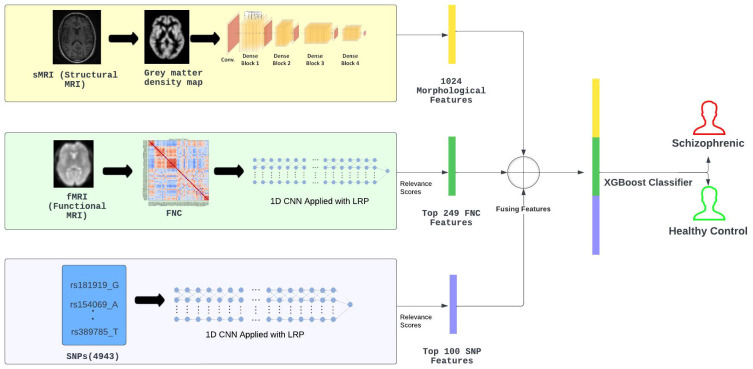
Our proposed method employed a deep learning framework combining features from structural magnetic resonance imaging (sMRI), functional magnetic resonance imaging (fMRI), and genetic markers such as single nucleotide polymorphism (SNP). For sMRI, we used a pre-trained DenseNet to extract the morphological features. To identify the most relevant functional connections in fMRI and SNPs linked to SZ, we applied a 1-dimensional convolutional neural network (CNN) followed by layerwise relevance propagation (LRP). Finally, we concatenated these obtained features across modalities and fed them to the extreme gradient boosting (XGBoost) tree-based classifier to classify SZ from healthy control (HC).
Experimental evaluation on clinical dataset demonstrated that, compared to the outcomes obtained from each modality individually, our proposed multi-modal approach performed classification of SZ individuals from HC with an improved accuracy of 79.01%.
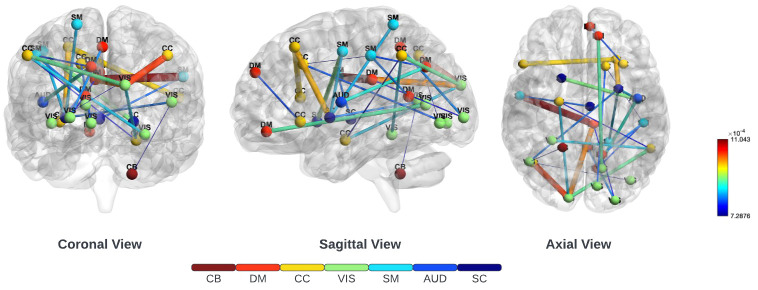
We proposed a deep learning based framework that selects multi-modal (sMRI, fMRI and genetic) features efficiently and fuse them to obtain improved classification scores. Additionally, by using Explainable AI (XAI), we were able to pinpoint and validate significant functional network connections and SNPs that contributed the most toward SZ classification, providing necessary interpretation behind our findings.
精神分裂症(SZ)是一种对个体的认知、情感和行为方面产生不利影响的精神疾病。尽管对SZ的病因进行了广泛研究,但其病因仍不明确,因为多种因素共同作用导致其发病。有一系列一致的证据记录了SZ患者大脑中存在结构和功能偏差。此外,基因组学标记的显著参与支持了SZ的遗传方面。因此,需要从多模态角度研究SZ并开发改进检测方法。
我们提出的方法采用了一个深度学习框架,该框架结合了来自结构磁共振成像(sMRI)、功能磁共振成像(fMRI)和单核苷酸多态性(SNP)等遗传标记的特征。对于sMRI,我们使用预训练的密集连接网络(DenseNet)来提取形态特征。为了识别fMRI中与SZ相关的最相关功能连接和SNP,我们应用了一维卷积神经网络(CNN),随后进行逐层相关传播(LRP)。最后,我们将跨模态获得的这些特征连接起来,并将它们输入到基于极端梯度提升(XGBoost)树的分类器中,以将SZ与健康对照(HC)进行分类。
对临床数据集的实验评估表明,与单独从每个模态获得的结果相比,我们提出的多模态方法对SZ个体与HC进行分类的准确率提高到了79.01%。
我们提出了一个基于深度学习的框架,该框架能够有效地选择多模态(sMRI、fMRI和遗传)特征并将它们融合以获得更高的分类分数。此外,通过使用可解释人工智能(XAI),我们能够确定并验证对SZ分类贡献最大的重要功能网络连接和SNP,为我们的研究结果提供必要的解释。