Kelly Rebecca, Calabro Ryan, Beatty Lisa, Schirmer Kristy, Coro Daniel
College of Education, Psychology and Social Work, Flinders University, Adelaide, Australia.
Behavioural Research and Evaluation Unit, Cancer Council SA, Eastwood, Australia.
Health Promot J Austr. 2025 Jan;36(1):e903. doi: 10.1002/hpja.903. Epub 2024 Jul 23.
The study addresses the global health concern of sugar overconsumption, particularly focusing on the prevalence of sugar-sweetened beverage consumption among young people.
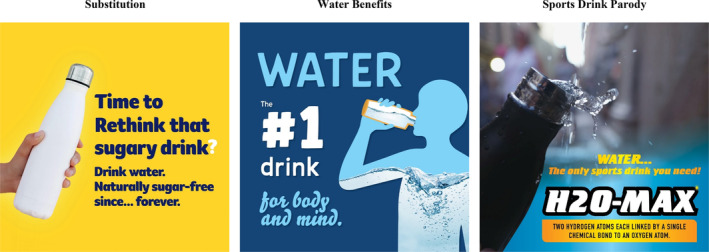
The study tested three different health promotion campaign concepts, designed to reduce sugar-sweetened beverage intake and promote water consumption as a healthier alternative. A total of 402 young adults (18-29) were recruited from a university campus and an online panel. Participants were randomly assigned to view one of three campaign images: one advocating for substituting sugar-sweetened beverages with water, and two exclusively promoting water consumption. These images were assessed through an online survey, which included questions on emotional response, salience, attitudes and intentions towards various beverages.
Participants exposed to the campaign emphasising the benefits of water showed a greater intention to increase water consumption and reduce both sugar- and non-sugar-sweetened beverages compared with the other groups. There were no significant differences observed for the beverage choice task across the campaigns.
The findings suggest that messaging focusing on the benefits of water holds promise in encouraging healthier beverage consumption intentions among young adults. The lack of significant differences in the beverage choice task across the campaigns indicates a need for further research to explore long-term behaviour change effects. SO WHAT?: By highlighting the benefits of water consumption, campaigns may have the potential to positively influence beverage choices and promote healthier habits. Continued research in this area can provide valuable insights for developing more impactful interventions aimed at reducing sugar-sweetened beverage consumption.
该研究探讨了全球对糖分过度摄入的健康担忧,尤其关注年轻人中含糖饮料的消费流行情况。
该研究测试了三种不同的健康促进活动概念,旨在减少含糖饮料的摄入量,并推广将水作为更健康的选择。总共从大学校园和在线小组中招募了402名年轻人(18 - 29岁)。参与者被随机分配观看三张宣传图片中的一张:一张倡导用水替代含糖饮料,另外两张专门宣传饮水。这些图片通过在线调查进行评估,调查内容包括对各种饮料的情感反应、显著程度、态度和意图等问题。
与其他组相比,接触强调水的益处的活动的参与者表现出更大的增加饮水量以及减少含糖和不含糖甜味饮料的意愿。在不同活动的饮料选择任务中未观察到显著差异。
研究结果表明,关注水的益处的信息传递有望鼓励年轻人形成更健康的饮料消费意愿。不同活动在饮料选择任务中缺乏显著差异表明需要进一步研究以探索长期行为改变的效果。那又如何?:通过强调饮水的益处,活动可能有潜力积极影响饮料选择并促进更健康的习惯。该领域的持续研究可为制定更有效的减少含糖饮料消费的干预措施提供有价值的见解。