Biologically Inspired System and Technology Laboratory, Department of Electronic Systems Engineering, Malaysia-Japan International Institute of Technology, Universiti Teknologi Malaysia, Kuala Lumpur, Malaysia.
Centre for Artificial Intelligence and Robotics Laboratory, Department of Electronic Systems Engineering, Malaysia-Japan International Institute of Technology, Universiti Teknologi Malaysia, Kuala Lumpur, Malaysia.
Sci Rep. 2024 Jul 24;14(1):17037. doi: 10.1038/s41598-024-66874-5.
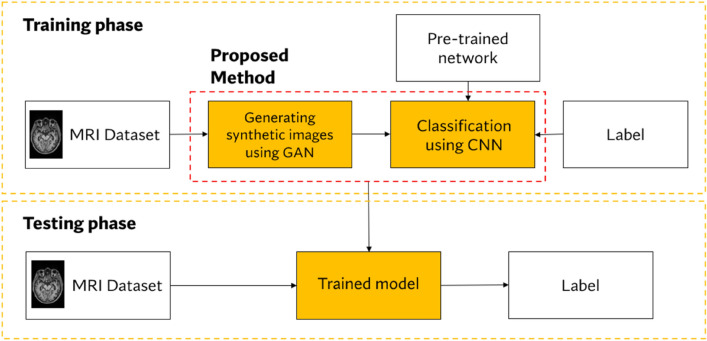
The classification of Alzheimer's disease (AD) using deep learning models is hindered by the limited availability of data. Medical image datasets are scarce due to stringent regulations on patient privacy, preventing their widespread use in research. Moreover, although open-access databases such as the Open Access Series of Imaging Studies (OASIS) are available publicly for providing medical image data for research, they often suffer from imbalanced classes. Thus, to address the issue of insufficient data, this study proposes the integration of a generative adversarial network (GAN) that can achieve comparable accuracy with a reduced data requirement. GANs are unsupervised deep learning networks commonly used for data augmentation that generate high-quality synthetic data to overcome data scarcity. Experimental data from the OASIS database are used in this research to train the GAN model in generating synthetic MRI data before being included in a pretrained convolutional neural network (CNN) model for multistage AD classification. As a result, this study has demonstrated that a multistage AD classification accuracy above 80% can be achieved even with a reduced dataset. The exceptional performance of GANs positions them as a solution for overcoming the challenge of insufficient data in AD classification.
使用深度学习模型对阿尔茨海默病 (AD) 进行分类受到数据有限的阻碍。由于对患者隐私的严格规定,医学图像数据集稀缺,这阻碍了它们在研究中的广泛使用。此外,尽管像开放获取成像研究系列 (OASIS) 这样的公开访问数据库可公开提供用于研究的医学图像数据,但它们通常存在类别不平衡的问题。因此,为了解决数据不足的问题,本研究提出了集成生成对抗网络 (GAN) 的方法,该方法可以在减少数据需求的情况下实现可比的准确性。GAN 是一种常用的无监督深度学习网络,用于数据扩充,可以生成高质量的合成数据,以克服数据稀缺的问题。本研究使用 OASIS 数据库的实验数据来训练 GAN 模型,在将其纳入用于多阶段 AD 分类的预训练卷积神经网络 (CNN) 模型之前生成合成 MRI 数据。结果表明,即使在数据集减少的情况下,也可以实现超过 80%的多阶段 AD 分类准确性。GAN 的出色表现使其成为克服 AD 分类中数据不足挑战的解决方案。