Li Haolin, Zhang Shuaihua, Liu Bohan, Li Xiaoheng, Shang Ningzhao, Zhao Xiaoxian, Eguchi Miharu, Yamauchi Yusuke, Xu Xingtao
Department of Chemistry, College of Science, Hebei Agricultural University Baoding 071001 Hebei China
School of Advanced Science and Engineering, Waseda University Shinjuku-ku Tokyo Japan.
Chem Sci. 2024 Jun 6;15(29):11540-11549. doi: 10.1039/d4sc00971a. eCollection 2024 Jul 24.
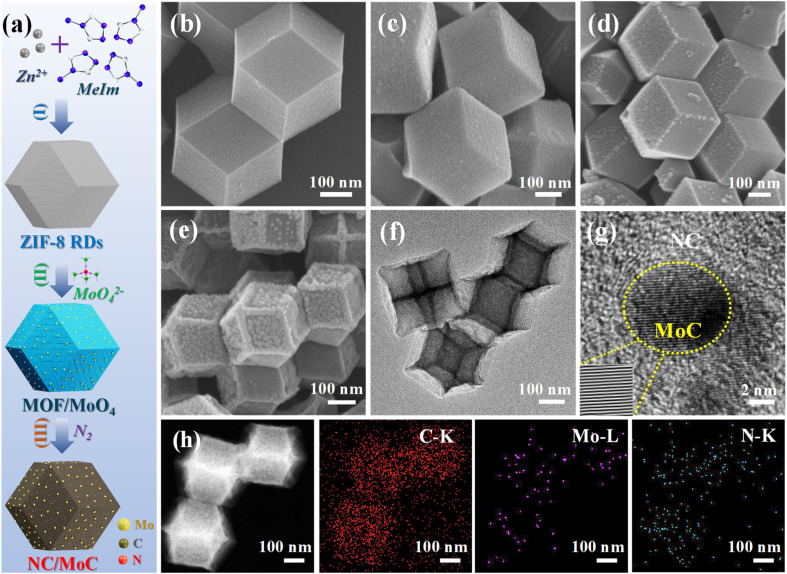
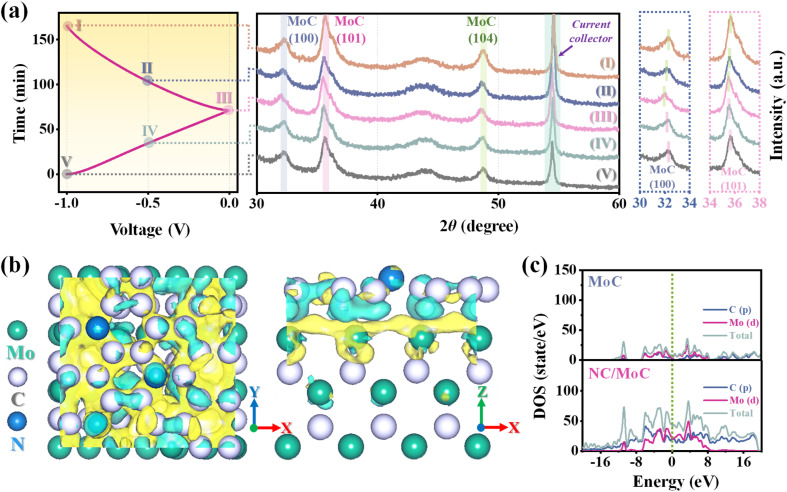
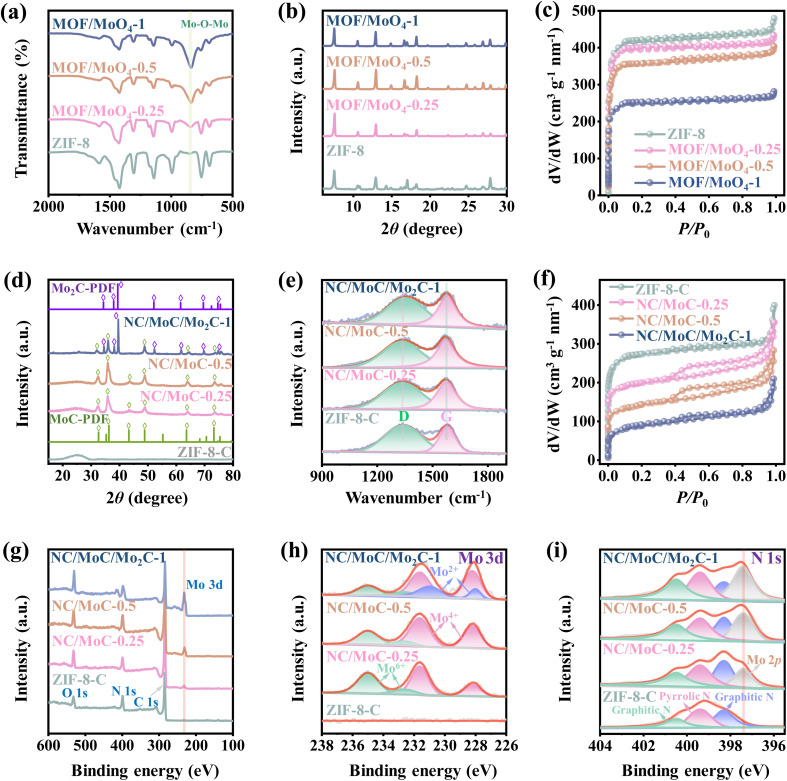
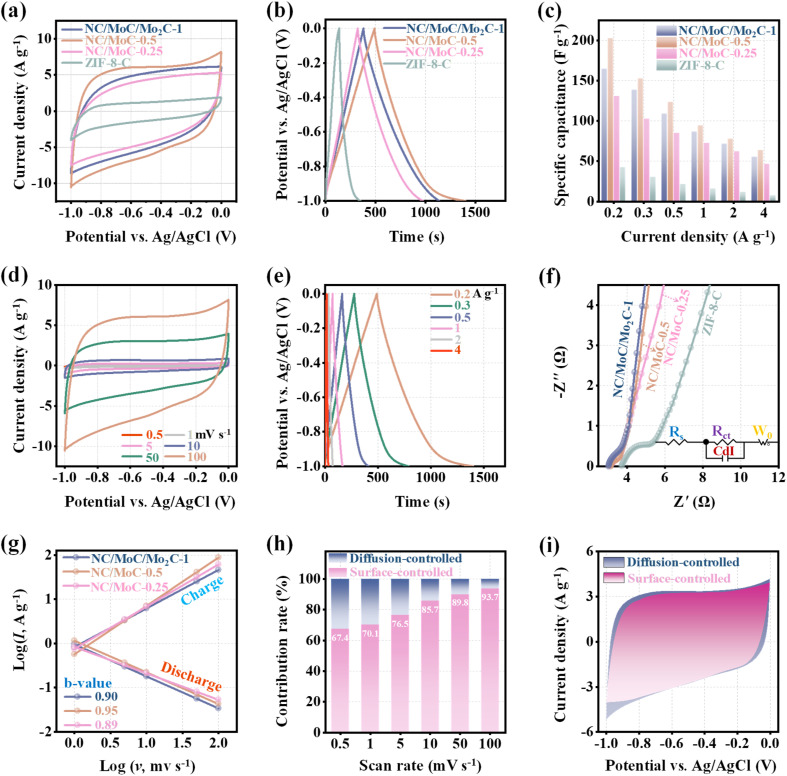
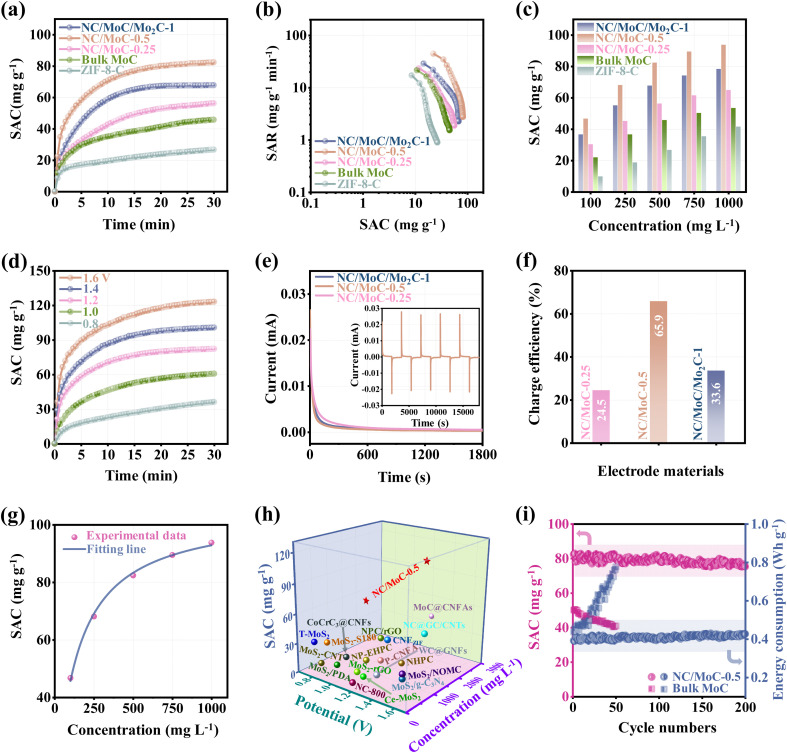
Molybdenum carbide (MoC) has emerged as a promising material for capacitive deionization (CDI), but the poor electrochemical kinetics in conventional MoC owing to the bulk structure and low electric conductivity limit its CDI performance. To address this challenge, herein, we develop a novel strategy to synthesize ultrafine MoC nanocrystals that are embedded within a three-dimensional nitrogen-doped carbon framework (NC/MoC). This synthesis method involves the space-confined pyrolysis of molybdate precursors within metal-organic frameworks (MOFs). In this process, molybdates are confined into the MOF crystalline structure, where MOFs provide a confined reactor and carbon source. The resulting NC/MoC with the uniformly distributed MoC nanocrystals provides sufficient active sites for the electrosorption of salt ions, while the MOF-derived NC matrix facilitates charge transfer and provides the space-confined effect for preventing the possible aggregations of MoC nanocrystals during the CDI process. The NC/MoC exhibits an impressive salt adsorption capacity (SAC, 84.2 mg g, 1.2 V), rapid desalination rate, and high cycling stability (91.4% SAC retention after 200 cycles), better than those of most previously reported carbon-based CDI materials. Besides, the possible mechanisms are systematically investigated by characterization and density functional theory calculations. This study opens up new avenues for the construction of metal carbide-based nanocrystals for CDI and other electrochemical applications.
碳化钼(MoC)已成为一种有前途的电容去离子(CDI)材料,但传统MoC由于其体相结构和低电导率导致的电化学动力学较差,限制了其CDI性能。为应对这一挑战,在此我们开发了一种新颖的策略来合成嵌入三维氮掺杂碳骨架(NC/MoC)中的超细MoC纳米晶体。这种合成方法涉及金属有机框架(MOF)内钼酸盐前驱体的空间限制热解。在此过程中,钼酸盐被限制在MOF晶体结构中,MOF提供了一个受限的反应器和碳源。所得的具有均匀分布的MoC纳米晶体的NC/MoC为盐离子的电吸附提供了足够的活性位点,而MOF衍生的NC基质促进了电荷转移,并为防止CDI过程中MoC纳米晶体可能的聚集提供了空间限制效应。NC/MoC表现出令人印象深刻的盐吸附容量(SAC,84.2 mg g,1.2 V)、快速的脱盐速率和高循环稳定性(200次循环后SAC保留率为91.4%),优于大多数先前报道的碳基CDI材料。此外,通过表征和密度泛函理论计算系统地研究了可能的机制。这项研究为构建用于CDI和其他电化学应用的金属碳化物基纳米晶体开辟了新途径。