Mishra Akanksha, Aggarwal Ashish, Khan Fazlurrahman
School of Bioengineering and Biosciences, Lovely Professional University, Phagwara 144001, Punjab, India.
Institute of Fisheries Science, Pukyong National University, Busan 48513, Republic of Korea.
Antibiotics (Basel). 2024 Jul 4;13(7):623. doi: 10.3390/antibiotics13070623.
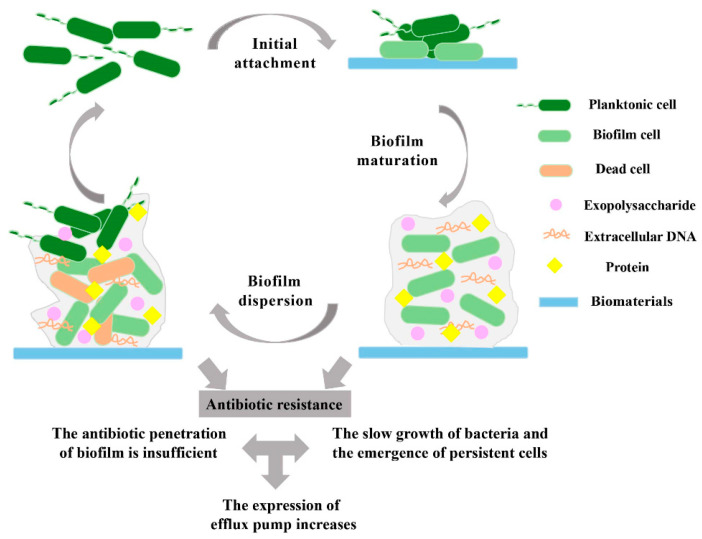
Hospital-acquired infections, also known as nosocomial infections, include bloodstream infections, surgical site infections, skin and soft tissue infections, respiratory tract infections, and urinary tract infections. According to reports, Gram-positive and Gram-negative pathogenic bacteria account for up to 70% of nosocomial infections in intensive care unit (ICU) patients. Biofilm production is a main virulence mechanism and a distinguishing feature of bacterial pathogens. Most bacterial pathogens develop biofilms at the solid-liquid and air-liquid interfaces. An essential requirement for biofilm production is the presence of a conditioning film. A conditioning film provides the first surface on which bacteria can adhere and fosters the growth of biofilms by creating a favorable environment. The conditioning film improves microbial adherence by delivering chemical signals or generating microenvironments. Microorganisms use this coating as a nutrient source. The film gathers both inorganic and organic substances from its surroundings, or these substances are generated by microbes in the film. These nutrients boost the initial growth of the adhering bacteria and facilitate biofilm formation by acting as a food source. Coatings with combined antibacterial efficacy and antifouling properties provide further benefits by preventing dead cells and debris from adhering to the surfaces. In the present review, we address numerous pathogenic microbes that form biofilms on the surfaces of biomedical devices. In addition, we explore several efficient smart antiadhesive coatings on the surfaces of biomedical device-relevant materials that manage nosocomial infections caused by biofilm-forming microbial pathogens.
医院获得性感染,也称为医院感染,包括血流感染、手术部位感染、皮肤和软组织感染、呼吸道感染以及尿路感染。据报道,革兰氏阳性和革兰氏阴性病原菌在重症监护病房(ICU)患者的医院感染中占比高达70%。生物膜形成是细菌病原体的主要致病机制和显著特征。大多数细菌病原体在固液和气液界面形成生物膜。生物膜形成的一个基本条件是存在调理膜。调理膜提供细菌可以附着的首个表面,并通过创造有利环境促进生物膜的生长。调理膜通过传递化学信号或产生微环境来改善微生物的附着。微生物将这种涂层用作营养源。该膜从周围环境中收集无机和有机物质,或者这些物质由膜中的微生物产生。这些营养物质促进附着细菌的初始生长,并作为食物来源促进生物膜的形成。具有抗菌和防污组合功效的涂层通过防止死细胞和碎片附着在表面上提供了更多益处。在本综述中,我们讨论了在生物医学设备表面形成生物膜的多种致病微生物。此外,我们还探索了生物医学设备相关材料表面上的几种高效智能抗粘附涂层,这些涂层可控制由形成生物膜的微生物病原体引起的医院感染。