Ganesan Prasanth, Feng Ruibin, Deb Brototo, Tjong Fleur V Y, Rogers Albert J, Ruipérez-Campillo Samuel, Somani Sulaiman, Clopton Paul, Baykaner Tina, Rodrigo Miguel, Zou James, Haddad Francois, Zaharia Matei, Narayan Sanjiv M
Department of Medicine and Stanford Cardiovascular Institute (CVI), Stanford University, Stanford, CA 94305, USA.
Heart Center, Department of Clinical and Experimental Cardiology, Amsterdam UMC, University of Amsterdam, 1105 AZ Amsterdam, The Netherlands.
Diagnostics (Basel). 2024 Jul 17;14(14):1538. doi: 10.3390/diagnostics14141538.
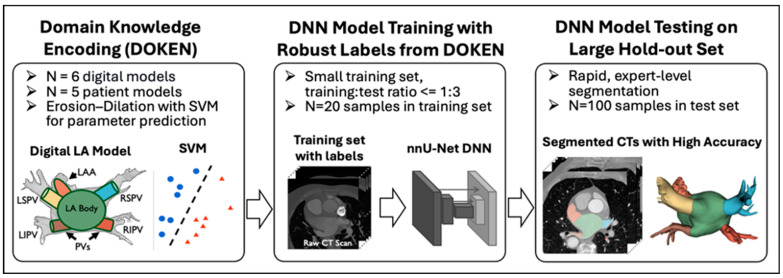
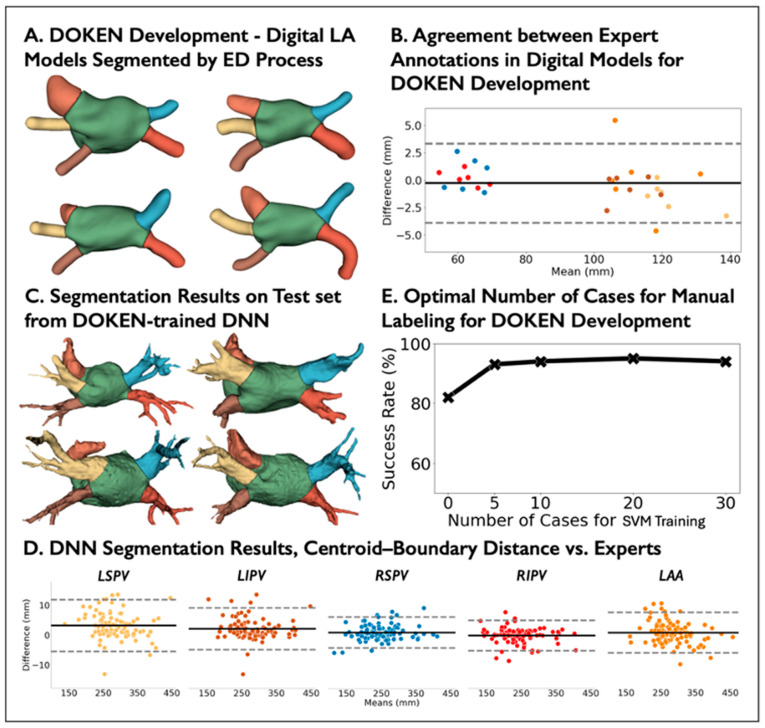
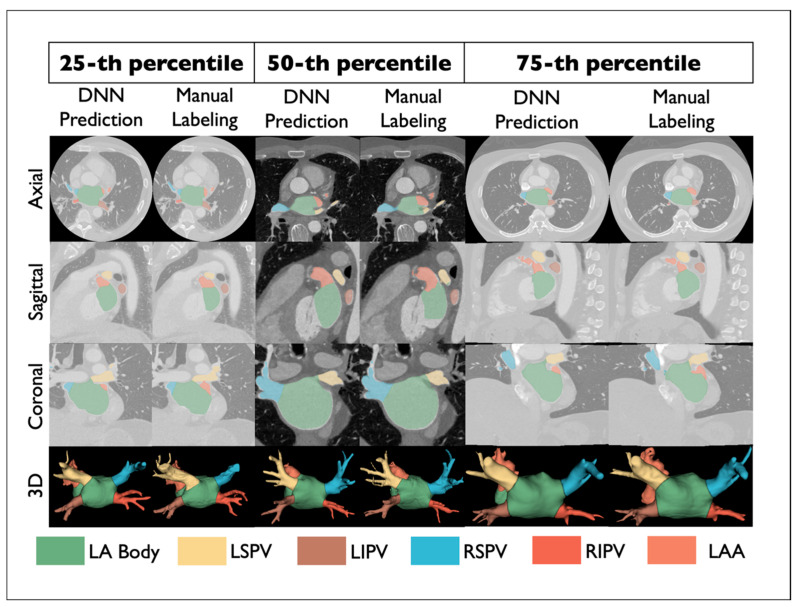
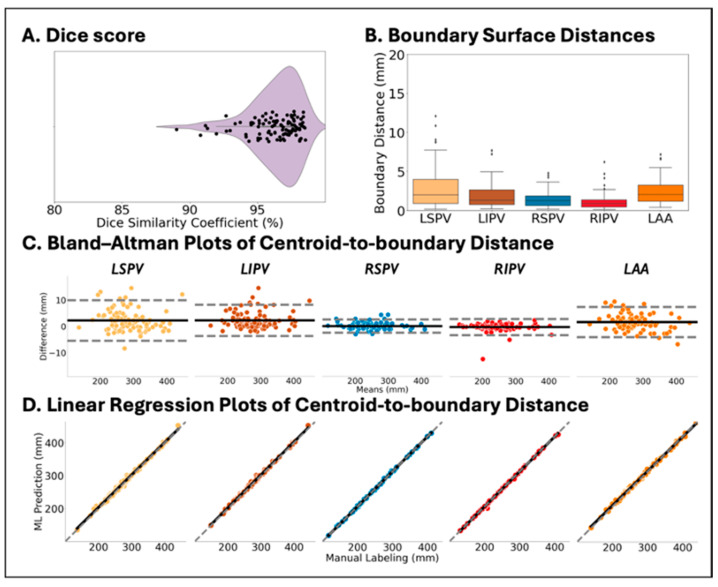
Segmenting computed tomography (CT) is crucial in various clinical applications, such as tailoring personalized cardiac ablation for managing cardiac arrhythmias. Automating segmentation through machine learning (ML) is hindered by the necessity for large, labeled training data, which can be challenging to obtain. This article proposes a novel approach for automated, robust labeling using domain knowledge to achieve high-performance segmentation by ML from a small training set. The approach, the domain knowledge-encoding (DOKEN) algorithm, reduces the reliance on large training datasets by encoding cardiac geometry while automatically labeling the training set. The method was validated in a hold-out dataset of CT results from an atrial fibrillation (AF) ablation study. The DOKEN algorithm parses left atrial (LA) structures, extracts "anatomical knowledge" by leveraging digital LA models (available publicly), and then applies this knowledge to achieve high ML segmentation performance with a small number of training samples. The DOKEN-labeled training set was used to train a nnU-Net deep neural network (DNN) model for segmenting cardiac CT in = 20 patients. Subsequently, the method was tested in a hold-out set with = 100 patients (five times larger than training set) who underwent AF ablation. The DOKEN algorithm integrated with the nn-Unet model achieved high segmentation performance with few training samples, with a training to test ratio of 1:5. The Dice score of the DOKEN-enhanced model was 96.7% (IQR: 95.3% to 97.7%), with a median error in surface distance of boundaries of 1.51 mm (IQR: 0.72 to 3.12) and a mean centroid-boundary distance of 1.16 mm (95% CI: -4.57 to 6.89), similar to expert results (r = 0.99; < 0.001). In digital hearts, the novel DOKEN approach segmented the LA structures with a mean difference for the centroid-boundary distances of -0.27 mm (95% CI: -3.87 to 3.33; r = 0.99; < 0.0001). The proposed novel domain knowledge-encoding algorithm was able to perform the segmentation of six substructures of the LA, reducing the need for large training data sets. The combination of domain knowledge encoding and a machine learning approach could reduce the dependence of ML on large training datasets and could potentially be applied to AF ablation procedures and extended in the future to other imaging, 3D printing, and data science applications.
在各种临床应用中,如为治疗心律失常量身定制个性化心脏消融术,计算机断层扫描(CT)图像分割至关重要。通过机器学习(ML)实现自动化分割受到获取大量带标签训练数据的限制,而获取此类数据颇具挑战性。本文提出一种新颖方法,利用领域知识进行自动、稳健的标注,以便从少量训练集中通过ML实现高性能分割。该方法即领域知识编码(DOKEN)算法,通过对心脏几何结构进行编码并自动标注训练集,减少了对大型训练数据集的依赖。该方法在心房颤动(AF)消融研究的CT结果验证数据集中得到验证。DOKEN算法解析左心房(LA)结构,借助公开可用的数字LA模型提取“解剖学知识”,然后应用此知识,以少量训练样本实现高ML分割性能。使用DOKEN标注的训练集对20例患者的心脏CT分割训练了nnU-Net深度神经网络(DNN)模型。随后,该方法在100例接受AF消融的患者(比训练集大五倍)的验证集中进行测试。与nn-Unet模型集成的DOKEN算法以少量训练样本实现了高分割性能,训练与测试比例为1:5。DOKEN增强模型的Dice分数为96.7%(四分位距:95.3%至97.7%),边界表面距离的中位数误差为1.51毫米(四分位距:0.72至3.12),质心与边界的平均距离为1.16毫米(95%置信区间:-4.57至6.89),与专家结果相似(r = 0.99;P < 0.001)。在数字心脏模型中,新颖的DOKEN方法分割LA结构时,质心与边界距离的平均差异为-0.27毫米(95%置信区间:-3.87至3.33;r = 0.99;P < 0.0001)。所提出的新颖领域知识编码算法能够对LA的六个子结构进行分割,减少了对大型训练数据集的需求。领域知识编码与机器学习方法的结合可以减少ML对大型训练数据集的依赖,并有可能应用于AF消融手术,未来还可扩展到其他成像、3D打印和数据科学应用中。