Cocîrlea Maria Denisa, Soare Amalia, Petrovici Anca Roxana, Silion Mihaela, Călin Teodora, Oancea Simona
Department of Agricultural Sciences and Food Engineering, "Lucian Blaga" University of Sibiu, 7-9 Ion Ratiu Street, 550024 Sibiu, Romania.
National Research and Development Institute for Cryogenic and Isotopic Technologies ICSI, 4 Uzinei Street, 240050 Râmnicu-Vâlcea, Romania.
Antioxidants (Basel). 2024 Jul 9;13(7):824. doi: 10.3390/antiox13070824.
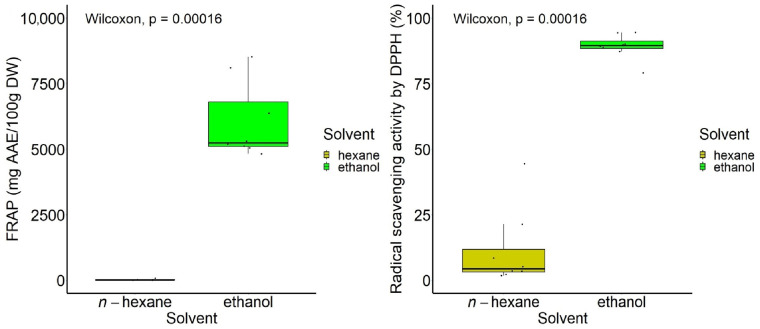
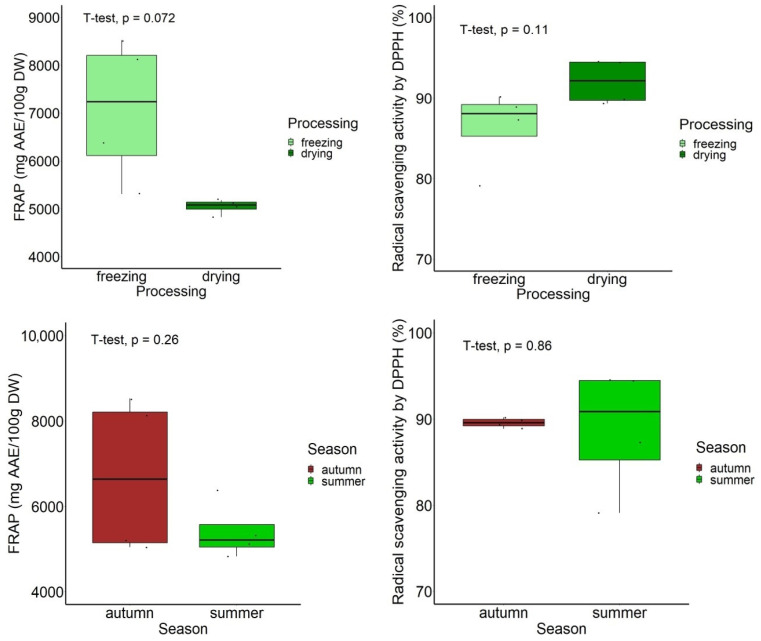
, a highly invasive species, contains valuable compounds in different plant parts, indicating great practical potential. This paper proposes the use of non-polar (-hexane) and polar (ethanol) solvents for the extraction of antioxidant compounds from (family Simaroubaceae) leaves in a sequential two-step process. Fresh and dried leaves were examined for their microstructure by scanning electron microscopy, and for color changes in the CIELAB color space co-ordinates. An investigation of the harvesting season, processing (freezing and drying), and solvent indicates ethanol can be used for the highly efficient extraction of phenolics, flavonoids, tannins, and carotenoids. Statistically significant differences were found between the autumn and summer samples for phenolic content, and between dried and frozen samples for tannin content. The HPLC phenolic profile indicates more phenolics (nine polyphenols) in dried leaves harvested in both seasons compared to those in frozen ones (five to six polyphenols). Frozen leaves showed a higher antioxidant activity in a ferric-reducing antioxidant power assay than that of the dried samples, which exhibited a higher antioxidant activity using the 1, 1-diphenyl-2-picryl-hydrazyl assay, but it was not statistically significant. The phenolic, flavonoid, and carotenoid contents significantly influenced the antioxidant activities. Among the ethanolic extracts, those from dried leaves showed better antibacterial activity, in particular, on and . The high bioactive content and activity of leaves make them suitable natural raw materials for various applications.
作为一种极具入侵性的物种,在其不同植物部位含有有价值的化合物,显示出巨大的实际应用潜力。本文提出采用非极性(正己烷)和极性(乙醇)溶剂,通过连续两步法从苦木科植物的叶子中提取抗氧化化合物。通过扫描电子显微镜检查新鲜和干燥叶子的微观结构,并在CIELAB颜色空间坐标中检测颜色变化。对收获季节、加工方式(冷冻和干燥)以及溶剂的研究表明,乙醇可用于高效提取酚类、黄酮类、单宁和类胡萝卜素。在酚类含量方面,秋季和夏季样本之间存在统计学上的显著差异,在单宁含量方面,干燥和冷冻样本之间存在显著差异。高效液相色谱酚类图谱显示,与冷冻叶子(五到六种多酚)相比,两个季节收获的干燥叶子中含有更多的酚类(九种多酚)。在铁还原抗氧化能力测定中,冷冻叶子显示出比干燥样本更高的抗氧化活性,而在1,1 - 二苯基 - 2 - 苦基肼测定中,干燥样本表现出更高的抗氧化活性,但差异无统计学意义。酚类、黄酮类和类胡萝卜素含量显著影响抗氧化活性。在乙醇提取物中,干燥叶子的提取物表现出更好的抗菌活性,特别是对[具体菌种1]和[具体菌种2]。苦木科植物叶子的高生物活性含量和活性使其成为适用于各种应用的天然原料。