Damanti Sarah, Citterio Lorena, Zagato Laura, Brioni Elena, Magnaghi Cristiano, Simonini Marco, De Lorenzo Rebecca, Ruggiero Mariapia, Santoro Simona, Senini Eleonora, Messina Marco, Vitali Giordano, Manunta Paolo, Manfredi Angelo A, Lanzani Chiara, Querini Patrizia Rovere
Internal Medicine Unit, IRCCS San Raffaele Scientific Institute, Milan, Italy.
Vita-Salute San Raffaele University, Milan, Italy.
BMC Geriatr. 2024 Jul 31;24(1):638. doi: 10.1186/s12877-024-05216-6.
The ageing process is characterized by a change of body composition with an increase of fat mass and a reduction of muscle mass. Above a certain threshold these alterations configure a condition named sarcopenic obesity (SO). SO is associated with physical frailty in Asian and Brazilian populations. SO impacts on physical frailty in other ethnic groups but its influence on general frailty which is multidimensional and includes cognitive, social and physical factors, remain insufficiently explored in the Italian population.
Frailty was measured in community dwelling Italian older adults enrolled in the FRASNET study with the frailty index (FI). The FI quantifies frailty as the ratio of the number of present health deficits to the total number of health deficits considered. Regression analyses were performed to assess the association between body composition categories and frailty. Classification and regression tree models were run to evaluate the frailty predictors.
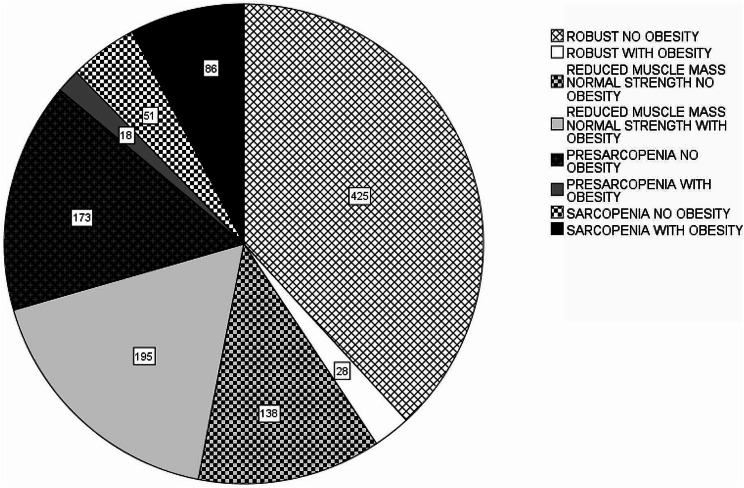
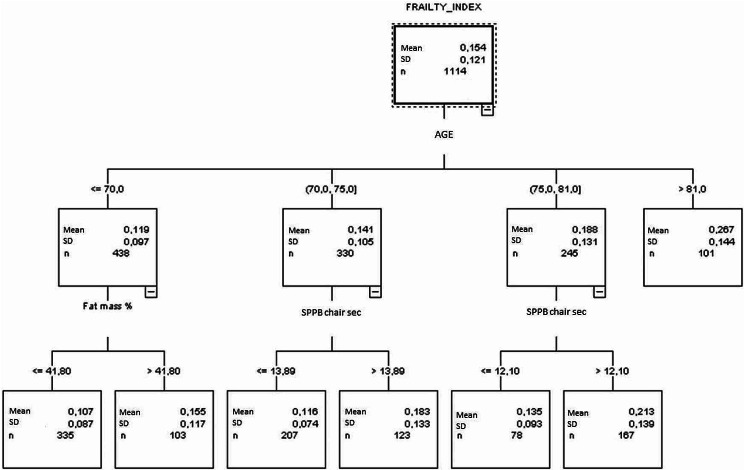
One Thousand One Hundred Fourteen participants of the FRASNET study were included in the present analysis. The sample was composed for the 60.5% by females and its median age was 72 years. The median FI score was 0.11 (IQR 0.07-0.20); 234 individuals (21%) were frail (FI ≥ 0.25). SO (B 0.074, 95% C.I. 0.05-0.1, p < 0.001) and pre-sarcopenia (without obesity B 0.03, 95% C.I, 0.007-0.044, p < 0.001, with obesity B 0.11, 95% C.I. 0.05-0.16, p < 0.001) were associated with frailty. Fat mass percentage predicted frailty in people aged 65-70 years whereas, muscle strength predicted general frailty in people aged 70-81 years.
Pre-sarcopenia and SO represent potentially treatable predictors of frailty.
衰老过程的特征是身体成分发生变化,脂肪量增加而肌肉量减少。超过一定阈值后,这些改变构成了一种名为肌少症肥胖(SO)的状况。在亚洲和巴西人群中,SO与身体虚弱相关。SO对其他种族群体的身体虚弱有影响,但其对包括认知、社会和身体因素在内的多维一般虚弱的影响,在意大利人群中仍未得到充分研究。
在参与FRASNET研究的意大利社区居住老年人中,使用虚弱指数(FI)测量虚弱程度。FI将虚弱量化为当前健康缺陷数量与所考虑的健康缺陷总数的比率。进行回归分析以评估身体成分类别与虚弱之间的关联。运行分类和回归树模型以评估虚弱的预测因素。
FRASNET研究的1114名参与者纳入了本分析。样本中60.5%为女性,中位年龄为72岁。FI中位数得分为0.11(四分位间距0.07 - 0.20);234人(21%)虚弱(FI≥0.25)。SO(B 0.074,95%置信区间0.05 - 0.1,p < 0.001)和肌少症前期(无肥胖B 0.03,95%置信区间0.007 - 0.044,p < 0.001,有肥胖B 0.11,95%置信区间0.05 - 0.16,p < 0.001)与虚弱相关。脂肪质量百分比可预测65 - 70岁人群的虚弱,而肌肉力量可预测70 - 81岁人群的一般虚弱。
肌少症前期和SO是虚弱的潜在可治疗预测因素。