Ambulatório de Cardiologia Geriátrica, Divisão de Cardiologia, Escola Paulista de Medicina, Universidade Federal de São Paulo, São Paulo, SP, Brasil.
Grupo de Pesquisa em Vulnerabilidade a Doenças do Idoso - Divisão de Cardiologia, Escola Paulista de Medicina, Universidade Federal de São Paulo, São Paulo, SP, Brasil.
Arch Endocrinol Metab. 2023 Mar 30;67(3):361-371. doi: 10.20945/2359-3997000000587.
To identify the obesity diagnosis with the highest association with physical frailty associated with sarcopenia EWGSOP II (sarcopenic obesity).
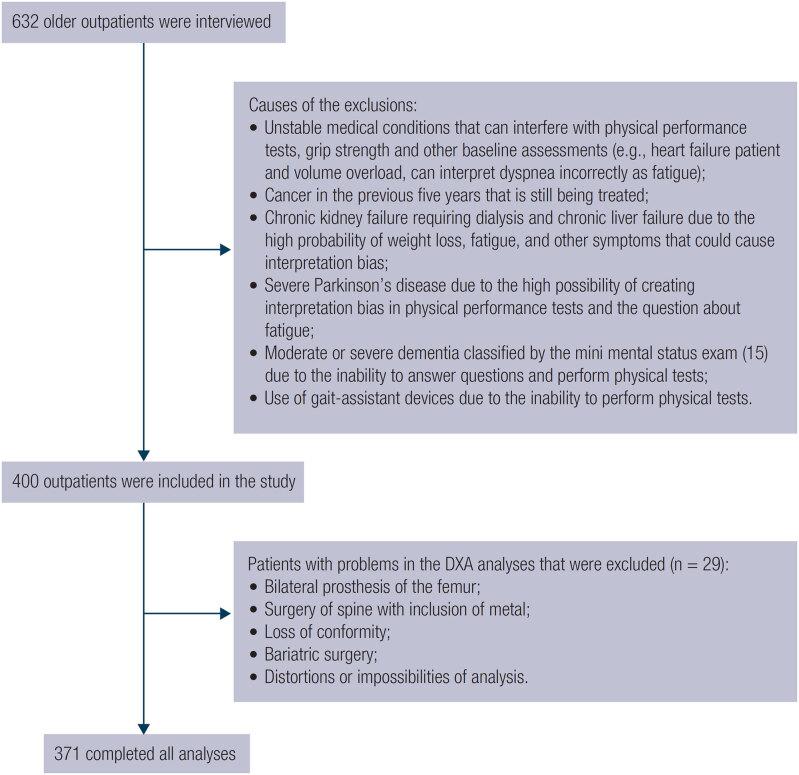
We performed a cross-sectional analysis of 371 community-dwelling older adults. Appendicular skeletal lean mass and total body fat (TBF) were assessed using dual-energy x-ray absorptiometry, and physical frailty was defined using Fried's criteria. The phenotypes were identified according to the presence of sarcopenia by EWGSOP II and obesity, which was diagnosed using two concepts: BMI obesity (BMI ≥ 30 kg/m) and TBF obesity (percentage of TBF ≥ 35% for women and ≥ 25% for men). Finally, the association of each group with physical frailty was evaluated.
The mean age was 78.15 ± 7.22 years. Sarcopenia EWGSOP II was diagnosed in 19.8% (n = 73), body mass index obesity was identified in 21.8% (n = 81), TBF obesity was identified in 67.7% (n = 251), and physical frailty was identified in 38.5% (n = 142). In a regression analysis for frailty, sarcopenic TBF obesity presented an odds ratio of 6.88 (95% confidence interval 2.60-18.24; p < 0.001).
In older Brazilian adults, sarcopenic obesity diagnosed by TBF obesity has a robust association with frailty and is independent of body mass index.
确定与 EWGSOP II 定义的与肌少症相关的躯体脆弱性(肌少症性肥胖)关联度最高的肥胖诊断。
我们对 371 名居住在社区的老年人进行了横断面分析。使用双能 X 射线吸收法评估四肢骨骼肌瘦质量和全身脂肪(TBF),并根据 Fried 标准定义躯体脆弱性。根据 EWGSOP II 确定的肌少症和肥胖的存在来确定表型,肥胖采用两种概念来诊断:体重指数肥胖(BMI≥30kg/m²)和 TBF 肥胖(女性 TBF 百分比≥35%,男性 TBF 百分比≥25%)。最后,评估每组与躯体脆弱性的关联。
平均年龄为 78.15±7.22 岁。19.8%(n=73)诊断为 EWGSOP II 肌少症,21.8%(n=81)诊断为体重指数肥胖,67.7%(n=251)诊断为 TBF 肥胖,38.5%(n=142)诊断为躯体脆弱性。在脆弱性的回归分析中,TBF 肥胖的肌少症性肥胖的优势比为 6.88(95%置信区间 2.60-18.24;p<0.001)。
在巴西老年人群中,通过 TBF 肥胖诊断的肌少症性肥胖与脆弱性具有很强的关联,且与体重指数无关。