Department of Psychology and Columbine Health Systems Center for Healthy Aging, Colorado State University, Fort Collins, Colorado, USA.
USC Chan Division of Occupational Science and Occupational Therapy, University of Southern California, Los Angeles, California, USA.
Gerontologist. 2024 Oct 1;64(10). doi: 10.1093/geront/gnae097.
The central aim of the present study was to model developmental trends in communal and independent religious practices, spirituality, positive and negative religious/spiritual coping, as well as their confluence, across ages 45-80.
Participants derived from the Notre Dame Study of Health & Well-being (NDHWB), a longitudinal study spanning 10 years in an age-heterogeneous sample. Using 2-level multilevel models, we estimated no change, linear change, quadratic change, and cubic change functions across ages 45-80 in each construct. Cohort differences were also tested.
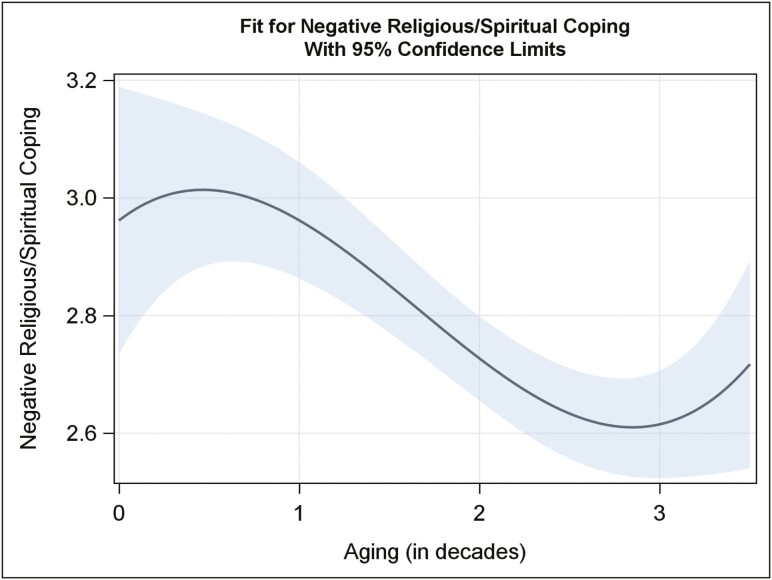
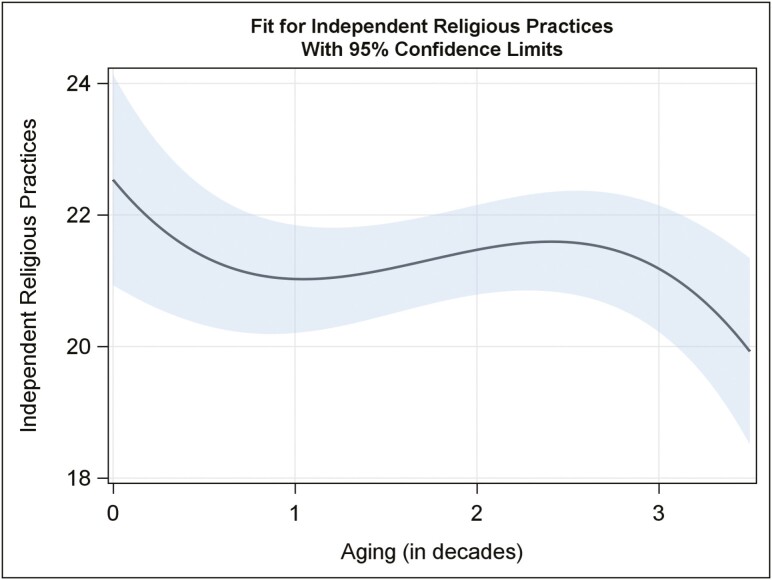
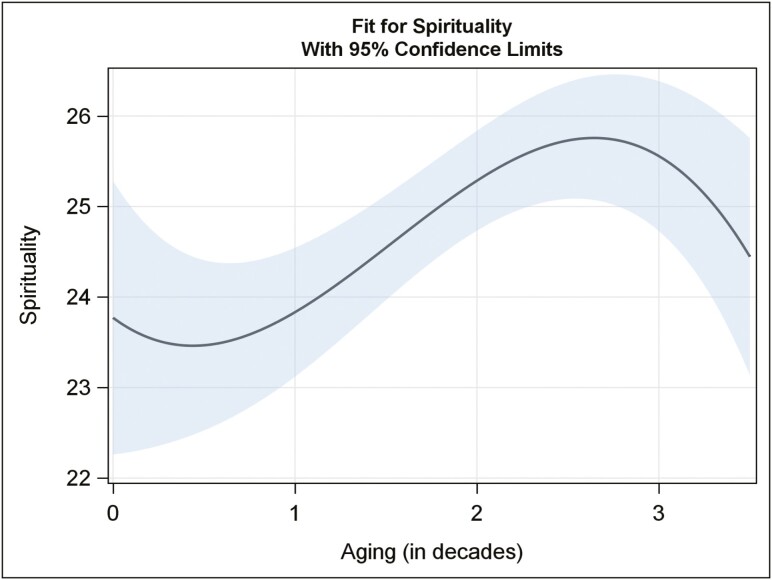
Communal and independent practices, spirituality, negative religious/spiritual coping, as well as composite religiosity/spirituality, followed cubic trajectories across mid- to later life. Communal religious practices peaked twice: once at 45 and again around age 70. Independent practices, in contrast, peaked at age 45 and then declined in a stage-like manner until age 80. Spirituality reached its nadir around age 50 and peaked in the early 70s; the reverse was true for negative religious/spiritual coping. The change trajectory in composite religiosity/spirituality most resembled that of independent religious practices. Finally, positive religious/spiritual coping followed a linear trajectory, but a cohort difference precluded its interpretation as developmental change.
Individuals appear to engage with their faith in different ways as they age, meaning extant conclusions about age-related differences and change in global religiosity/spirituality may be distorted.
本研究的主要目的是建立模型,以描绘 45 岁至 80 岁人群在公共和独立宗教实践、灵性、积极和消极宗教/精神应对方面的发展趋势,以及它们的融合。
参与者来自圣母大学健康与幸福感研究(NDHWB),这是一项跨越 10 年的、年龄多样化的纵向研究。我们使用 2 级多层模型,估计了每个结构在 45 岁至 80 岁期间没有变化、线性变化、二次变化和三次变化的函数。还测试了队列差异。
公共和独立的宗教实践、灵性、消极的宗教/精神应对以及综合宗教/精神信仰在中年到晚年期间都呈现出三次曲线轨迹。公共宗教实践有两个高峰:一次在 45 岁,另一次在 70 岁左右。相比之下,独立的宗教实践在 45 岁时达到高峰,然后呈阶段式下降,直到 80 岁。灵性在 50 岁左右达到最低点,在 70 年代初达到高峰;消极的宗教/精神应对则相反。综合宗教/精神信仰的变化轨迹最类似于独立宗教实践。最后,积极的宗教/精神应对呈现线性轨迹,但由于队列差异,不能将其解释为发展变化。
随着年龄的增长,个体似乎以不同的方式参与他们的信仰,这意味着关于年龄相关差异和整体宗教/精神信仰变化的现有结论可能会被扭曲。