Ayana Gelan, Dese Kokeb, Daba Nemomssa Hundessa, Habtamu Bontu, Mellado Bruce, Badu Kingsley, Yamba Edmund, Faye Sylvain Landry, Ondua Moise, Nsagha Dickson, Nkweteyim Denis, Kong Jude Dzevela
School of Biomedical Engineering, Jimma University, Jimma, Ethiopia.
Global South Artificial Intelligence for Pandemic and Epidemic Preparedness and Response Network (AI4PEP).
R Soc Open Sci. 2024 Aug 7;11(8):231994. doi: 10.1098/rsos.231994. eCollection 2024 Aug.
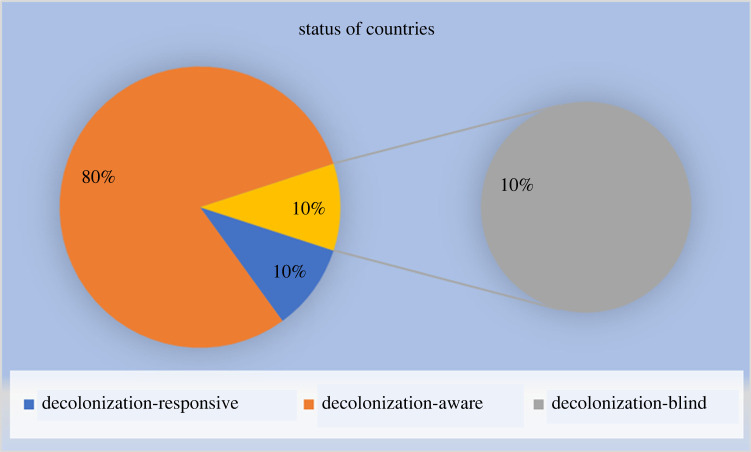
Global artificial intelligence (AI) governance must prioritize equity, embrace a decolonial mindset, and provide the Global South countries the authority to spearhead solution creation. Decolonization is crucial for dismantling Western-centric cognitive frameworks and mitigating biases. Integrating a decolonial approach to AI governance involves recognizing persistent colonial repercussions, leading to biases in AI solutions and disparities in AI access based on gender, race, geography, income and societal factors. This paradigm shift necessitates deliberate efforts to deconstruct imperial structures governing knowledge production, perpetuating global unequal resource access and biases. This research evaluates Sub-Saharan African progress in AI governance decolonization, focusing on indicators like AI governance institutions, national strategies, sovereignty prioritization, data protection regulations, and adherence to local data usage requirements. Results show limited progress, with only Rwanda notably responsive to decolonization among the ten countries evaluated; 80% are 'decolonization-aware', and one is 'decolonization-blind'. The paper provides a detailed analysis of each nation, offering recommendations for fostering decolonization, including stakeholder involvement, addressing inequalities, promoting ethical AI, supporting local innovation, building regional partnerships, capacity building, public awareness, and inclusive governance. This paper contributes to elucidating the challenges and opportunities associated with decolonization in SSA countries, thereby enriching the ongoing discourse on global AI governance.
全球人工智能治理必须将公平置于优先地位,秉持去殖民化思维,并赋予全球南方国家率先创造解决方案的权力。去殖民化对于打破以西方为中心的认知框架和减轻偏见至关重要。将去殖民化方法融入人工智能治理,需要认识到持续存在的殖民影响,这种影响导致人工智能解决方案存在偏见,以及在人工智能获取方面基于性别、种族、地理位置、收入和社会因素的差异。这种范式转变需要刻意努力去解构主导知识生产的帝国结构,因为这种结构使全球资源获取不平等和偏见长期存在。本研究评估了撒哈拉以南非洲在人工智能治理去殖民化方面的进展,重点关注人工智能治理机构、国家战略、主权优先事项、数据保护法规以及对本地数据使用要求的遵守情况等指标。结果显示进展有限,在所评估的十个国家中,只有卢旺达对去殖民化有显著响应;80%的国家“意识到去殖民化”,还有一个国家则“对去殖民化毫无察觉”。本文对每个国家进行了详细分析,并提出了促进去殖民化的建议,包括利益相关者参与、解决不平等问题、推广符合伦理的人工智能、支持本地创新、建立区域伙伴关系、能力建设、提高公众意识以及包容性治理。本文有助于阐明撒哈拉以南非洲国家去殖民化相关的挑战和机遇,从而丰富正在进行的关于全球人工智能治理的讨论。