Di Lillo Luigi, Gode Tilia, Zhou Xilin, Atzei Margherita, Chen Ruoshu, Victor Trent
Swiss Reinsurance Company, Ltd, Switzerland.
Autonomous Systems Laboratory, Stanford University, USA.
Heliyon. 2024 Jul 14;10(14):e34379. doi: 10.1016/j.heliyon.2024.e34379. eCollection 2024 Jul 30.
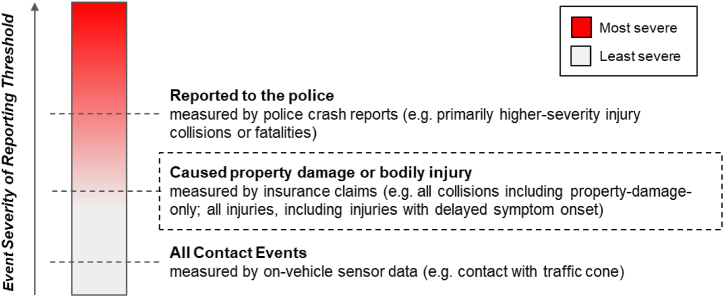
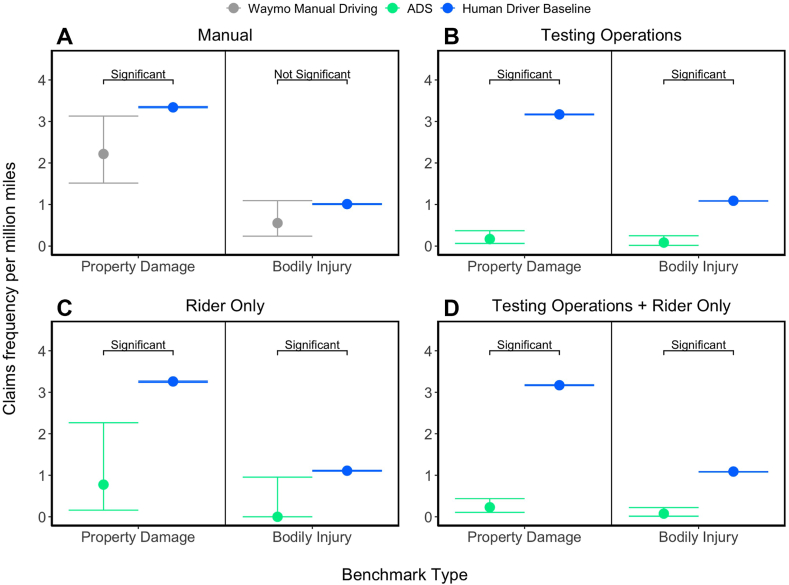
After several years of public road testing, the commercial deployment of fully autonomous vehicles-or Automated Driving Systems (ADS)-is poised to scale substantially following significant technological advancements and recent regulatory approvals. However, the fundamental question of whether an ADS is safer than its human counterparts remain largely unsolved due to several challenges in establishing an appropriate real-world safety comparison method. As scaling ensues, the lack of an established method can contribute to misinterpretations or uncertainties regarding ADS safety and impede the continuous and consistent assessment of ADS performance. This study introduces three research developments to define a robust and replicable safety comparison method to address this critical methodological gap. First, we introduce the use of liability insurance claims data to measure the comparative safety between ADS and human drivers. Second, we use Swiss Re insurance claims data to establish the first zip code- and responsibility-calibrated human performance benchmark, composed of over 600,000 private passenger vehicle claims and 125 billion miles of driving exposure. Third, we perform a case study by applying the developed baseline to evaluate the safety impact of the Waymo Driver. We find that when benchmarked against zip code-calibrated human baselines, the Waymo Driver significantly improves safety towards other road users. The comparison method established in this study can be replicated for other regions or ADS deployments to aid the decision-making of ADS safety stakeholders such as regulators, and instill trust in the general public.
经过数年的公共道路测试,随着重大技术进步和近期监管批准,全自动驾驶车辆或自动驾驶系统(ADS)的商业部署有望大幅扩展。然而,由于在建立合适的现实世界安全比较方法方面存在若干挑战,ADS是否比人类驾驶更安全这一基本问题在很大程度上仍未得到解决。随着规模扩大,缺乏既定方法可能导致对ADS安全的误解或不确定性,并阻碍对ADS性能进行持续一致的评估。本研究介绍了三项研究进展,以定义一种稳健且可重复的安全比较方法,来填补这一关键的方法学空白。首先,我们引入使用责任保险索赔数据来衡量ADS与人类驾驶员之间的相对安全性。其次,我们使用瑞士再保险的索赔数据建立了首个经邮政编码和责任校准的人类性能基准,该基准由超过60万起私人乘用车索赔和1250亿英里的驾驶里程组成。第三,我们通过应用所开发的基线进行案例研究,以评估Waymo Driver的安全影响。我们发现,与经邮政编码校准的人类基线相比,Waymo Driver显著提高了对其他道路使用者的安全性。本研究中建立的比较方法可在其他地区或ADS部署中复制,以帮助监管机构等ADS安全利益相关者进行决策,并在公众中树立信任。