Zabihi Mariam, Kia Seyed Mostafa, Wolfers Thomas, de Boer Stijn, Fraza Charlotte, Dinga Richard, Arenas Alberto Llera, Bzdok Danilo, Beckmann Christian F, Marquand Andre
Donders Institute for Brain, Cognition and Behavior, Radboud University Nijmegen, Nijmegen, the Netherlands.
Department for Cognitive Neuroscience, Radboud University Medical Center Nijmegen, Nijmegen, the Netherlands.
PLoS One. 2024 Aug 8;19(8):e0308329. doi: 10.1371/journal.pone.0308329. eCollection 2024.
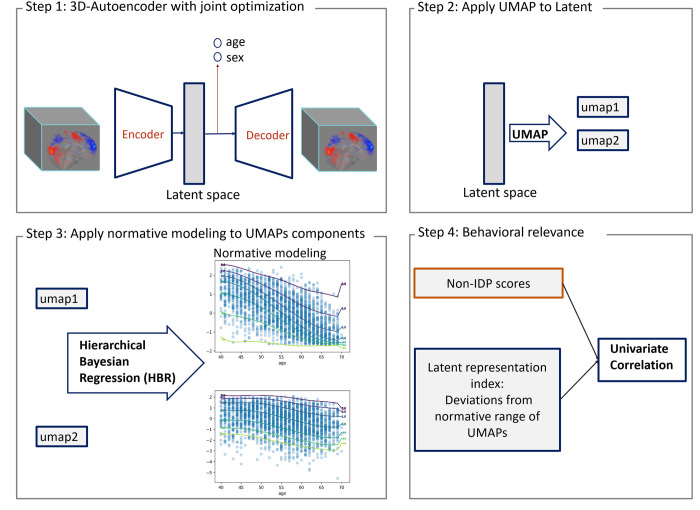
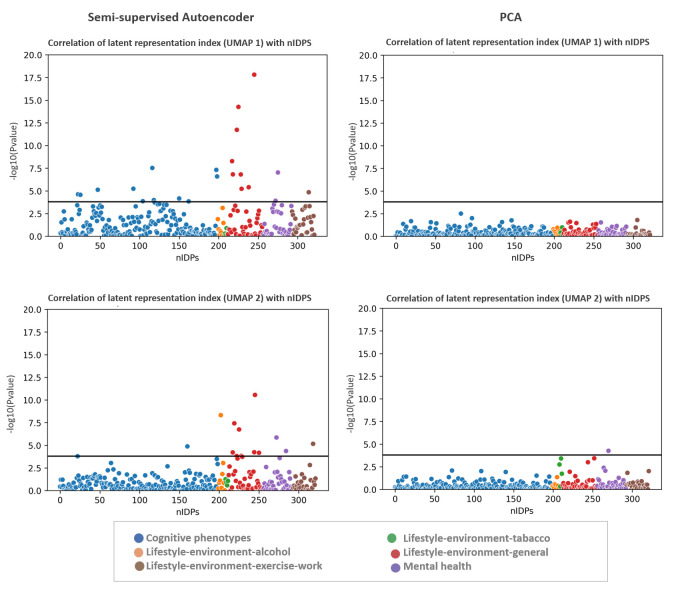
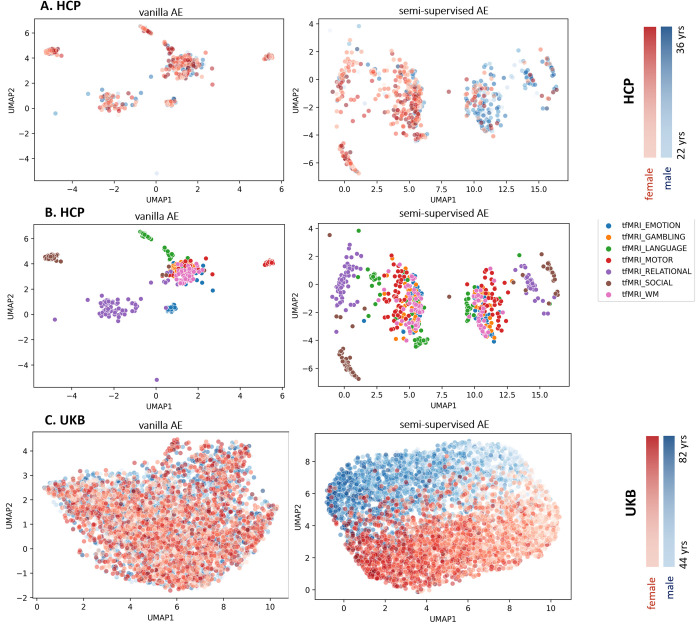
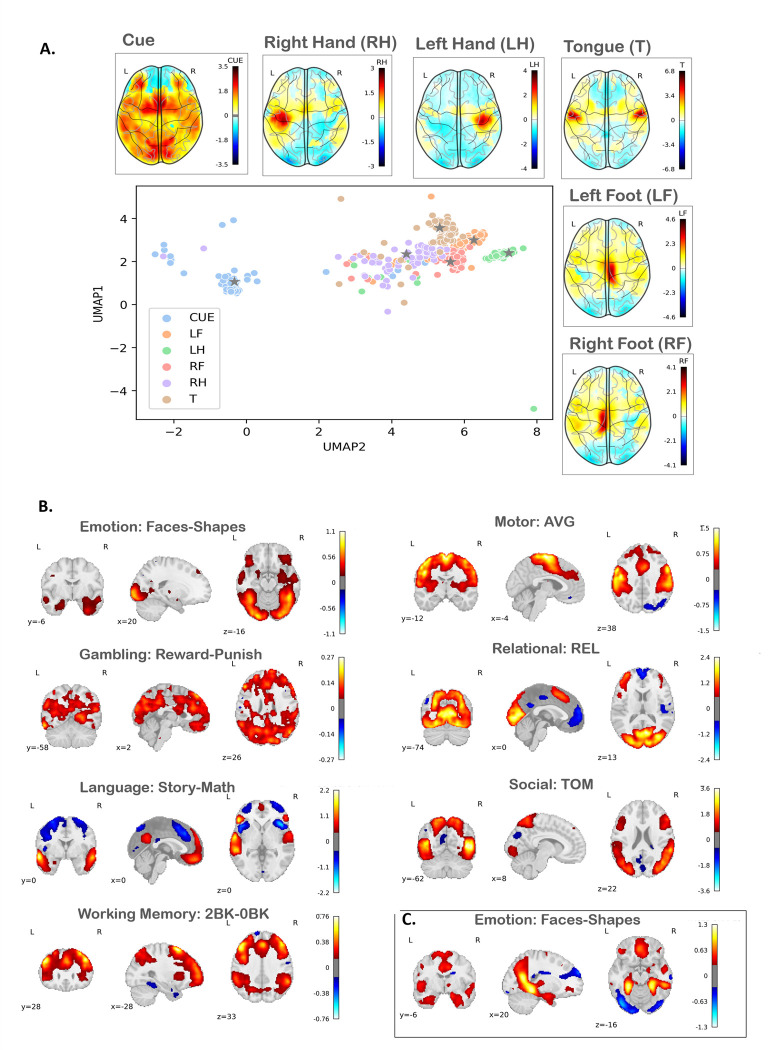
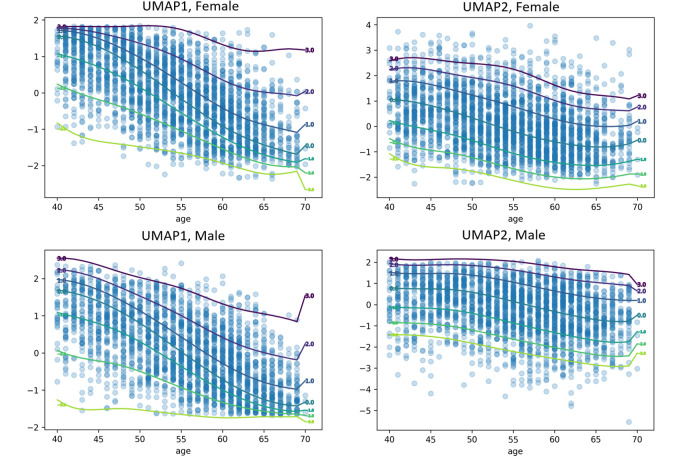
Finding an interpretable and compact representation of complex neuroimaging data is extremely useful for understanding brain behavioral mapping and hence for explaining the biological underpinnings of mental disorders. However, hand-crafted representations, as well as linear transformations, may inadequately capture the considerable variability across individuals. Here, we implemented a data-driven approach using a three-dimensional autoencoder on two large-scale datasets. This approach provides a latent representation of high-dimensional task-fMRI data which can account for demographic characteristics whilst also being readily interpretable both in the latent space learned by the autoencoder and in the original voxel space. This was achieved by addressing a joint optimization problem that simultaneously reconstructs the data and predicts clinical or demographic variables. We then applied normative modeling to the latent variables to define summary statistics ('latent indices') and establish a multivariate mapping to non-imaging measures. Our model, trained with multi-task fMRI data from the Human Connectome Project (HCP) and UK biobank task-fMRI data, demonstrated high performance in age and sex predictions and successfully captured complex behavioral characteristics while preserving individual variability through a latent representation. Our model also performed competitively with respect to various baseline models including several variants of principal components analysis, independent components analysis and classical regions of interest, both in terms of reconstruction accuracy and strength of association with behavioral variables.
找到复杂神经影像数据的可解释且紧凑的表示形式,对于理解大脑行为映射以及解释精神障碍的生物学基础极为有用。然而,手工制作的表示形式以及线性变换可能无法充分捕捉个体间的显著变异性。在此,我们在两个大规模数据集上使用三维自动编码器实现了一种数据驱动的方法。这种方法提供了高维任务功能磁共振成像(task-fMRI)数据的潜在表示,它可以解释人口统计学特征,同时在自动编码器学习的潜在空间以及原始体素空间中都易于解释。这是通过解决一个联合优化问题来实现的,该问题同时重建数据并预测临床或人口统计学变量。然后,我们对潜在变量应用规范建模来定义汇总统计量(“潜在指标”)并建立到非成像测量的多变量映射。我们的模型使用来自人类连接组计划(HCP)的多任务功能磁共振成像数据和英国生物银行任务功能磁共振成像数据进行训练,在年龄和性别预测方面表现出高性能,并通过潜在表示成功捕捉了复杂的行为特征,同时保留了个体变异性。在重建准确性以及与行为变量的关联强度方面,我们的模型相对于各种基线模型(包括主成分分析、独立成分分析的几种变体以及经典感兴趣区域)也具有竞争力。