Department of Biomedical Engineering, Yale University, New Haven, Connecticut, USA.
Halıcıoğlu Data Science Institute, University of California San Diego, La Jolla, California, USA.
Hum Brain Mapp. 2021 Oct 1;42(14):4510-4524. doi: 10.1002/hbm.25561. Epub 2021 Jun 29.
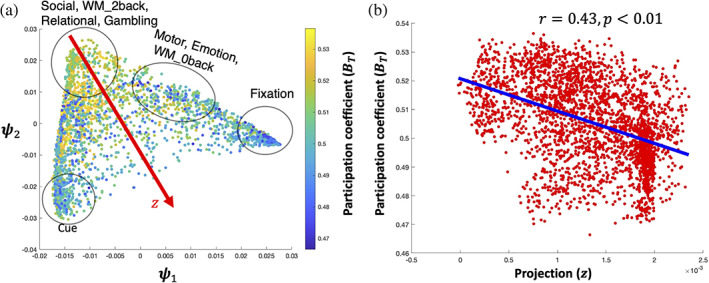
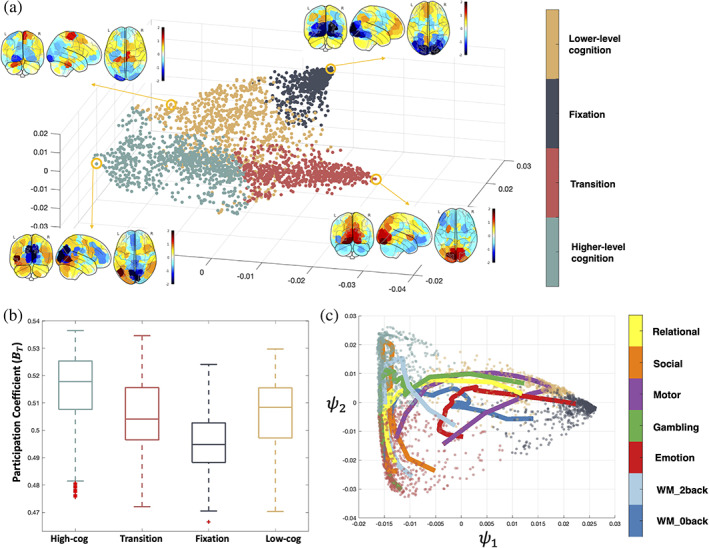
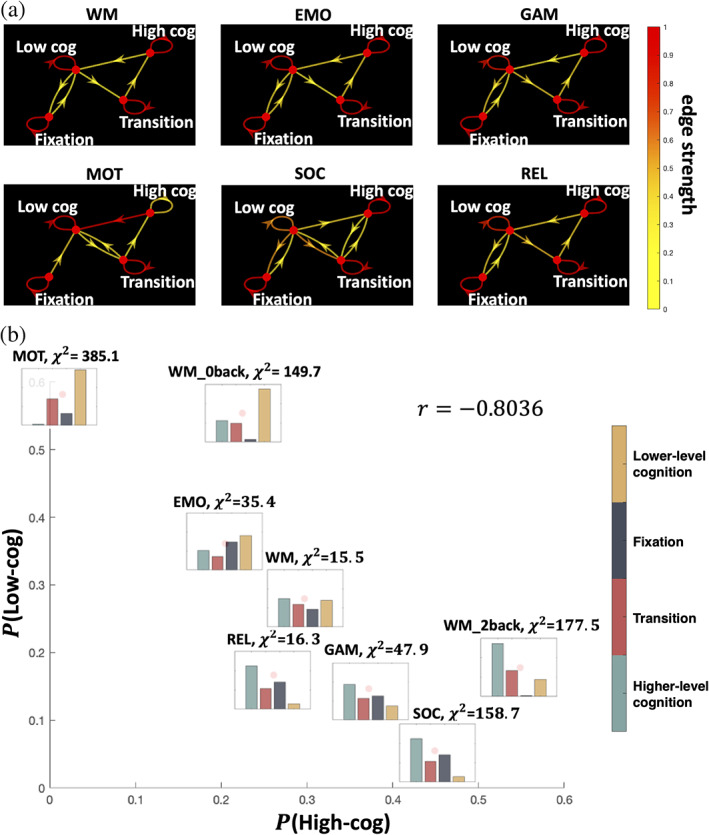
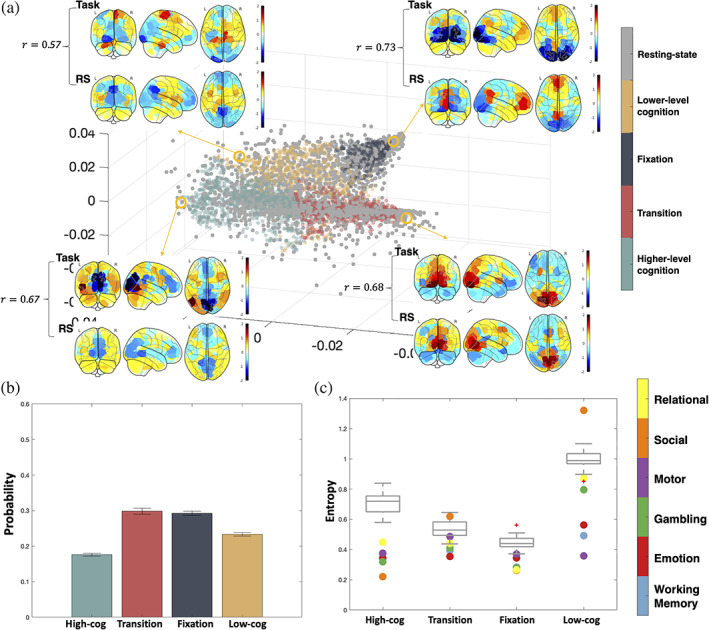
Large-scale brain dynamics are believed to lie in a latent, low-dimensional space. Typically, the embeddings of brain scans are derived independently from different cognitive tasks or resting-state data, ignoring a potentially large-and shared-portion of this space. Here, we establish that a shared, robust, and interpretable low-dimensional space of brain dynamics can be recovered from a rich repertoire of task-based functional magnetic resonance imaging (fMRI) data. This occurs when relying on nonlinear approaches as opposed to traditional linear methods. The embedding maintains proper temporal progression of the tasks, revealing brain states and the dynamics of network integration. We demonstrate that resting-state data embeds fully onto the same task embedding, indicating similar brain states are present in both task and resting-state data. Our findings suggest analysis of fMRI data from multiple cognitive tasks in a low-dimensional space is possible and desirable.
人们相信大规模的大脑动力学存在于潜在的低维空间中。通常,脑扫描的嵌入是分别从不同的认知任务或静息态数据中得出的,忽略了这个空间中潜在的、大量的共享部分。在这里,我们证明了可以从丰富的基于任务的功能磁共振成像(fMRI)数据中恢复出一个共享的、稳健的和可解释的大脑动力学低维空间。这是通过依赖于非线性方法而不是传统的线性方法来实现的。该嵌入保持了任务的适当时间进展,揭示了大脑状态和网络整合的动力学。我们证明静息态数据完全嵌入到相同的任务嵌入中,表明在任务和静息态数据中都存在相似的大脑状态。我们的发现表明,在低维空间中对来自多个认知任务的 fMRI 数据进行分析是可能的,也是可取的。