Zhao Jia, Ren Ruihang, Beeraka Narasimha M, Pa Mahesh, Xue Nannan, Lu Pengfei, Bai Wenhua, Mao Zhihan, Pr Hemanth Vikram, Bulygin Kirill V, Nikolenko Vladimir N, Fan Ruitai, Liu Junqi
Department of Thoracic Surgery, The First Affiliated Hospital of Zhengzhou University, Zhengzhou, China.
Department of Radiation Oncology & Cancer Center, The First Affiliated Hospital of Zhengzhou University, Zhengzhou, China.
Front Oncol. 2024 Jul 25;14:1398679. doi: 10.3389/fonc.2024.1398679. eCollection 2024.
Tracheal, Bronchus, and Lung (TBL) cancer continues to represent the majority of cancer-related incidence and mortality in United States (U.S.). While air pollutants are considered essential risk factors, both global and national average concentrations of major harmful air pollutants have significantly decreased over the decades. Green space may have a beneficial effect on human health.
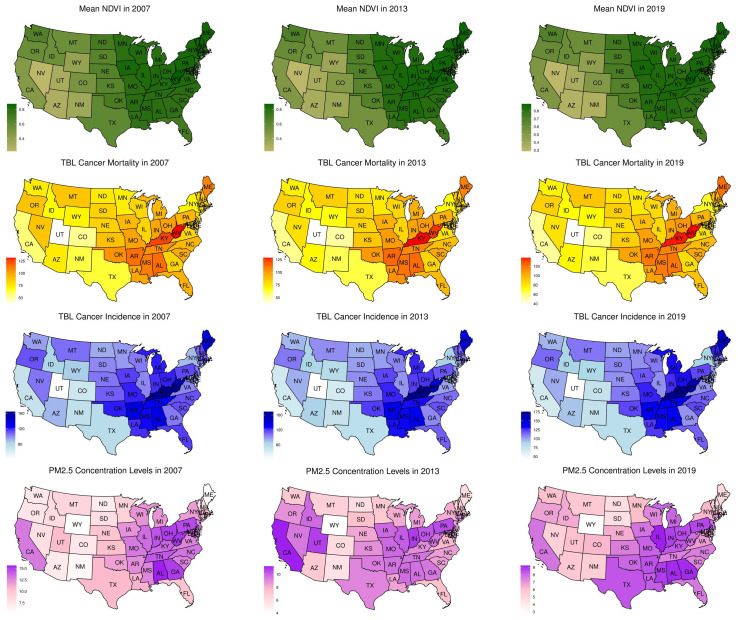
We obtained data on national and state-level burden of TBL cancer, the annual average concentration of main air pollutants, and levels of green spaces in 2007, 2013, and 2019. According to generalized estimating equation (GEE), we examine the associations among incidence and mortality of TBL cancer, air pollutants, and greenspaces, represented by the Normalized Difference Vegetation Index (NDVI) in different age groups with models adjusted with meteorological, and socio-demographic. We observed additional effects of the interaction between the NDVI, Ozone, PM2.5, and other factors, which helped us to interpret and understand our results. Also, we collated states that witnessed net increments in forest coverage and conducted the same analysis separately.
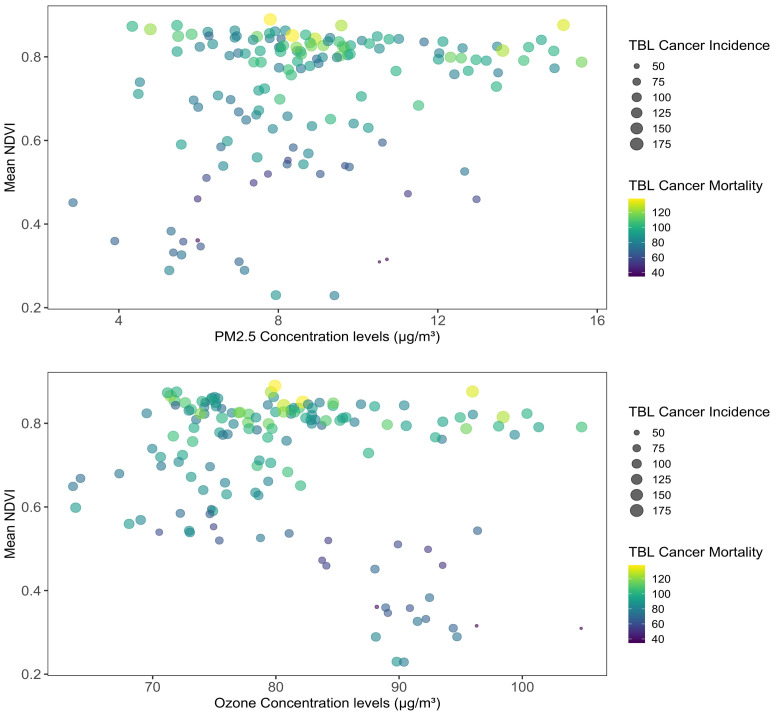
In our analysis, the majority of associations between NDVI and air pollutants with TBL cancer remained significantly positive, particularly noticeable among individuals aged 20 to 54. However, our findings did not explore air pollution as a potential mediator between greenspace exposure and TBL cancer. While the associations of PM2.5 with TBL cancer remained positive, the other four pollutants showed positive but statistically insignificant associations. Our interaction analysis yielded that there were positive associations between NDVI and ozone, PM2.5, and tobacco use. Max NDVI acts as a protective factor along with high HDI. Additionally, PM2.5 and HDI also showed a negative association. In 18 states with more forest, NDVI acts as a protective factor along with higher health care coverage, better health status, and participation in physical activities.
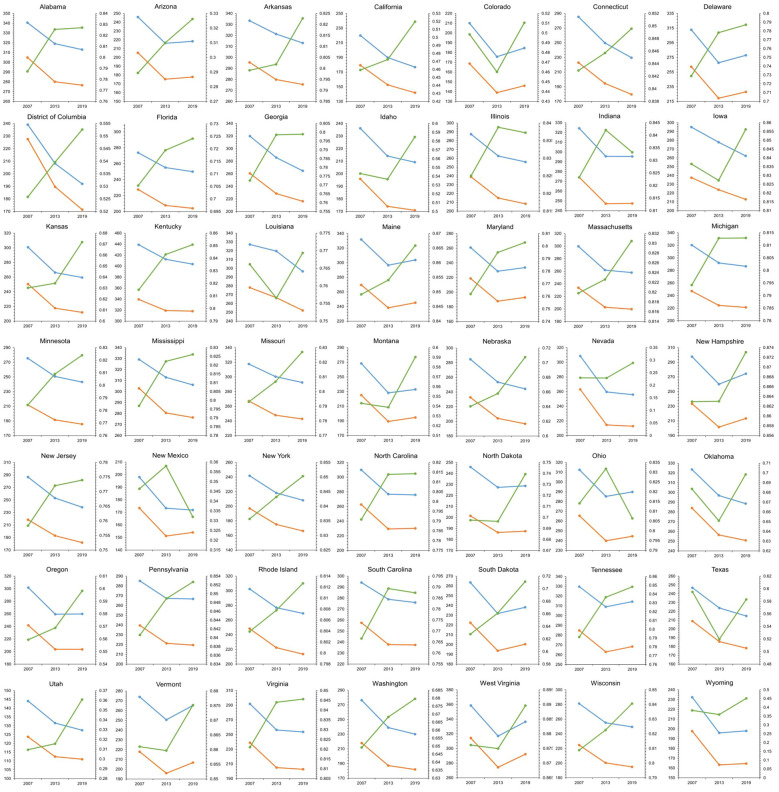
In the state-level of U.S., the effects of total greenspace with TBL cancer are mixed and could be modified by various socio-economic factors. PM2.5 has a direct correlation with TBL cancer and the effects can be influenced by underlying socioeconomic conditions.
气管、支气管和肺癌(TBL)在美国癌症相关发病率和死亡率中仍占大多数。虽然空气污染物被认为是主要风险因素,但几十年来,主要有害空气污染物的全球和国家平均浓度已显著下降。绿色空间可能对人类健康有有益影响。
我们获取了2007年、2013年和2019年国家和州层面的TBL癌症负担、主要空气污染物的年平均浓度以及绿色空间水平的数据。根据广义估计方程(GEE),我们研究了不同年龄组中TBL癌症发病率和死亡率、空气污染物以及以归一化植被指数(NDVI)表示的绿色空间之间的关联,并使用气象和社会人口统计学因素进行模型调整。我们观察了NDVI、臭氧、PM2.5和其他因素之间相互作用的额外影响,这有助于我们解释和理解研究结果。此外,我们整理了森林覆盖率有净增长的州,并分别进行了相同的分析。
在我们的分析中,NDVI和空气污染物与TBL癌症之间的大多数关联仍显著为正,在20至54岁的个体中尤为明显。然而,我们的研究结果并未将空气污染作为绿色空间暴露与TBL癌症之间的潜在中介因素进行探讨。虽然PM2.5与TBL癌症的关联仍为正,但其他四种污染物显示出正相关但在统计学上不显著。我们的交互分析表明,NDVI与臭氧、PM2.5和烟草使用之间存在正相关。最大NDVI与高人类发展指数(HDI)一起作为保护因素。此外,PM2.5与HDI也呈负相关。在18个森林较多的州,NDVI与更高的医疗保健覆盖率、更好的健康状况以及参与体育活动一起作为保护因素。
在美国州层面,绿色空间总量对TBL癌症的影响是复杂的,并且可能受到各种社会经济因素的影响。PM2.5与TBL癌症有直接关联,其影响可能受到潜在社会经济状况的影响。