School of Communications and Information Engineering, Chongqing University of Posts and Telecommunications, Chongqing, 400065, China.
School of Medical Information and Engineering, Southwest Medical University, Luzhou, 646000, China.
BMC Med Imaging. 2024 Aug 9;24(1):207. doi: 10.1186/s12880-024-01386-2.
The quality of low-light endoscopic images involves applications in medical disciplines such as physiology and anatomy for the identification and judgement of tissue structures. Due to the use of point light sources and the constraints of narrow physiological structures, medical endoscopic images display uneven brightness, low contrast, and a lack of texture information, presenting diagnostic challenges for physicians.
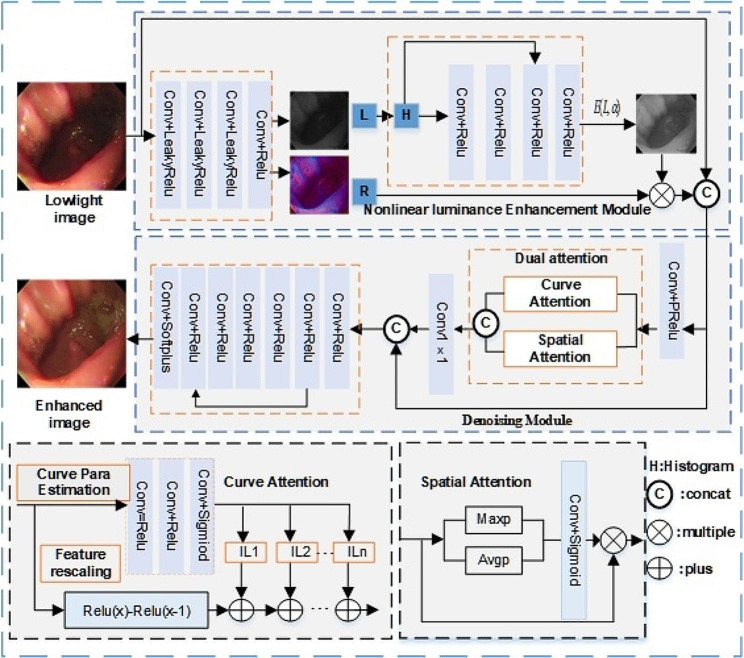
In this paper, a nonlinear brightness enhancement and denoising network based on Retinex theory is designed to improve the brightness and details of low-light endoscopic images. The nonlinear luminance enhancement module uses higher-order curvilinear functions to improve overall brightness; the dual-attention denoising module captures detailed features of anatomical structures; and the color loss function mitigates color distortion.
Experimental results on the Endo4IE dataset demonstrate that the proposed method outperforms existing state-of-the-art methods in terms of Peak Signal-to-Noise Ratio (PSNR), Structural Similarity (SSIM), and Learned Perceptual Image Patch Similarity (LPIPS). The PSNR is 27.2202, SSIM is 0.8342, and the LPIPS is 0.1492. It provides a method to enhance image quality in clinical diagnosis and treatment.
It offers an efficient method to enhance images captured by endoscopes and offers valuable insights into intricate human physiological structures, which can effectively assist clinical diagnosis and treatment.
低光照内镜图像的质量涉及到生理学和解剖学等医学学科的应用,用于识别和判断组织结构。由于使用点光源和狭窄生理结构的限制,医学内镜图像呈现出亮度不均匀、对比度低、纹理信息缺失的特点,给医生的诊断带来了挑战。
本文设计了一种基于 Retinex 理论的非线性亮度增强和去噪网络,用于提高低光照内镜图像的亮度和细节。非线性亮度增强模块使用高阶曲线函数来提高整体亮度;双注意力去噪模块捕捉解剖结构的详细特征;颜色损失函数减轻颜色失真。
在 Endo4IE 数据集上的实验结果表明,与现有最先进的方法相比,该方法在峰值信噪比(PSNR)、结构相似性(SSIM)和学习感知图像补丁相似性(LPIPS)方面表现更好。PSNR 为 27.2202,SSIM 为 0.8342,LPIPS 为 0.1492。它为临床诊断和治疗中提供了一种增强图像质量的方法。
它提供了一种有效的方法来增强内窥镜拍摄的图像,并为复杂的人体生理结构提供了有价值的见解,这可以有效辅助临床诊断和治疗。