Tang Chuyun, Chen Ling, Xu Yifan, Huang Lixuan, Zeng Zisan
Department of Radiology, The First Affiliated Hospital of Guangxi Medical University, Nanning, China.
Front Neurol. 2024 Jul 26;15:1439598. doi: 10.3389/fneur.2024.1439598. eCollection 2024.
Telomerase reverse transcriptase () promoter mutation status in gliomas is a key determinant of treatment strategy and prognosis. This study aimed to analyze the radiogenomic features and construct radiogenomic models utilizing medical imaging techniques to predict the promoter mutation status in gliomas.
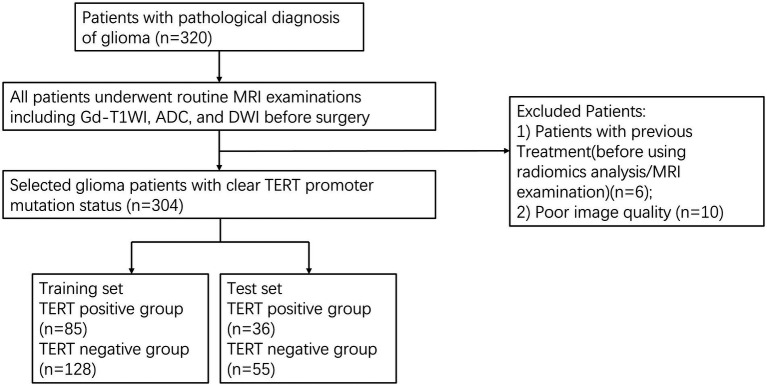
This was a retrospective study of 304 patients with gliomas. T1-weighted contrast-enhanced, apparent diffusion coefficient, and diffusion-weighted imaging MRI sequences were used for radiomic feature extraction. A total of 3,948 features were extracted from MRI images using the FAE software. These included 14 shape features, 18 histogram features, 24 gray level run length matrix, 14 gray level dependence matrix, 16 gray level run length matrix, 16 gray level size zone matrix (GLSZM), 5 neighboring gray tone difference matrix, and 744 wavelet transforms. The dataset was randomly divided into training and testing sets in a ratio of 7:3. Three feature selection methods and six classification algorithms were used to model the selected features. Predictive performance was evaluated using receiver operating characteristic curve analysis.
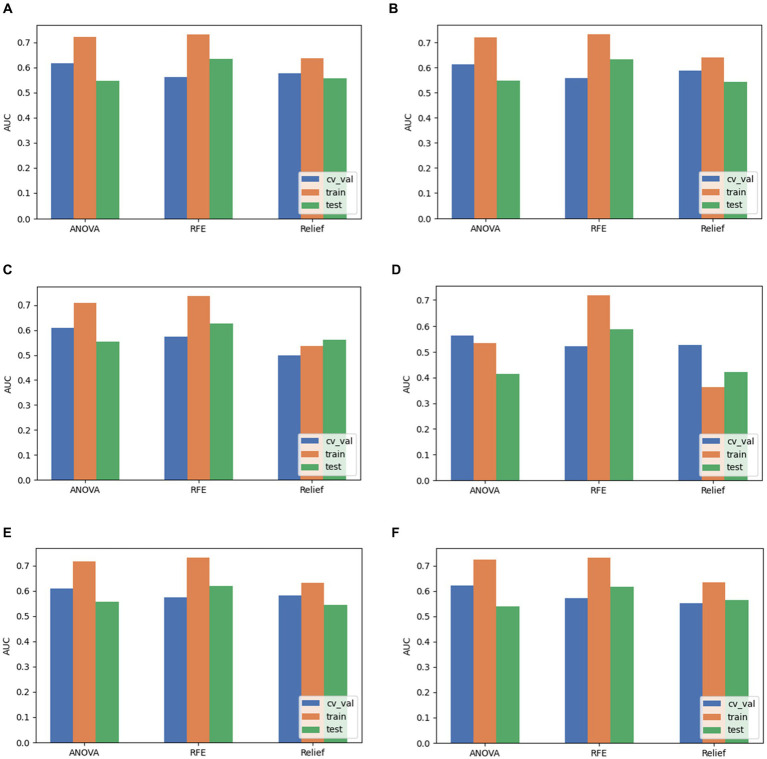
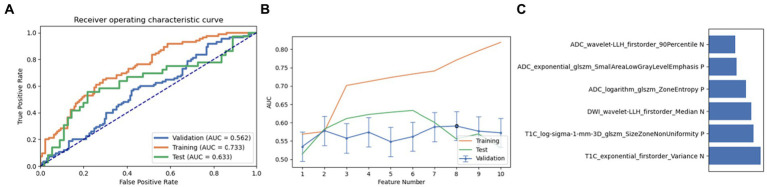
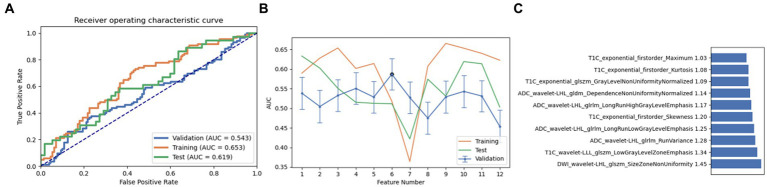
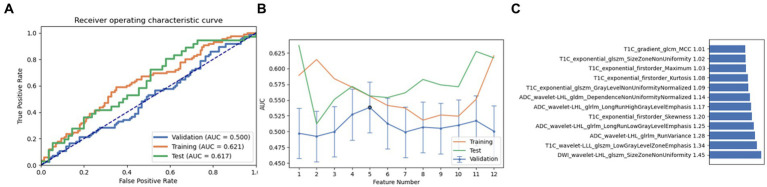
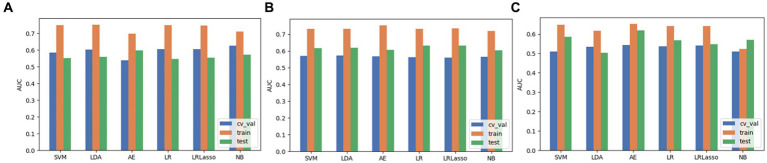
Among the evaluated classification algorithms, the combination model of recursive feature elimination (RFE) with linear regression (LR) using six features showed the best diagnostic performance (area under the curve: 0.733, 0.562, and 0.633 in the training, validation, and testing sets, respectively). The next best-performing models were naive Bayes, linear discriminant analysis, autoencoder, and support vector machine. Regarding the three feature selection algorithms, RFE showed the most consistent performance, followed by relief and ANOVA. T1-enhanced entropy and GLSZM derived from T1-enhanced images were identified as the most critical radiomics features for distinguishing promoter mutation status.
The LR and LRLasso models, mainly based on T1-enhanced entropy and GLSZM, showed good predictive ability for promoter mutations in gliomas using radiomics models.
胶质瘤中端粒酶逆转录酶()启动子突变状态是治疗策略和预后的关键决定因素。本研究旨在分析放射基因组特征,并利用医学成像技术构建放射基因组模型,以预测胶质瘤中的启动子突变状态。
这是一项对304例胶质瘤患者的回顾性研究。使用T1加权对比增强、表观扩散系数和扩散加权成像MRI序列进行放射组学特征提取。使用FAE软件从MRI图像中提取了总共3948个特征。这些特征包括14个形状特征、18个直方图特征、24个灰度游程长度矩阵、14个灰度共生矩阵、16个灰度游程长度矩阵、16个灰度大小区域矩阵(GLSZM)、5个邻域灰度差矩阵和744个小波变换。数据集以7:3的比例随机分为训练集和测试集。使用三种特征选择方法和六种分类算法对所选特征进行建模。使用受试者工作特征曲线分析评估预测性能。
在评估的分类算法中,使用六个特征的递归特征消除(RFE)与线性回归(LR)的组合模型显示出最佳的诊断性能(训练集、验证集和测试集中的曲线下面积分别为0.733、0.562和0.633)。表现次之的模型是朴素贝叶斯、线性判别分析、自动编码器和支持向量机。关于三种特征选择算法,RFE表现出最一致的性能,其次是Relief和方差分析。T1增强图像的T1增强熵和GLSZM被确定为区分启动子突变状态的最关键放射组学特征。
主要基于T1增强熵和GLSZM的LR和LRLasso模型,使用放射组学模型对胶质瘤中的启动子突变显示出良好的预测能力。