Microbiology Graduate Program, University of Delaware, Newark, Delaware, USA.
Delaware Biotechnology Institute, Newark, Delaware, USA.
Appl Environ Microbiol. 2024 Sep 18;90(9):e0059924. doi: 10.1128/aem.00599-24. Epub 2024 Aug 12.
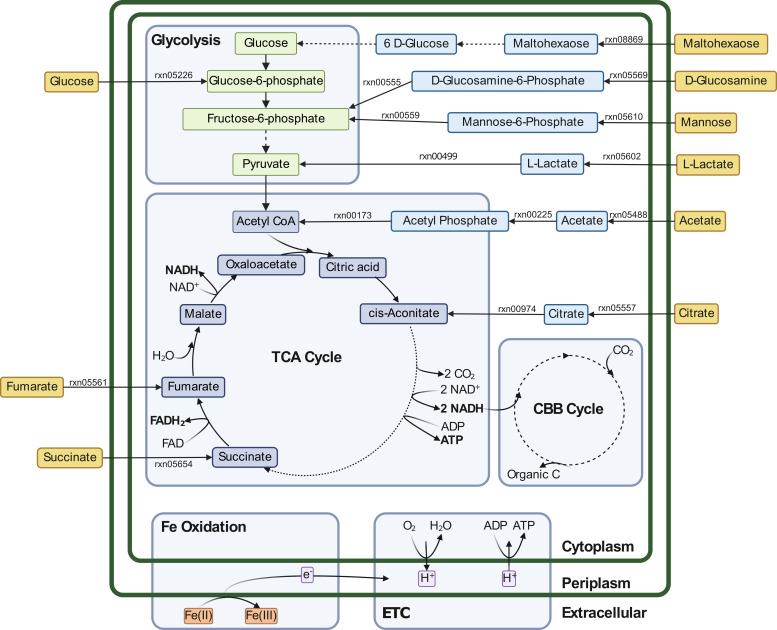
creates distinctive iron-mineralized mats that carpet streams and wetlands. Easily recognized by its iron-mineralized sheaths, was one of the first microorganisms described in the 1800s. Yet it has never been isolated and does not have a complete genome sequence available, so key questions about its physiology remain unresolved. It is debated whether iron oxidation can be used for energy or growth and if is an autotroph, heterotroph, or mixotroph. To address these issues, we sampled -rich mats from three of its typical environments (a stream, wetlands, and a drainage channel) and reconstructed nine high-quality genomes of from metagenomes. These genomes contain iron oxidase genes and showing that has the potential to conserve energy from iron oxidation. Sox genes confer potential to oxidize sulfur for energy. There are genes for both carbon fixation (RuBisCO) and utilization of sugars and organic acids (acetate, lactate, and formate). stoichiometric metabolic models further demonstrated the potential for growth using sugars and organic acids. Metatranscriptomes showed a high expression of genes for iron oxidation; aerobic respiration; and utilization of lactate, acetate, and sugars, as well as RuBisCO, supporting mixotrophic growth in the environment. In summary, our results suggest that has substantial metabolic flexibility. It is adapted to iron-rich, organic carbon-containing wetland niches, where it can thrive as a mixotrophic iron oxidizer by utilizing both iron oxidation and organics for energy generation and both inorganic and organic carbon for cell and sheath production.
Winogradsky's observations of led him to propose autotrophic iron oxidation as a new microbial metabolism, following his work on autotrophic sulfur-oxidizers. While much culture-based research has ensued, isolation proved elusive, so most work on has been based in the environment and in microcosms. Meanwhile, the autotrophic became the model for freshwater microbial iron oxidation, while heterotrophic and mixotrophic iron oxidation is not well-studied. Ecological studies have shown that overtakes when dissolved organic carbon content increases, demonstrating distinct niches. This study presents the first near-complete genomes of , which share some features with autotrophic iron oxidizers, while also incorporating heterotrophic metabolisms. These genome, metabolic modeling, and transcriptome results give us a detailed metabolic picture of how the organism may combine lithoautotrophy with organoheterotrophy to promote Fe oxidation and C cycling and drive many biogeochemical processes resulting from microbial growth and iron oxyhydroxide formation in wetlands.
形成独特的铁矿物垫,覆盖溪流和湿地。因其铁矿物鞘而易于识别,是 19 世纪最早描述的微生物之一。然而,它从未被分离出来,也没有可用的完整基因组序列,因此其生理学的关键问题仍未解决。关于其铁氧化是否可用于能量或生长,以及 是自养生物、异养生物还是混合营养生物存在争议。为了解决这些问题,我们从三个典型环境(溪流、湿地和排水通道)中采集了富含 的垫子,并从宏基因组中重建了 9 个高质量的 基因组。这些基因组包含铁氧化酶基因 和 ,表明 具有从铁氧化中保存能量的潜力。Sox 基因赋予氧化硫以获取能量的潜力。有用于固碳(RuBisCO)和利用糖和有机酸(乙酸盐、乳酸盐和甲酸盐)的基因。代谢平衡模型进一步证明了使用糖和有机酸生长的潜力。宏转录组显示出铁氧化、需氧呼吸以及利用乳酸盐、乙酸盐和糖以及 RuBisCO 的基因的高表达,支持环境中混合营养生长。总之,我们的结果表明 具有相当大的代谢灵活性。它适应富含铁和含碳有机物的湿地小生境,在那里它可以通过利用铁氧化和有机物来产生能量,以及利用无机和有机碳来产生细胞和鞘来作为混合营养铁氧化剂茁壮成长。
Winogradsky 对 的观察促使他提出了自养铁氧化作为一种新的微生物代谢,这是继他对自养硫氧化菌的研究之后。虽然进行了大量的基于培养的研究,但分离仍然难以实现,因此对 的大多数研究都是基于环境和微宇宙。同时,自养 成为淡水微生物铁氧化的模型,而异养和混合营养铁氧化则研究不足。生态研究表明,当溶解有机碳含量增加时, 会超过 ,从而证明存在明显的小生境。本研究首次提供了 的近完整基因组,这些基因组与自养铁氧化菌有一些共同特征,同时还包含异养代谢。这些基因组、代谢建模和转录组结果为我们提供了一个详细的代谢图景,说明该生物体如何将自养与有机异养结合起来促进 Fe 氧化和 C 循环,并推动微生物生长和铁氢氧化物形成在湿地中导致的许多生物地球化学过程。