Beijing Key Laboratory of Hypertension, Heart Center of Beijing Chao-Yang Hospital, Capital Medical University, Beijing, China.
Senior Department of Cardiology, the Sixth Medical Center, Chinese PLA General Hospital, Beijing, China.
Curr Atheroscler Rep. 2024 Oct;26(10):573-588. doi: 10.1007/s11883-024-01229-z. Epub 2024 Aug 12.
Macrophage accumulation and activation function as hallmarks of atherosclerosis and have complex and intricate dynamics throughout all components and stages of atherosclerotic plaques. In this review, we focus on the regulatory roles and underlying mechanisms of macrophage phenotypes and metabolism in atherosclerosis. We highlight the diverse range of macrophage phenotypes present in atherosclerosis and their potential roles in progression and regression of atherosclerotic plaque. Furthermore, we discuss the challenges and opportunities in developing therapeutic strategies for preventing and treating atherosclerotic cardiovascular disease.
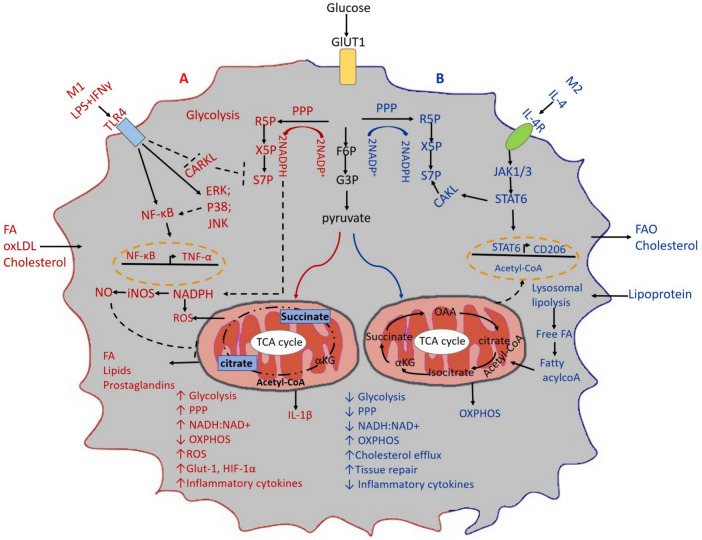
Dysregulation of macrophage polarization between the proinflammatory M1 and anti-inflammatory M2 phenotypealters the immuno-inflammatory response during atherosclerosis progression, leading to plaque initiation, growth, and ultimately rupture. Altered metabolism of macrophage is a key feature for their function and the subsequent progression of atherosclerotic cardiovascular disease. The immunometabolism of macrophage has been implicated to macrophage activation and metabolic rewiring of macrophages within atherosclerotic lesions, thereby shifting altered macrophage immune-effector and tissue-reparative function. Targeting macrophage phenotypes and metabolism are potential therapeutic strategies in the prevention and treatment of atherosclerosis and atherosclerotic cardiovascular diseases. Understanding the precise function and metabolism of specific macrophage subsets and their contributions to the composition and growth of atherosclerotic plaques could reveal novel strategies to delay or halt development of atherosclerotic cardiovascular diseases and their associated pathophysiological consequences. Identifying biological stimuli capable of modulating macrophage phenotypes and metabolism may lead to the development of innovative therapeutic approaches for treating patients with atherosclerosis and coronary artery diseases.
巨噬细胞的积累和激活是动脉粥样硬化的标志,在动脉粥样硬化斑块的所有成分和阶段都具有复杂而复杂的动态。在这篇综述中,我们专注于巨噬细胞表型及其在动脉粥样硬化中的代谢的调节作用和潜在机制。我们强调了动脉粥样硬化中存在的多种巨噬细胞表型及其在动脉粥样硬化斑块进展和消退中的潜在作用。此外,我们讨论了开发预防和治疗动脉粥样硬化性心血管疾病的治疗策略所面临的挑战和机遇。
巨噬细胞极化从促炎 M1 向抗炎 M2 表型的失调改变了动脉粥样硬化进展过程中的免疫炎症反应,导致斑块的起始、生长,最终破裂。巨噬细胞代谢的改变是其功能和随后动脉粥样硬化性心血管疾病进展的关键特征。巨噬细胞的免疫代谢被认为是巨噬细胞激活和动脉粥样硬化病变中巨噬细胞代谢重编程的关键,从而改变了改变的巨噬细胞免疫效应和组织修复功能。靶向巨噬细胞表型和代谢是预防和治疗动脉粥样硬化及动脉粥样硬化性心血管疾病的潜在治疗策略。了解特定巨噬细胞亚群的精确功能和代谢及其对动脉粥样硬化斑块组成和生长的贡献,可能揭示出延迟或阻止动脉粥样硬化性心血管疾病及其相关病理生理后果发展的新策略。确定能够调节巨噬细胞表型和代谢的生物刺激物可能会导致为治疗动脉粥样硬化和冠状动脉疾病患者开发创新治疗方法。