Department of Clinical Biochemistry, Faculty of Medicine, Tehran University of Medical Sciences, Tehran, Iran.
Applied Cellular and Molecular Research Center, Kerman University of Medical Sciences, Kerman, Iran.
PLoS One. 2024 Aug 12;19(8):e0306977. doi: 10.1371/journal.pone.0306977. eCollection 2024.
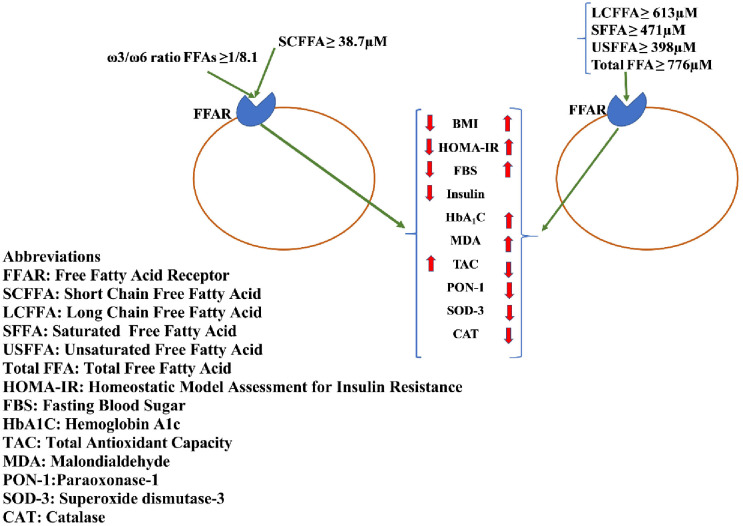
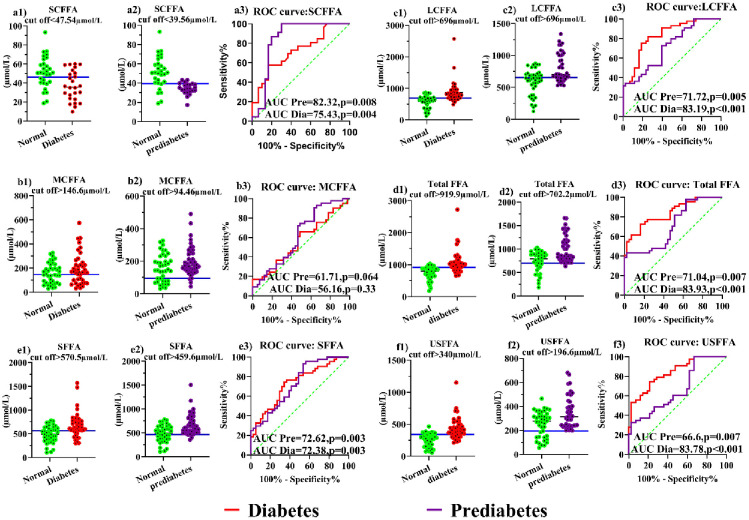
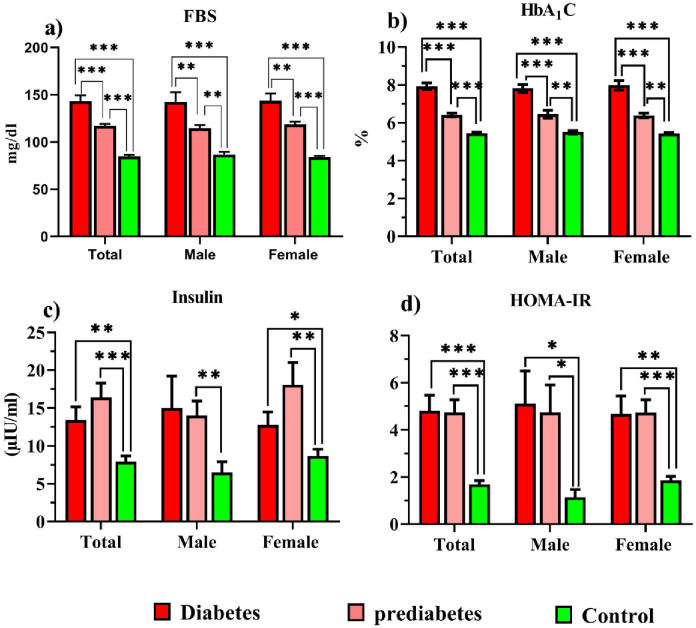
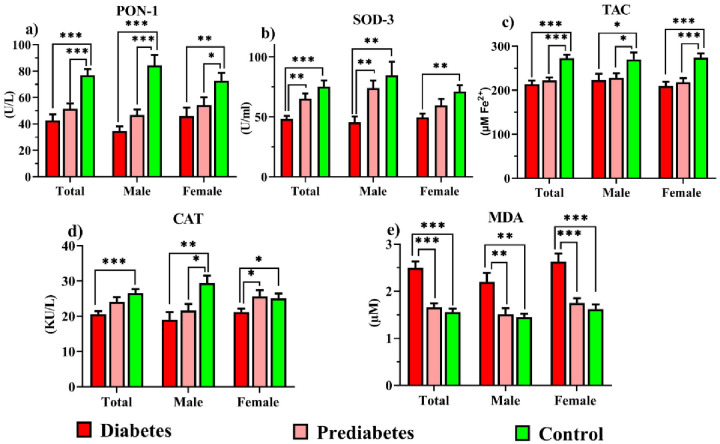
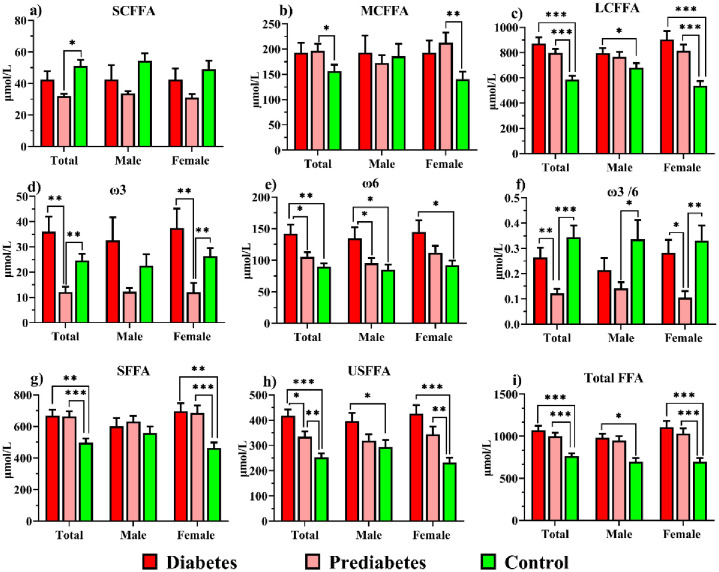
Free Fatty Acids (FFAs) are vital for energy homeostasis and the pathogenesis of a variety of diseases, including diabetes. For the first time, we presumed and investigated the types and levels of FFAs and their links to Insulin Resistance (IR) and Oxidative Stress (OS) in T2DM. A case-control study was conducted on 60 individuals with diabetes, 60 prediabetics with IFG, and 60 control groups. A Gas Chromatography Flame Ionization Detector (GC-FID) was used to estimate FFAs, which were then classified based on length and saturation. Indeed, antioxidant parameters such as TAC, MDA levels, PON-1, SOD-3, and CAT activity were assessed. Higher levels of LCFFA, SFFA, USFFA, and total FFA were found in people with diabetes and prediabetes. These levels were also linked to higher levels of HOMA-IR, BMI, FBS, HbA1C, and MDA, but lower levels of antioxidants. Furthermore, adjusting the above FFAs with age, sex, and antihypertensive medication increased T2DM development. SCFFA and ω3/6 fatty acids had a negative relationship with HOMA-IR, FBS, and insulin and a positive relationship with TAC. Adjusted SCFFA reduces T2DM risk. According to our models, total FFA is utilized to diagnose diabetes (AUC = 83.98, cut-off > 919 μM) and SCFFA for prediabetes (AUC = 82.32, cut-off < 39.56 μM). Total FFA (≥ 776 μM), LCFFA (≥ 613 μM), SFFA (≥ 471 μM), and USFFA (≥ 398 μM) all increase the risk of T2DM by increasing OS, BMI, and HOMA-IR. On the other hand, SCFFAs (≥ 38.7 μM) reduce the risk of T2DM by reducing BMI, HOMA-IR, and OS. SCFFAs and total FFAs can be used for the diagnosis of prediabetes and diabetes, respectively.
游离脂肪酸(FFAs)对能量平衡和多种疾病的发病机制至关重要,包括糖尿病。我们首次假设并研究了 T2DM 中 FFAs 的类型和水平及其与胰岛素抵抗(IR)和氧化应激(OS)的关系。对 60 名糖尿病患者、60 名 IFG 前期糖尿病患者和 60 名对照组进行了病例对照研究。使用气相色谱火焰离子化检测器(GC-FID)来估计 FFAs,然后根据长度和饱和度对其进行分类。事实上,评估了抗氧化参数,如 TAC、MDA 水平、PON-1、SOD-3 和 CAT 活性。糖尿病和前期糖尿病患者的 LCFFA、SFFA、USFFA 和总 FFA 水平较高。这些水平也与更高的 HOMA-IR、BMI、FBS、HbA1C 和 MDA 水平相关,但与抗氧化剂水平较低相关。此外,在用年龄、性别和抗高血压药物调整上述 FFAs 后,T2DM 的发生增加。SCFFA 和 ω3/6 脂肪酸与 HOMA-IR、FBS 和胰岛素呈负相关,与 TAC 呈正相关。调整后的 SCFFA 降低了 T2DM 的风险。根据我们的模型,总 FFA 用于诊断糖尿病(AUC = 83.98,cut-off > 919 μM),SCFFA 用于诊断前期糖尿病(AUC = 82.32,cut-off < 39.56 μM)。总 FFA(≥776 μM)、LCFFA(≥613 μM)、SFFA(≥471 μM)和 USFFA(≥398 μM)均通过增加 OS、BMI 和 HOMA-IR 增加 T2DM 的风险。另一方面,SCFFAs(≥38.7 μM)通过降低 BMI、HOMA-IR 和 OS 降低 T2DM 的风险。SCFFAs 和总 FFAs 可分别用于诊断前期糖尿病和糖尿病。