Lin Hanfeng, Riching Kristin, Lai May Poh, Lu Dong, Cheng Ran, Qi Xiaoli, Wang Jin
The Verna and Marrs McLean Department of Biochemistry and Molecular Pharmacology, Baylor College of Medicine, Houston, Texas 77030, United States.
Center for NextGen Therapeutics, Baylor College of Medicine, Houston, Texas 77030, United States.
ACS Med Chem Lett. 2024 Jul 28;15(8):1367-1375. doi: 10.1021/acsmedchemlett.4c00271. eCollection 2024 Aug 8.
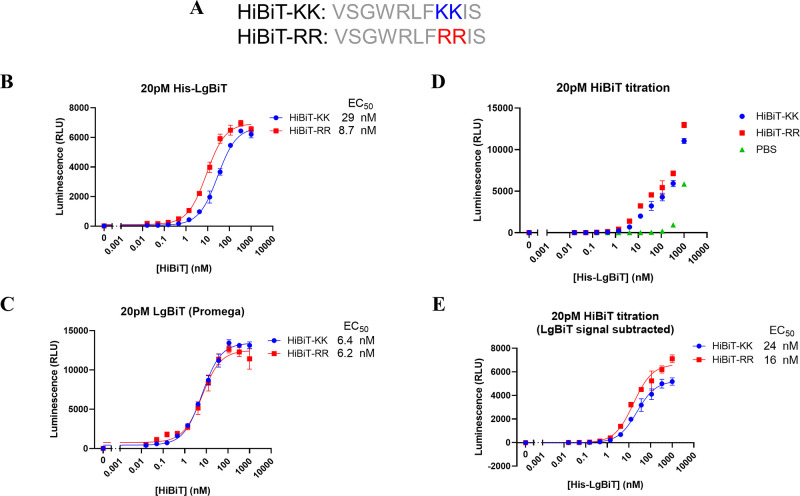
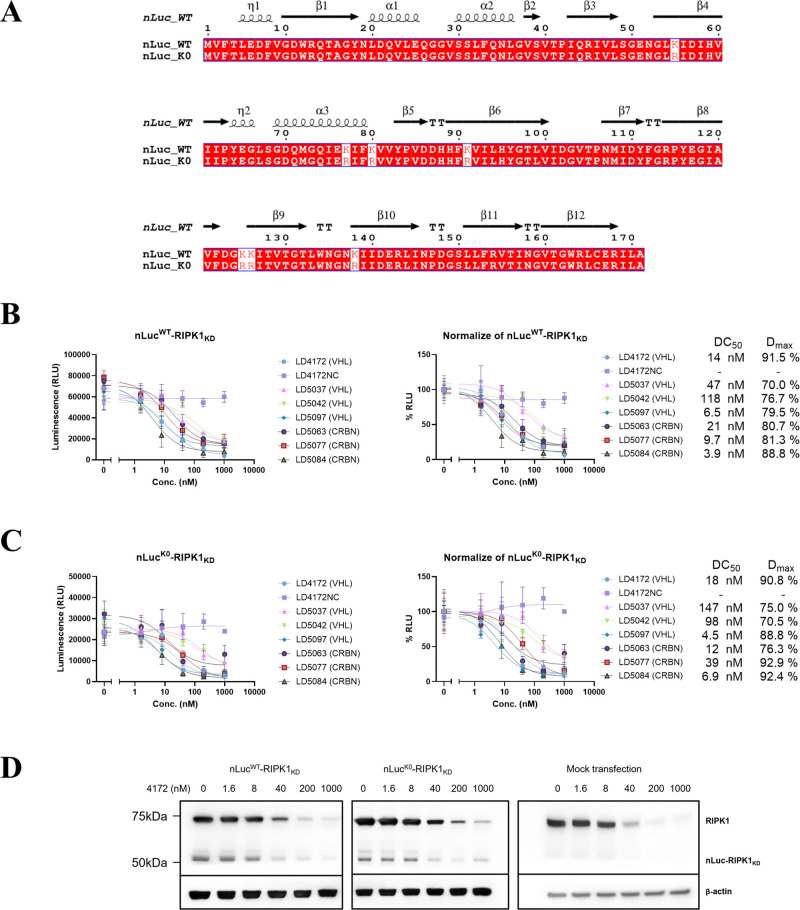
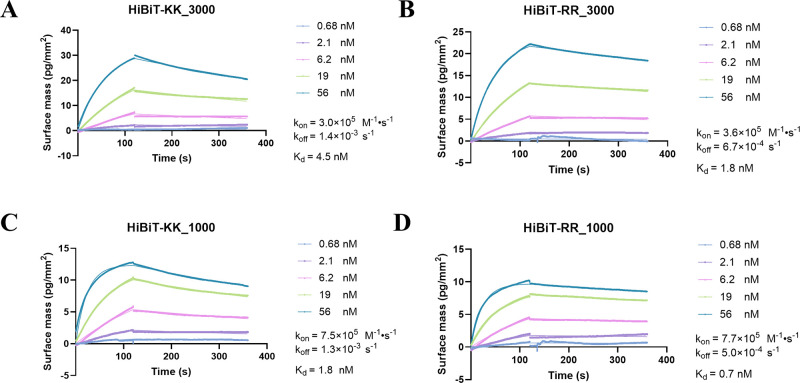
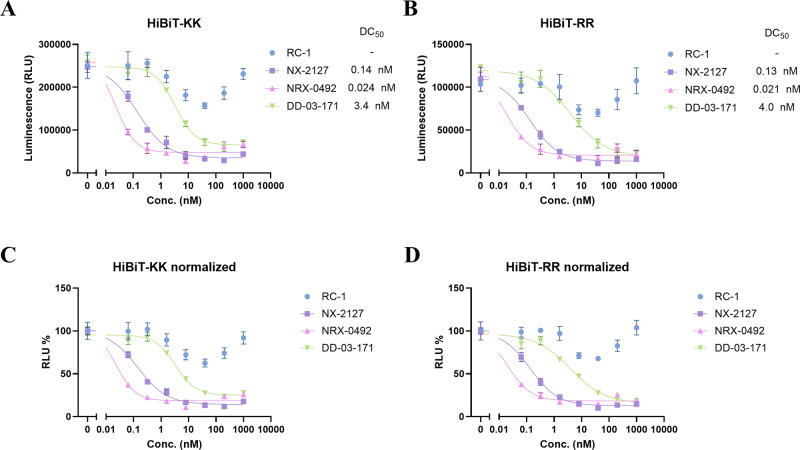
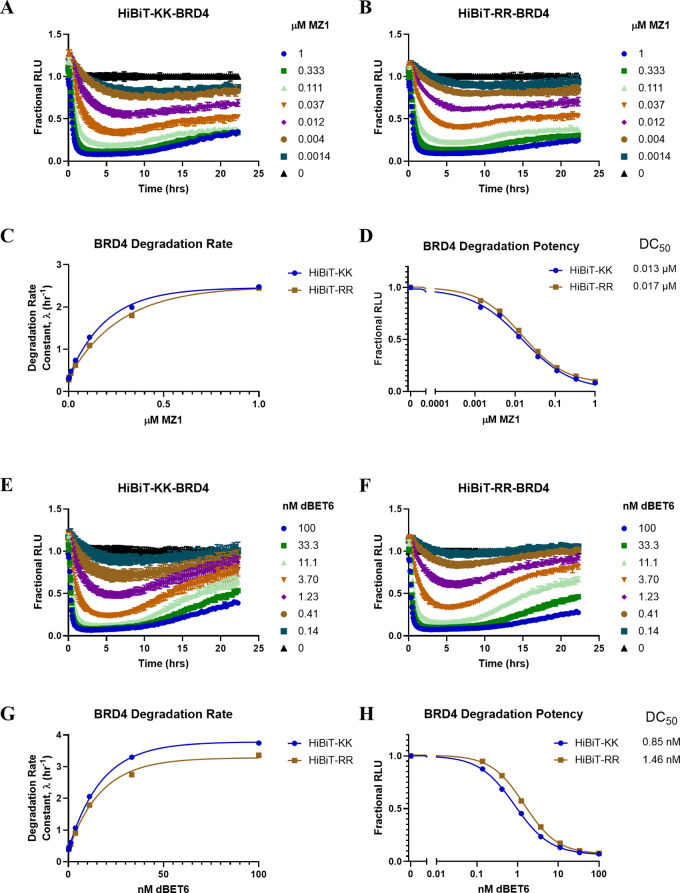
Target protein degradation (TPD) has emerged as a revolutionary approach in drug discovery, leveraging the cell's intrinsic machinery to selectively degrade disease-associated proteins. Nanoluciferase (nLuc) fusion proteins and the NanoBiT technology offer two robust and sensitive screening platforms to monitor the subtle changes in protein abundance induced by TPD molecules. Despite these advantages, concerns have arisen regarding potential degradation artifacts introduced by tagging systems due to the presence of lysine residues on them, prompting the development of alternative tools. In this study, we introduce HiBiT-RR and nLuc, variants devoid of lysine residues, to mitigate such artifacts. Our findings demonstrate that HiBiT-RR maintains a similar sensitivity and binding affinity with the original HiBiT. Moreover, the comparison between nLuc and nLuc constructs reveals variations in degradation patterns induced by certain TPD molecules, emphasizing the importance of choosing appropriate tagging systems to ensure the reliability of experimental outcomes in studying protein degradation processes.
靶向蛋白降解(TPD)已成为药物发现中的一种革命性方法,它利用细胞的内在机制来选择性降解与疾病相关的蛋白质。纳米荧光素酶(nLuc)融合蛋白和纳米生物发光技术(NanoBiT)提供了两个强大且灵敏的筛选平台,以监测TPD分子诱导的蛋白质丰度的细微变化。尽管有这些优点,但由于标记系统上存在赖氨酸残基,人们对其可能引入的潜在降解假象产生了担忧,这促使了替代工具的开发。在本研究中,我们引入了不含赖氨酸残基的变体HiBiT-RR和nLuc,以减轻此类假象。我们的研究结果表明,HiBiT-RR与原始HiBiT保持相似的灵敏度和结合亲和力。此外,nLuc与nLuc构建体之间的比较揭示了某些TPD分子诱导的降解模式的差异,强调了选择合适的标记系统以确保在研究蛋白质降解过程中实验结果可靠性的重要性。