Moustaqim-Barrette Amina, Conte Santina, Kelly Alexandra, Lebeau Jonathan, Alli Sauliha, Lagacé François, Litvinov Ivan V
Faculty of Medicine and Health Sciences, McGill University, Montréal, Québec, Canada.
Division of Dermatology, McGill University, Montréal, Québec, Canada.
JAAD Int. 2024 Jun 22;16:264-271. doi: 10.1016/j.jdin.2024.05.009. eCollection 2024 Sep.
Cutaneous melanoma (CM) is a significant contributor to skin cancer-related mortality globally and in Canada. Despite the well-established link between ultraviolet (UV) radiation exposure and skin cancer risk, there remains a gap in population-level interventions and persistent misconceptions about sun exposure and impact of environment on individual behavior.
The current study provides an ecological analysis using latest available data (2011-2017) to define geographic/environmental contributors to the CM landscape in Canada.
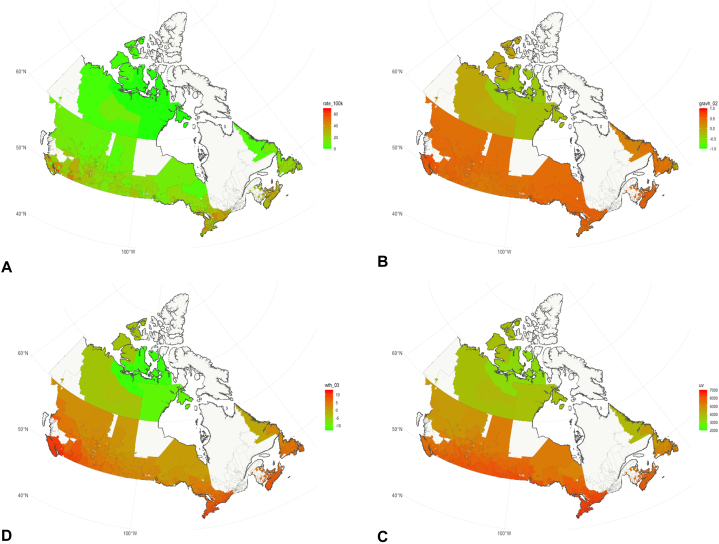
Utilizing Canadian Cancer Registry and Canadian Urban Environmental Health Research Consortium data, we analyzed 39,605 CM cases occurring in Canada from 2011 to 2017. Environmental data, including UV radiation, greenspace (normalized difference vegetation index), temperature, heat events, and precipitation was used to evaluate the effect of environment on CM incidence rates across Forward Sortation Area postal codes.
Forward Sortation Areas with increased CM incidence were associated with higher annual average temperature, snowfall, heat events, normalized difference vegetation index, and vitamin D-weighted UV exposure. Conversely, factors associated with decreased incidence included an increased annual highest temperature, rain precipitation, and a longer duration of heat events.
This study is subject to ecological bias and findings should be interpreted with caution.
This study further substantiates associations between specific environmental factors and CM incidence.
皮肤黑色素瘤(CM)是全球及加拿大皮肤癌相关死亡的一个重要因素。尽管紫外线(UV)辐射暴露与皮肤癌风险之间的联系已得到充分证实,但在人群层面的干预措施方面仍存在差距,并且对于阳光暴露以及环境对个人行为的影响也一直存在误解。
本研究利用最新可得数据(2011 - 2017年)进行生态分析,以确定加拿大皮肤黑色素瘤发病情况的地理/环境影响因素。
利用加拿大癌症登记处和加拿大城市环境卫生研究联盟的数据,我们分析了2011年至2017年在加拿大发生的39,605例皮肤黑色素瘤病例。环境数据,包括紫外线辐射、绿地(归一化植被指数)、温度、高温事件和降水量,被用于评估环境对按前向分拣区邮政编码划分的皮肤黑色素瘤发病率的影响。
皮肤黑色素瘤发病率增加的前向分拣区与年平均温度较高、降雪量、高温事件、归一化植被指数以及维生素D加权紫外线暴露量较高有关。相反,与发病率降低相关的因素包括年最高温度升高、降雨量以及高温事件持续时间较长。
本研究存在生态偏倚,研究结果应谨慎解读。
本研究进一步证实了特定环境因素与皮肤黑色素瘤发病率之间的关联。